
ISO Certification in Nigeria: Complete Guide to Requirements, Procedure, Cost & Business Benefits
Simplify your path to global compliance. We offer end-to-end consulting, training, and audit support for ISO, HACCP, CE Mark, and a wide range of international standards.
- 11+ Years Experience
- 30+ Countries Served
ISO Standard Certification in Nigeria helps businesses align with international standards for quality, safety, and efficiency. Whether you’re in manufacturing, IT, or services, it boosts your brand reputation, ensures regulatory compliance, and opens global market access. For companies in Nigeria and across Africa, this certification is a smart move toward sustainable growth and trust in both national and international markets.
Nigeria is Africa’s largest economy and a hub of innovation, with businesses growing fast across many industries. From tech startups in Lagos to thriving agro-processors in Kano, and from manufacturers in Port Harcourt to pharmaceutical units in Ibadan and engineering firms in Abuja, companies across the nation are reaching for higher standards and ISO certification is helping them get there.
What is ISO Certification in Nigeria – And Why Is It So Important Now?
ISO Certification is a seal of quality, safety, and professionalism. It’s issued by the International Organization for Standardization (ISO), and it proves your company follows international best practices.
But why is this important in Nigeria, right now?
- Tenders now demand ISO – both public and private contracts
- Exporters can’t go global without ISO
- Customers are smarter—they check for quality first
- ISO helps you beat competition by building trust
In Nigeria’s current business environment, ISO isn’t just an option it’s a smart move. Businesses that adopt ISO stand out from the crowd and are often first in line for contracts and recognition.
ISO certified means:
We’re not just running a business. We’re doing it right.
Whether you run a factory in Kano, a clinic in Lagos, or a digital company in Abuja ISO makes you stand out. It shows you’re not only in business to make money but also to deliver quality, safety, and reliability.
How to Get ISO Certified in Nigeria?
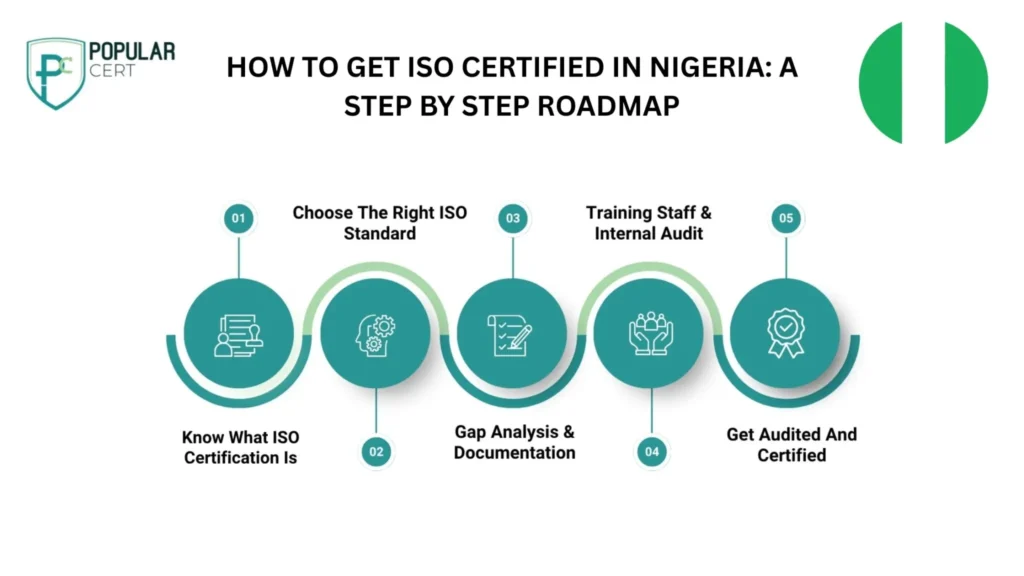
Know What ISO Certification Is

The first step is to understand the purpose and benefits of ISO certification for your business. ISO standards provide internationally recognized frameworks that help organizations improve quality, efficiency, safety, and customer satisfaction. Understanding these standards helps businesses choose the right direction for growth and compliance.
Choose the Right ISO Standard

Select the ISO standard that best suits your industry and operational needs. For example, ISO 9001 focuses on quality management, ISO 14001 on environmental management, and ISO 45001 on occupational health and safety. Choosing the correct standard ensures your certification supports your business objectives and industry requirements.
Gap Analysis & Documentation

Conduct a gap analysis to compare your current processes with ISO requirements and identify areas that need improvement. Based on the findings, develop the necessary documentation such as policies, procedures, manuals, and records required for implementing the management system effectively.
Training Staff & Internal Audit

Train employees on ISO requirements and their responsibilities in maintaining compliance. Once the system is implemented, perform internal audits to evaluate effectiveness, identify non-conformities, and take corrective actions. This step ensures your organization is fully prepared for the certification audit.
Get Audited and Certified

An accredited certification body conducts the external audit to verify that your organization complies with the chosen ISO standard. After successfully completing the audit and resolving any findings, your organization is awarded ISO certification, demonstrating your commitment to quality, compliance, and continuous improvement.
Why Get ISO Certified in Nigeria? Key Benefits for Your Business
The Nigerian economy is moving fast. Businesses are going digital, the government is making its procurement process online, and international partners are becoming more selective. Every industry is looking for better structure, clear accountability, and stronger performance.
Get Free Consultation
Our Clients

Our Projects

Why Choose PopularCert?
- Trusted Global ISO Certification Partner
- Experienced Industry-Focused Consultants
- Complete End-to-End Certification Support
- Fast & Transparent Certification Process
- International Compliance & Audit Readiness
- Dedicated Long-Term Customer Support
Types Of ISO Certification In Nigeria
- ISO Certification In Nigeria
- ISO 9001 Certification in Nigeria
- ISO 14001 Certification in Nigeria
- ISO 45001 Certification in Nigeria
- ISO 22000 Certification in Nigeria
- ISO 27001 Certification in Nigeria
- ISO 17025 Certification in Nigeria
- ISO 13485 Certification in Nigeria
- CE Mark Certification in Nigeria
- ISO 20000-1 Certification in Nigeria
- GMP Certification in Nigeria
- Halal Certification in Nigeria
- SOC-1 Certification in Nigeria
- SOC-2 Certification in Nigeria
If your business has ever:
- Faced rejections when bidding for contracts
- Lost customers to competitors
- Struggled with being consistent or having staff issues
Then ISO certification can be your solution. ISO guides you to look closely at how your business works, find any weak spots, and improve everything from the ground up.
With ISO, your business can truly:
- Build stronger, more reliable internal systems
- Make your customers happier and keep them coming back
- Reduce frustrating mistakes, waste, and annoying delays
- Win high-value contracts that only ISO certified organizations can get
- Attract local and international investors who trust certified businesses
ISO isn’t just a certificate it’s a business transformation.
Once you get certified, your customers know they’re working with a business that genuinely cares about quality and safety. And that deep trust is what keeps people coming back, time and time again. You get that valuable ISO certified certificate that speaks volumes.
For guidance on ISO systems supporting scale, accountability, and market access, explore our Nigeria Certification resources
ISO Certification in Major Nigerian Cities: What Businesses Are Asking For
ISO certification needs can be a bit different depending on your location and industry. Here’s what’s trending in some of Nigeria’s key cities:
City | What Businesses Want | Common ISO Certifications |
Lagos | Tech, Export, Fintech, Services | ISO 9001, ISO 27001 |
Abuja | Government Suppliers, NGOs, Service Providers | ISO 9001, ISO 21001 |
Kano | Agro-processing, Manufacturing, Packaging | ISO 22000, ISO 14001 |
Port Harcourt | Oil & Gas Contractors, Logistics, Engineering | ISO 45001, ISO 14001 |
Ibadan | Clinics, Schools, Food Services | ISO 9001, ISO 13485 |
Enugu | Startups, Artisans, Food Traders | ISO 9001, ISO 22000 |
Whether you’re in a megacity or a smaller town, ISO certification helps create a level playing field. With the right documentation and training which PopularCert provides any business can pass the audit and become an ISO certified organization.
Role of Nigerian Regulatory Bodies in ISO Certification
Understanding the regulatory landscape is crucial for successful ISO certification in Nigeria. Several organizations play important roles in the standardization and certification ecosystem.
Standards Organization of Nigeria (SON)
SON is Nigeria’s national standards body and represents the country in ISO. It develops national standards, promotes quality assurance, and provides certification services for management systems including ISO standards.
Nigerian National Accreditation Service (NiNAS)
NiNAS accredits certification bodies operating in Nigeria, ensuring they meet international standards for conducting ISO certifications. Choosing a NiNAS-accredited certification body ensures your certification will be recognized globally.
Real Examples (Use Cases):
- NAFDAC (National Agency for Food and Drug Administration and Control) labs now follow ISO 17025 for reliable testing.
- Teaching hospitals are using ISO 13485 to better manage their medical devices.
- Public schools are aligning with ISO 21001 to improve the quality of education they provide.
Citizens truly notice the difference when public offices adopt ISO standards, leading to more trust and better services.
Which ISO Standard is Best for My Nigerian Business? (Don't Guess, Get Expert Advice)
Sector | Recommended ISO | Why It Matters for Your Business |
Any Business | ISO 9001 | Improves overall quality and consistency in everything you do. |
Food/Catering | ISO 22000 | Ensures your food products are safe and hygienic for everyone. |
Construction | ISO 45001 | Dramatically improves safety for workers on your building sites. |
Fintech, IT | ISO 27001 | Crucially protects digital data and builds cybersecurity trust. |
Schools/Training | ISO 21001 | Enhances the quality and management of education systems. |
Hospitals/Clinics | ISO 13485 (for medical devices); ISO 9001 (for services) | Ensures medical device quality control and high standards of care. |
Which Additional Certifications Can Help Your Business in Nigeria Grow Faster?
- CE Mark Certification: A must for manufacturers exporting to the European Union. It proves your product meets EU safety and quality standards.
- GMP Certification: Important for pharmaceutical and food companies. It ensures clean, safe, and compliant manufacturing practices.
- Halal Certification: Helps you access Islamic and GCC markets by confirming that your product meets Halal requirements.
- SEDEX Audit: Vital for textile, garment, and supply chain businesses. It shows your company follows ethical labor and sourcing standards.
- BIFMA Certification: Best for furniture manufacturers. It ensures your products meet durability and safety standards.
- SOC 2 Compliance: Critical for IT and SaaS companies. It proves your systems handle customer data securely.
What Documents Are Required for ISO Certification
| No. | Key Area | Details |
|---|---|---|
| 1 | Company Structure | Company chart, Departments, Reporting lines |
| 2 | Human Resources | Job descriptions, Competencies, Training records |
| 3 | Process Management | Process SOPs, Work instructions, Flow diagrams |
| 4 | Risk Management | Risk assessments, Mitigation plans, Emergency steps |
| 5 | Customer Management | Complaint logs, Customer surveys, Action reports |
| 6 | Audit & Review | Audit schedules, Inspection reports, Review minutes |
Real Nigerian Success Stories: ISO Changed Their Businesses
- Lagos – Tech Startup Gets ISO 27001 This firm handled user data. They needed to prove their cybersecurity systems. After ISO 27001, they gained trust from a foreign investor and closed their first international deal.
- Kano – Food Processor Gets ISO 22000 They sold local groundnut oil. With ISO 22000, they improved hygiene and product consistency. Now, their bottles are sold in supermarkets in three northern states and exported to Ghana.
- Port Harcourt – Marine Firm Gets ISO 45001 They work in oil and gas logistics. ISO helped them win safety-focused contracts with multinationals. Workplace accidents dropped by 40%.
- Jos – School Gets ISO 21001 Parents were skeptical. The school implemented structured policies, teacher evaluations, and safety protocols. Enrollment doubled in a year.
How Much Does ISO Certification Cost in Nigeria?
Yes, ISO certification isn’t free but with PopularCert, it’s more affordable than ever, and it’s a solid investment that pays off big time
Considering ISO Certification in Nigeria brings up the question of ISO certification cost. While not free, it’s increasingly affordable and offers significant value. This cost varies by business size and readiness, typically covering expert guidance, documentation, training, audit preparation, and the final certificate fee. View it as a strategic investment, unlocking more contracts and building a stronger, trusted reputation for your business.
Total timeline: For most Nigerian businesses, this process can take as little as 2–6 weeks. If you have urgent deadlines (like for a tender), ask us about our faster options; we can often help you get ISO accreditation in just 10–15 business days
Final Words – It’s Time to Take Action for Your Nigerian Business!
Don’t wait until your competitors grab those opportunities first. This is your time. Get ISO certified. Grow with confidence. Be the business Nigeria can trust, and the world can rely on.
Ready to get started? Contact PopularCert today for your free consultation and become the next ISO certified organization in Nigeria. Apply Now or reach out for your free consultation.
FAQ
Is ISO hard to maintain once I get it?
No, not at all! Once the systems are properly put in place with PopularCert’s help, following them becomes a natural part of your routine.
Can a small team or even a single person's business do ISO?
Yes! Absolutely. Even very small businesses and one-person consultancies in Nigeria have successfully achieved ISO certification.
What is the cost of ISO certification?
The cost of ISO certification in Nigeria depends on the type of ISO standard, company size, and current systems. PopularCert offers affordable, customized ISO solutions for Nigerian businesses.
What’s the benefit beyond just having the certificate?
So much more! You get better planning, happier customers, reduced costs, and faster business growth. It’s truly transformative.
What does ISO certification mean?
ISO certification means your organization follows internationally recognized standards for quality, safety, efficiency, and continuous improvement, helping build trust with customers and partners.
How can I get ISO certification?
To get ISO certification, choose the right ISO standard, improve your processes to meet its requirements, complete internal audits, and get audited by an accredited certification body with expert guidance.
- Join 1000+ Certified Companies
Ready to Get Certified for Your Next Project?
- Free Consultation
- Expert Guidance
- Fast Turnaround
Reach Us Now
Claim Your Free Consultation Today!