
The Real Price of Postponing ISO Certification: What Saudi Companies Lose Without Knowing
1000+
Successful Projects
10+ Years
Industry Experience
Worldwide
Certification Services
24/7 Support
Expert Consultation
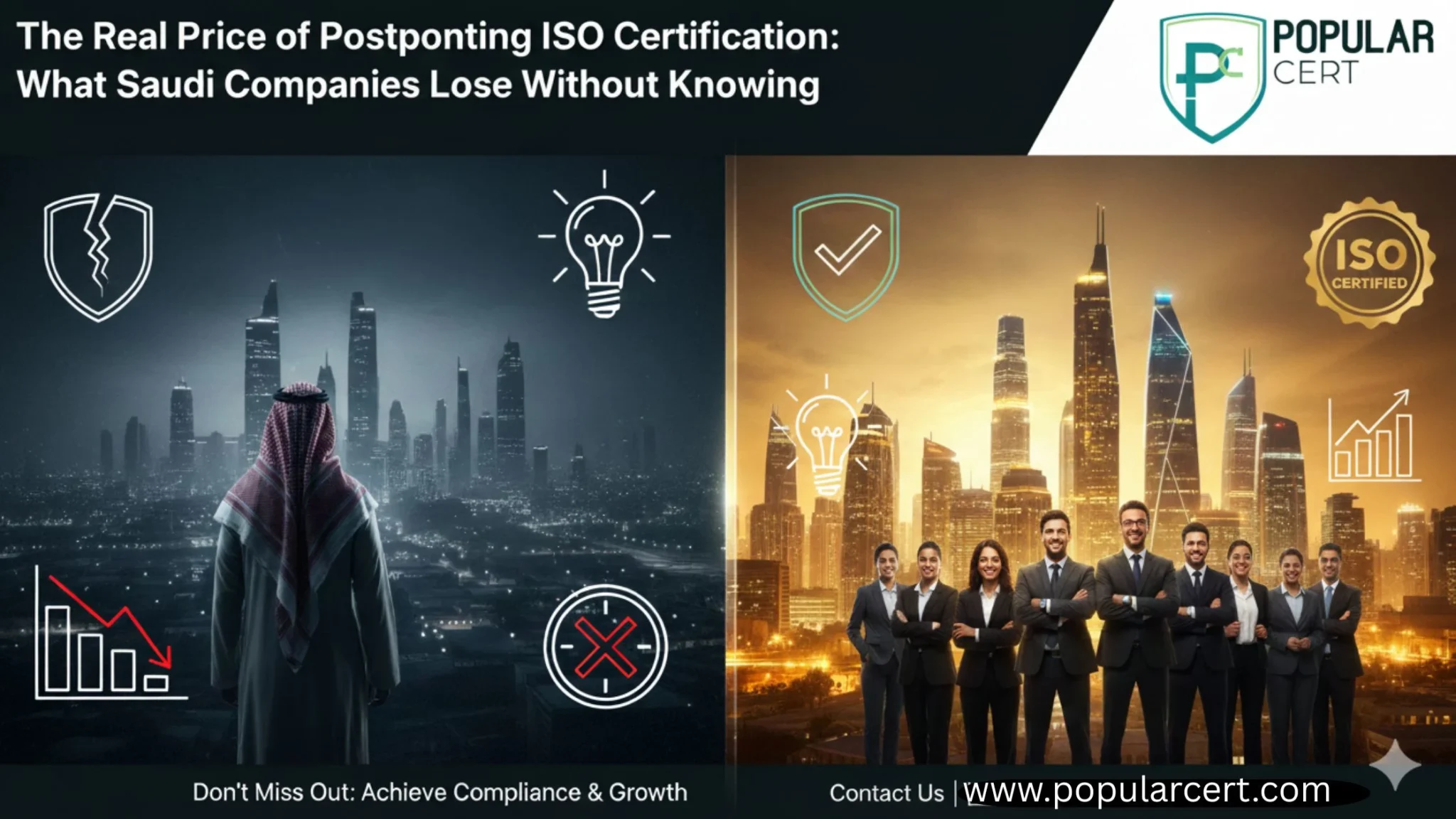
Many Saudi companies delay ISO certification because they think they are saving money, but the truth is they lose much more without knowing. Most business owners view ISO certification as an expense, but what if not getting certified is actually costing your business more?
Vision 2030 is bringing higher quality expectations, so understanding ISO certification risks has never been more critical. This blog breaks down the overlooked losses caused by delaying ISO certification Saudi Arabia and explains why working with the best ISO consultant can help avoid long-term damage.
Table of Contents
Why Saudi Companies Often Delay ISO Certification
Common misconceptions holding companies back:
- Too costly or too time-consuming beliefs create false security
- “Not required yet” mindset while hidden ISO certification risks accumulate
- Focus on short-term budget concerns without calculating opportunity costs
Decision-making delays from operational pressures:
- Managers juggle daily firefighting and struggle to prioritize strategic investments
- Lack of clarity about standards keeps companies stuck in analysis paralysis
- Cannot assess true ISO implementation cost versus cost of inaction
Underestimating long-term impacts:
- Without good ISO consultant in KSA, companies cannot understand the real cost
- Only see today’s cost but not future losses and missed chances
- Biggest loss is lost growth and lost market trust
The Hidden Costs of Delaying ISO Certification
Higher Operational Waste & Inefficiency
Uncontrolled processes creating daily problems:
- Without ISO frameworks (ISO 9001, ISO 27001), operational consistency becomes difficult to maintain
- Problems repeat every day and root causes are often not addressed systematically
- Employees follow different routes creating confusion
- Rework becomes normal and business loses time and money
Documentation chaos slowing everything:
- Bad documentation makes workflow messy and unpredictable
- Every employee follows their own method creating inconsistent operational workflows
- Problems increase actual ISO implementation cost when finally addressed
- Training new staff takes 2-3 times longer without clear procedures
Increased Customer Complaints & Lost Repeat Business
- Quality problems stay hidden because there is no proper system. Companies cannot find main issues, so problems keep coming back. Customers slowly move to competitors who are ISO certified. Clients trust certified businesses more than non-certified ones. Lack of certification sends the message: “We’re not serious about quality, safety, or security.” Reputation damage costs more than any certification investment.
Higher Cost of Fixing Problems Later
Small process problems tend to compound the longer they go unaddressed what would have been a documentation fix during initial implementation often becomes a full corrective action plan by the time an external auditor catches it. Companies that rush certification under deadline pressure (for example, to meet a specific tender deadline) more frequently fail their Stage 1 audit on the first attempt, which means paying for a repeat audit and pushing the tender timeline further out. Surveillance audits after certification are typically annual regardless of how the initial certification was obtained but a system that was rushed into place is more likely to generate nonconformities at those surveillance audits, which does carry real cost in corrective action time and repeat visits.
Trending Posts
Get Free Consultation
Our Clients

Projects

Our Happy Clients
⭐⭐⭐⭐⭐
“PopularCert made our ISO certification process smooth and professional.”
— Manufacturing Client, Oman
⭐⭐⭐⭐⭐
“Excellent support and documentation guidance.”
— Healthcare Client, Saudi Arabia
⭐⭐⭐⭐⭐
“PopularCert simplified our ISO certification process with professional guidance and fast support.”
— Manufacturing Client, Saudi Arabia
Financial & Strategic Losses Caused by Delaying ISO
Government and enterprise requirements:
- Government and big companies need ISO certified suppliers as baseline qualification
- Without ISO, many Saudi companies get rejected even before applying
- Especially critical in tech, manufacturing, logistics, and healthcare sectors
- Many tenders explicitly list ISO 9001, ISO 45001, or ISO 14001 as mandatory
Million-riyal tender losses:
- Some businesses lose tenders worth millions for lacking certification on time
- Working with best ISO consultant early prevents devastating losses
- Single lost tender can exceed certification cost by 10-20 times
- Competitors with certifications build long-term government relationships
Slower Growth Due to Low Brand Trust
- International buyers do not trust non-certified companies. Without ISO, it is hard to join global supply chains and export markets. Foreign partners view certification as a minimum quality standard. Investors choose companies with strong system documentation. ISO certification demonstrates organizational maturity. Banks view certified companies as lower credit risk.
Rising Insurance & Compliance Liabilities
- No ISO means higher risk rating and more penalties from regulators. In food, safety, energy, or finance, non-certification increases non-compliance chances. Non-compliance leads to penalties, shutdowns, or lawsuits. Insurance premiums higher for non-certified companies. Safety and environmental issues stay unmanaged without systematic controls. Regulatory exposure grows into costly crises and reputation damage.
Why ISO Certification Is Becoming Essential in Saudi Arabia
Saudi Arabia’s regulatory and commercial environment is rapidly evolving as Vision 2030 drives higher expectations for quality, safety, cybersecurity, and sustainability.
Organizations working in sectors such as manufacturing, logistics, healthcare, oil & gas, construction, food production, and technology are increasingly expected to demonstrate compliance with internationally recognized standards.
Government entities, large enterprises, and international partners now frequently require certifications such as:
- ISO 9001
- ISO 27001
- ISO 45001
- ISO 14001
as part of supplier qualification, vendor approval, and tender evaluation processes.
Companies delaying certification may find themselves excluded from high-value projects, government initiatives, and international expansion opportunities.
Common Problems Popularcert Identifies in Saudi Businesses
Most companies pay more because they start too late. Urgent projects need more consultant hours and often result in incomplete systems needing expensive rework.
Common problems found in Saudi operations:
Common Gap | Business Impact | Typical Cost |
Documentation overload and lack of structure | Confusion, delays, failed audits | High rework costs, 3-6 month delays |
Weak risk management practices | Unexpected crises, reactive firefighting | Emergency expenses, lost production |
Poor traceability during product lifecycle | Quality issues, customer complaints | Lost business, returns, warranty claims |
Supplier qualification not done properly | Supply chain failures, quality problems | Production delays, defective materials |
Internal audits treated as “formality” | Undetected issues, certification failures | Repeat audit fees, extended timelines |
Business Opportunities Lost Without ISO Certification
Delayed or impossible market entry:
- Without ISO, entering new markets becomes slow or impossible
- Competitors take market first while you wait
- International markets require ISO certification Saudi Arabia standards as baseline
- Competitors establish market dominance while you remain locked out
Vision 2030 alignment problems:
- Uncertified companies get left out from Vision 2030 programs
- Excluded from national development projects and government support
- Programs favor certified suppliers for contracts and funding
Difficulty proving reliability:
- Partners cannot trust you without recognized certification
- ISO serves as universal business language
- Building trust takes years without certification, weeks with it
Business trajectory impact:
- Biggest loss is your future growth and business position
- About entire trajectory of business development
- Companies without ISO remain stuck serving small, local clients
How Popularcert Helps Reduce These Costs for Saudi Companies
Popularcert helps Saudi companies get ISO certified quickly and cost-effectively by combining Vision 2030 expertise with practical, Saudi-focused implementation.Using Industry-Specific Documentation Kits
Templates for production, quality control, maintenance, and supplier evaluation make the work faster and more efficient.
What Popularcert Delivers
- Early gap detection to prevent costly rework and avoid rushed certification expenses.
- Saudi-ready templates that cut 3–4 months of documentation work and pass audits the first time.
- Fast 3–6 month certification timeline so businesses can start winning tenders sooner.
- Bilingual (Arabic + English) training for smooth internal adoption.
- High audit success rates through internal audits and mock assessments.
- Transparent pricing with SME-friendly packages and no hidden fees.
Proven Impact
For clients pursuing certification specifically to qualify for tenders that require it, the certification cost is often recovered from a single won tender since many Saudi government and enterprise tenders exceed the total cost of certification many times over.
Practical Tips to Avoid ISO Delays
- Assign one internal coordinator.
- Start with a simple gap assessment.
- Choose a consultant with Saudi industry experience.
- Focus on key processes first.
- Use mock audits to ensure a first-time pass.
Avoid Delays. Avoid Costs. Get Certified Now.
Stop losing tenders and money due to ISO delays. Contact Popularcert today for a free consultation and gap assessment. Get a fast-track certification plan tailored to your Saudi business.The businesses winning Saudi tenders this year already made this call don’t let certification be the reason you’re not on that list.
FAQ
How long is ISO 9001 certification valid and what’s the renewal process?
An initial ISO 9001 certificate is typically valid for three years. After that, you must complete a recertification audit to maintain certified status. Meanwhile, most certification bodies require annual “surveillance” audits to ensure ongoing compliance
Can small and medium-sized enterprises (SMEs) get ISO 9001 certified?
Yes. ISO standards are designed to work for businesses of any size or sector including SMEs. Certification helps even small companies organize processes, reduce errors, and access larger contracts.
What does ISO 9001 certification require from a company (staff, documentation, audits)?
To comply with ISO 9001, a company must implement a documented Quality Management System (QMS), conduct internal audits, hold management reviews, and maintain records (procedures, work instructions, audit logs, corrective actions, etc.).
Does ISO 9001 certification guarantee winning contracts or tenders?
No standard guarantees success but ISO 9001 acts as a minimum quality assurance credential. In many sectors (especially government, large corporations, exports), ISO certification is a pre-requisite. Without it, businesses risk disqualification from tenders or loss of trust. While certification doesn’t guarantee contracts, it’s often the baseline for eligibility and competitive differentiation.
- Join 1000+ Certified Companies
Ready to Get Certified for Your Next Project?
- Free Consultation
- Expert Guidance
- Fast Turnaround
Reach Us Now