
Bifma Certification
Simplify your path to global compliance. We offer end-to-end consulting, training, and audit support for ISO, HACCP, CE Mark, and a wide range of international standards.
- 11+ Years Experience
- 30+ Countries Served
BIFMA Certification refers to independent testing and certification showing that office furniture meets ANSI/BIFMA standards. BIFMA, the trade association, writes the standards but does not certify products. Accredited laboratories test safety, durability and emissions, and approved certification bodies issue LEVEL sustainability certificates at Levels 1, 2 and 3. PopularCert prepares manufacturers but does not issue certificates.
This page explains the routes behind the term, what each one verifies, and what manufacturers need to prepare. It also shows where PopularCert supports the process and where the laboratory or certification body takes over.
How to Get BIFMA Certification:
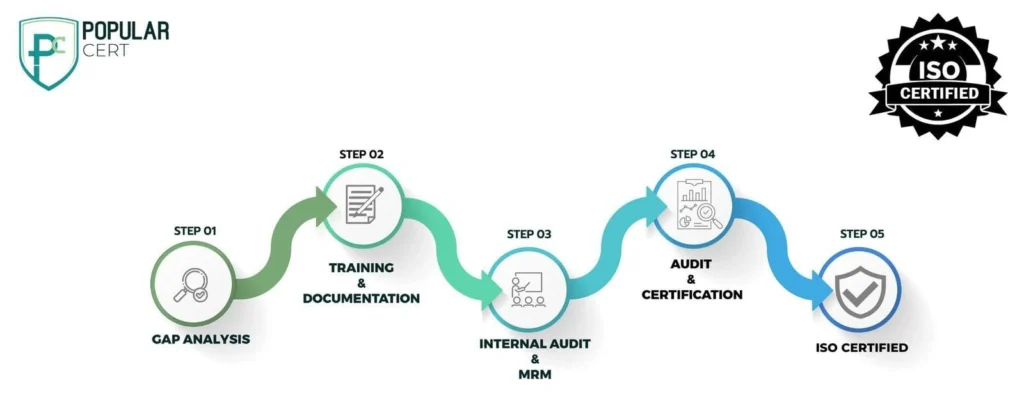
Gap Analysis

The first step in BIFMA certification is conducting a gap analysis to evaluate your current furniture design, manufacturing processes, and testing practices against BIFMA standards. This step helps identify areas where your products or processes do not meet required safety, durability, and performance criteria. By understanding these gaps, organizations can create a clear plan to upgrade product quality and align with BIFMA requirements.
Training and Documentation

After identifying the gaps, the next step is to train your team and prepare the necessary documentation. Employees must be trained on BIFMA standards, testing requirements, and quality procedures. At the same time, organizations need to develop and maintain documents such as product specifications, testing protocols, quality manuals, and compliance records. Proper documentation ensures consistency and provides evidence that products meet required standards.
Internal Audit and MRM (Management Review Meeting)

Once systems and processes are implemented, internal audits are conducted to verify compliance with BIFMA standards. These audits assess whether products meet required performance and safety criteria and whether processes are being followed correctly. After the audit, a Management Review Meeting (MRM) is held where top management evaluates audit findings, product performance, and overall readiness for certification. This step ensures that the organization is fully prepared for external evaluation.
Audit and Certification

In this stage, an external testing or certification body evaluates your products and processes. This includes product testing for strength, durability, stability, and safety as per BIFMA standards, along with a review of documentation and manufacturing practices. If any non-conformities are found, corrective actions must be taken before approval. Successful evaluation leads to certification.
BIFMA Certified

After passing the audit and testing process, your products are recognized as BIFMA certified. This certification demonstrates that your furniture meets industry standards for safety, performance, and durability. However, maintaining certification requires ongoing compliance, periodic testing, and continuous improvement to ensure that products consistently meet BIFMA requirements.
Certification Routes and Responsible Parties
BIFMA (the Business and Institutional Furniture Manufacturers Association) is the trade association behind the ANSI/BIFMA standards used to evaluate office furniture. “BIFMA certification” is shorthand for three separate routes, each with a different verifier.
| Route | What it verifies | Verified or issued by |
|---|---|---|
| ANSI/BIFMA performance and safety conformance (e.g., X5 series for seating, desks and tables, storage) | Strength, durability, stability and safety | Test reports from a qualified laboratory, ideally accredited to ISO/IEC 17025. The manufacturer declares conformance. |
| LEVEL® certification (based on ANSI/BIFMA e3, the Furniture Sustainability Standard) | Sustainability and social responsibility, Levels 1 to 3 | A third-party certification body approved under the LEVEL program |
| Chemical emissions testing (ANSI/BIFMA M7.1 method) | VOC emissions from furniture | An accredited testing laboratory |
Each route above has a different verifier, so it helps to be clear about who is responsible for each stage. BIFMA writes the standards but does not test or certify products. Laboratories produce the test reports, and approved certification bodies review the evidence and issue LEVEL certificates.
The manufacturer owns the product and the submission, and PopularCert supports the preparation work around it. The table below sets out each party’s role.
Get Free Consultation
Our Clients

Our Projects

Why Choose PopularCert?
- Trusted Global ISO Certification Partner
- Experienced Industry-Focused Consultants
- Complete End-to-End Certification Support
- Fast & Transparent Certification Process
- International Compliance & Audit Readiness
- Dedicated Long-Term Customer Support
Types Of ISO Certification
- ISO Certification
- ISO 9001 Certification
- ISO 14001 Certification
- ISO 45001 Certification
- ISO 22000 Certification
- ISO 27001 Certification
- ISO 17025 Certification
- ISO 13485 Certification
- CE Mark Certification
- ISO 20000-1 Certification
- GMP Certification
- Halal Certification
- SOC-1 Certification
- SOC-2 Certification
| Party | Role |
|---|---|
| BIFMA | Develops and maintains the standards and manages the LEVEL program. It does not test or certify individual products. |
| Testing laboratory | Tests products against ANSI/BIFMA methods and issues test reports. |
| LEVEL certification body | Reviews evidence, audits where required, and issues the LEVEL certificate. |
| Manufacturer | Submits products for testing and certification and maintains conformance. |
| PopularCert | Independent consultancy. We prepare manufacturers for testing and certification. We are not a laboratory or certification body and do not issue BIFMA or LEVEL certificates. |
Scope Covered by ANSI/BIFMA Standards
ANSI/BIFMA standards cover how office furniture is built, what it is made from, and how it is produced. The table below groups the main areas, and each one is verified through the routes described above, either by laboratory testing or by a LEVEL certification body review.
| Area | Typical focus |
|---|---|
| Safety, strength and durability | Structural testing, stability, cycle and load performance for chairs, desks, tables and storage |
| Chemical content and emissions | VOC emission testing and material health considerations |
| Sustainability and social responsibility | Corporate social responsibility, energy, materials, and human and ecosystem health under e3 |
| Recycled content and recyclability | Documented material composition and end-of-life considerations |
LEVEL Certification Tiers: How Levels 1, 2 and 3 Measure Sustainability
LEVEL Certification is the sustainability route within the BIFMA framework. It is awarded to individual products by a third-party certification body approved under the LEVEL program, after that body reviews your evidence against ANSI/BIFMA e3, the Furniture Sustainability Standard. The review looks at areas such as corporate social responsibility, energy use, material selection, and human and ecosystem health. A product that meets the required conformance earns a level, and the level shown on the certificate reflects how much of the standard it satisfies.
- LEVEL 1: The entry tier. It shows that the product meets the baseline requirements of the e3 standard and that the manufacturer has documented its sustainability practices across the core categories. It is a practical starting point for manufacturers building their first sustainability evidence file.
- LEVEL 2: A stricter tier. It requires stronger performance in areas such as material sourcing, energy management and social-responsibility programs, supported by more complete supplier and facility records.
- LEVEL 3: The highest tier. It reflects the strongest overall performance across the standard and suits manufacturers whose buyers specify top-level sustainability credentials in tenders and green-building projects.
The level you target should follow what your buyers specify. Many procurement documents name a minimum level, so confirm the requirement before you invest in evidence collection. PopularCert helps manufacturers prepare for LEVEL by running a gap assessment and organizing documentation, but the approved certification body reviews the evidence and issues the certificate.
Free BIFMA Checklist
Assess compliance, reduce risks, and strengthen your furniture quality practices.
- Practical & Audit-Ready
- Save Time & Effort
- No Registration Required
Business Value for Manufacturers
BIFMA conformance and LEVEL certification give manufacturers independent evidence that buyers can check, which matters most in tenders where product claims are compared side by side. Because these standards are voluntary, the value comes from how widely procurement teams, specifiers and green-building projects reference them. The points below show where that evidence has the most commercial impact.
- Procurement access: Many corporate and public-sector buyers specify BIFMA conformance or LEVEL certification in tenders.
- Buyer confidence: Independent test reports and certificates back up your safety and sustainability claims.
- Lower product risk: Tested durability and stability reduce failures, workplace injuries and warranty claims.
- Sustainability proof: LEVEL supports green-building and corporate ESG specifications.
- Voluntary standards alignment: BIFMA standards are voluntary, but widely referenced in procurement and building specifications.
- Brand positioning: Third-party results differentiate your range in competitive bids.
Cost Drivers for BIFMA Certification: Testing, LEVEL Fees, Audits and Renewals
BIFMA Certification cost is not fixed, because the total depends on how many routes you pursue and how many products you submit. A manufacturer testing a single chair model for performance conformance will spend far less than one certifying a full range of seating, desks and storage, or one pursuing LEVEL certification across several product lines. Costs are set by the laboratories and certification bodies you choose, not by BIFMA, and they vary by provider, region and scope.
The main factors that move the total are:
- Product type and complexity: Task chairs and other moving or load-bearing products usually need more test procedures than simple storage or tables.
- Number of products and variants: Each model, and in some cases each configuration, may need its own testing or evidence.
- Testing requirements: Performance, stability and emissions testing are priced separately, and emissions testing can add significant cost.
- LEVEL tier pursued: Higher tiers require more complete evidence, which means more preparation and review time.
- Evidence readiness: Missing supplier data, material records or social-responsibility documentation causes delays and repeat review work.
Typical cost components include:
- Laboratory testing fees
- Certification body application and assessment fees
- Factory or documentation audits where required
- Annual renewal and re-testing after product changes
Repeat testing is usually the most avoidable cost. A product that fails a test, or an application returned for missing evidence, means paying for the work again and losing time against tender deadlines. Request written quotes from several accredited laboratories and approved certification bodies, and ask each one what is included, what triggers extra fees, and how renewals are charged.
PopularCert helps you prepare before you submit, through gap assessment and evidence preparation, so you reduce the risk of repeat testing and audit costs. We do not set or collect laboratory or certification body fees.
Role of PopularCert in BIFMA Certification: Readiness, Documentation and Coordination
PopularCert is an independent consultancy that has supported more than 3,000 clients through certification worldwide over 10+ years. For BIFMA projects, our work happens before and around testing and certification, so manufacturers go into laboratory and certification body reviews prepared, with the right evidence in the right format.
Our BIFMA support includes:
- Gap assessment: We compare your products, documents and processes against the relevant ANSI/BIFMA standards and LEVEL requirements, and give you a clear list of what needs to be fixed before submission.
- Route selection: We help you decide whether performance conformance, LEVEL certification, or both make sense, based on the buyers, tenders and markets you are targeting.
- Documentation and evidence preparation: We help you organize material, energy, social-responsibility and supplier records so they are complete, consistent and easy for a reviewer to verify.
- Coordination with laboratories and certification bodies: We help you prepare submissions, understand requests for information, and keep your application moving, while you choose and contract the provider directly.
- Corrective-action support: If a gap assessment, test result or review raises findings, we help you plan and document corrective actions.
- Pre-assessment checks: We run a final readiness review so that known issues are closed before you pay for formal testing or assessment.
Manufacturers usually engage us at one of three points: before choosing a route, while collecting evidence, or after a failed test or returned application. Starting early tends to reduce repeat testing and shorten the time to submission.
The laboratory or certification body performs the testing, evaluates your evidence, issues certificates, and sets its own fees and timelines. PopularCert does not issue BIFMA or LEVEL certificates, guarantee outcomes, or influence the decisions of any laboratory or certification body.
Start a BIFMA Readiness Review With PopularCert
Share your product range, target markets and the buyers or tenders you are aiming for, and our team will outline the testing and certification route that fits. You will get a clear view of which ANSI/BIFMA standards apply, whether LEVEL certification is worth pursuing, and what evidence to prepare before you approach a laboratory or certification body.
PopularCert provides readiness and documentation support only. Testing is carried out by accredited laboratories, and LEVEL certificates are issued by approved certification bodies. Have a question first? Contact us and our team will respond with the next steps.
FAQ
Does BIFMA issue BIFMA certificates?
No. BIFMA is a trade association that writes the ANSI/BIFMA standards and manages the LEVEL program. It does not test or certify individual products. Accredited laboratories produce test reports, and approved certification bodies issue LEVEL certificates to manufacturers whose products meet the requirements.
Is BIFMA certification mandatory?
No. BIFMA standards are voluntary and not a legal requirement. However, many corporate and public-sector buyers specify BIFMA conformance or LEVEL certification in tenders and procurement documents, so manufacturers often need them to compete for those contracts.
Can PopularCert issue a BIFMA or LEVEL certificate?
No. PopularCert is an independent consultancy that prepares manufacturers through gap assessment, evidence preparation and readiness checks. Testing is carried out by accredited laboratories, and LEVEL certificates are issued by approved certification bodies. PopularCert does not guarantee outcomes.
Does BIFMA certification cost the same for every manufacturer?
No. Cost depends on product type, the number of products and variants, testing requirements, and the LEVEL tier pursued. Laboratories and certification bodies set their own fees, so request written quotes from them directly. Preparing evidence early helps avoid repeat testing costs.
- Join 1000+ Certified Companies
Ready to Get Certified for Your Next Project?
- Free Consultation
- Expert Guidance
- Fast Turnaround
Reach Us Now
Claim Your Free Consultation Today!