
A New Dynasty of Excellence: ISO Certification in China's Evolving Landscape
Simplify your path to global compliance. We offer end-to-end consulting, training, and audit support for ISO, HACCP, CE Mark, and a wide range of international standards.
- 11+ Years Experience
- 30+ Countries Served
China, a nation of staggering scale and influence, is a testament to both ancient grandeur and future-facing innovation. From the awe-inspiring engineering of the Great Wall and the stoic dignity of the Terracotta Army to the pulsating heart of its modern metropolises and a leadership role in e-commerce and AI, China represents a synthesis of history and progress. Its economy, the world’s largest in manufacturing and trade, is a juggernaut of production and technological advancement. In this dynamic environment, ISO Certification in China isn’t just a best practice; it’s a strategic necessity that solidifies China’s position on the global stage.
For Chinese enterprises, particularly those looking to expand their reach and earn the trust of international partners, securing ISO certification with a reliable expert like Popularcert is the most effective path forward.
What is ISO Certification and Why is it Indispensable for Chinese Businesses?
ISO certification is a formal, third-party verification that a company’s processes, services, or management systems meet the stringent requirements of an international standard published by the International Organization for Standardization (ISO). This independent, non-governmental body unites experts from around the world to create voluntary, consensus-based standards that act as universal blueprints for quality, safety, and efficiency.
For a Chinese company, achieving ISO certification is a profound statement. It tells the world that the organization has adopted world-class practices, driving operational excellence and building a reputation for consistent quality and reliability. In a market often subject to intense scrutiny, this “badge of quality” is a powerful tool for building trust with both domestic and international clients, signaling an unwavering commitment to operational integrity and continuous improvement.
How to get ISO Certification in China: A step by step roadmap
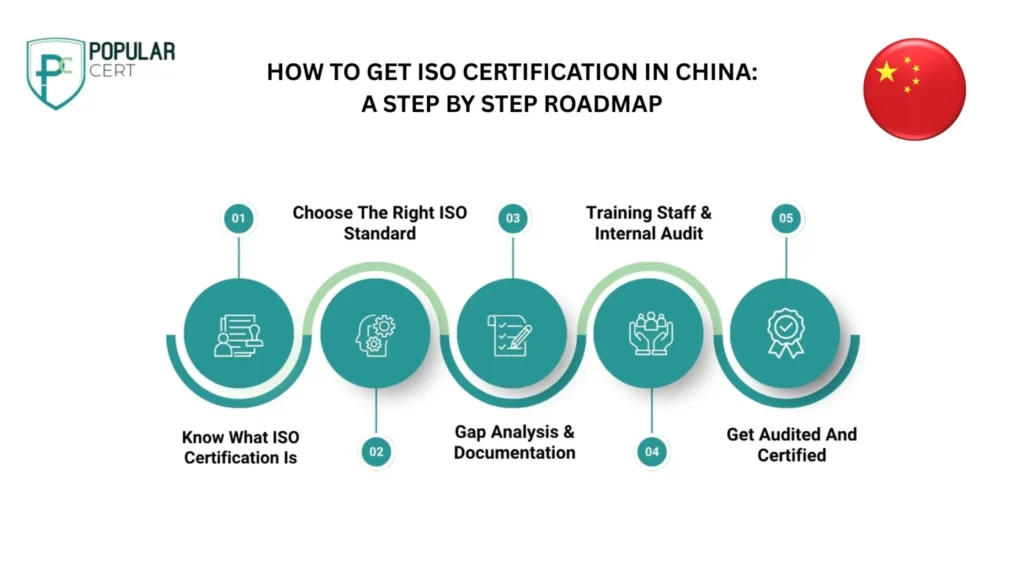
Know What ISO Certification Is

Start by understanding what ISO certification means. ISO (International Organization for Standardization) sets global standards for quality, safety, efficiency, and more. Certification shows your business meets those standards.
Choose the Right ISO Standard

Different ISO standards apply to different needs. For example: ISO 9001 → Quality management ISO 14001 → Environmental management ISO 45001 → Occupational health & safety You need to pick the one that fits your business goals and industry.
Gap Analysis & Documentation

This step involves: Comparing your current processes with ISO requirements Identifying what’s missing (“gaps”) Creating required documents like policies, procedures, and records It’s essentially preparing your system to meet the standard.
Training Staff & Internal Audit

Your team must understand and follow the ISO system: Train employees on new processes Conduct internal audits to check compliance Fix any issues found before the official audit
Get Audited and Certified

Finally, an external certification body audits your company: Stage 1 audit → Review documents Stage 2 audit → Check real implementation If you pass, you receive your ISO certification.
How Does ISO Certification Act as a Universal Passport for China's Economy?
China’s economy is undergoing a significant transformation, evolving from a manufacturing hub into a leader in high-tech and value-added industries. In this evolving landscape, ISO certification provides a crucial competitive advantage.
- Unlocking Global Trade Opportunities: As a key player in global supply chains, ISO certification serves as a universal passport for Chinese companies. It's a non-negotiable requirement for entering new markets and securing contracts with multinational corporations. This is particularly vital for the automotive, electronics, and aerospace sectors, where quality and reliability are paramount. An ISO 9001 certified manufacturer, for example, is seen as a more dependable and less risky supplier.
- Ensuring Regulatory Compliance: China has its own comprehensive system of national standards and its government actively participates in and promotes international standardization. ISO frameworks help Chinese enterprises not only meet their own national regulations but also navigate the complex web of international requirements related to safety, quality, and environmental management. This proactive approach significantly reduces the risk of non-compliance and potential penalties.
- Enhancing Brand Credibility: A certified business in China stands out in a crowded market. ISO certification builds immediate and profound trust with customers, partners, and regulatory bodies. For a foreign investor, this badge of quality can be the deciding factor when choosing a reliable supplier. It signals a dedication to excellence that transcends cultural and linguistic barriers.
How Are ISO Standards Shaping China's Key Industries?
China’s economic ascent is fueled by its powerful and diverse industrial base. From the sprawling factories of its manufacturing centers to the cutting-edge labs of its technology hubs, ISO standards are the invisible scaffolding supporting this growth.
Get Free Consultation
Our Clients

Our Projects

Why Choose PopularCert?
- Trusted Global ISO Certification Partner
- Experienced Industry-Focused Consultants
- Complete End-to-End Certification Support
- Fast & Transparent Certification Process
- International Compliance & Audit Readiness
- Dedicated Long-Term Customer Support
Types Of ISO Certification In China
- ISO Certification In China
- ISO 9001 Certification in China
- ISO 14001 Certification in China
- ISO 45001 Certification in China
- ISO 22000 Certification in China
- ISO 27001 Certification in China
- ISO 17025 Certification in China
- ISO 13485 Certification in China
- CE Mark Certification in China
- ISO 20000-1 Certification in China
- GMP Certification in China
- Halal Certification in China
- SOC-1 Certification in China
- SOC-2 Certification in China
A Manufacturing and Quality Powerhouse:
China’s manufacturing prowess is unparalleled. The implementation of ISO standards, particularly ISO 9001 (Quality Management Systems), has been a cornerstone of this success. This standard provides a systematic approach to quality control, ensuring that products are consistently produced to a high standard, reducing defects, and minimizing waste.
The country’s rise as a technological innovator, often referred to as “Silicon Valley of Asia” for cities like Shanghai and Shenzhen, is also intrinsically linked to international standards.
- ISO 27001 (Information Security Management) is critical for China's burgeoning tech sector. With massive growth in e-commerce, AI, and data-driven services, protecting sensitive information is paramount for building trust. This standard helps companies establish a robust framework for managing information security risks, ensuring the confidentiality, integrity, and availability of data.
- ISO/IEC 20000 (IT Service Management) provides a framework for managing IT services to ensure they are efficient and effective. This is particularly relevant for the tech giants of China that operate at immense scale, from Alibaba's cloud services to Tencent's gaming platforms.
Sustainable Development and Environmental Responsibility:
China’s rapid industrialization has come with significant environmental challenges. In response, the government and forward-thinking businesses are increasingly embracing sustainability. ISO 14001 (Environmental Management Systems) is a powerful tool in this effort. By implementing this standard, organizations can systematically manage their environmental responsibilities, reduce resource consumption, and mitigate their environmental footprint. This is crucial for industries like energy and manufacturing, but also for sectors like tourism, which depend on the preservation of natural beauty.
Building a Safe and Healthy Workforce:
The well-being of China’s immense workforce is a national priority. The Work Safety Law of the People’s Republic of China aligns with and is complemented by international standards. ISO 45001 (Occupational Health and Safety Management Systems) provides a framework for creating a safer and healthier working environment. By systematically identifying and mitigating workplace risks, Chinese businesses can reduce accidents, improve employee morale, and enhance overall productivity.
How Can ISO Standards Help Preserve and Promote China's Unique Heritage?
ISO standards are not just for boardrooms and factories; they can be powerful tools for preserving China’s unique cultural and natural treasures. From iconic historical sites to vibrant natural landscapes, these landmarks can leverage ISO principles to ensure sustainable management and a world-class visitor experience.
The Great Wall and the Terracotta Army: Stewarding History
The management of China’s most iconic historical sites, such as the Great Wall and the Terracotta Army, is a complex undertaking that combines preservation, tourism, and logistics.
- ISO 9001 can be applied to the management of visitor services at these sites. This ensures a consistent and high-quality experience, from ticketing and transportation to safety and accessibility.
- ISO 45001 is crucial for ensuring the health and safety of both employees and the millions of tourists who visit. This includes managing crowd control on the Great Wall's narrow sections and maintaining safe walkways around the Terracotta Army pits.
- ISO 21401 (Sustainable Management System for Tourism Organizations) offers a specific framework for these sites to ensure their economic, social, and environmental sustainability. It helps in managing the impact of tourism while contributing positively to local communities and preserving the integrity of the historical and natural environment.
The Majestic Natural Landscapes of Zhangjiajie and Guilin: Preserving Nature’s Art
China is home to some of the world’s most breathtaking natural landscapes, like the karst peaks of Guilin and the towering sandstone pillars of Zhangjiajie. Managing these tourist destinations requires a delicate balance of conservation and visitor management.
- ISO 14001 is highly relevant here. It helps park authorities and tour operators implement effective waste management programs, control pollution from high visitor volumes, and preserve the natural beauty for future generations.
- ISO 20121 (Event Sustainability Management Systems) can be used for managing large-scale cultural festivals or tourism-related events held in these areas, ensuring they are models of sustainability and responsible operation.
A Legacy of Science and Innovation:
It’s a historical fact that ancient China was a leader in science and technology, responsible for the Four Great Inventions: papermaking, printing, the compass, and gunpowder. This historical foundation of innovation continues to influence modern-day China. Today, the nation is building on this legacy by becoming a leader in new technologies like artificial intelligence and clean energy. ISO standards provide the necessary framework for this rapid technological innovation, ensuring that these advancements are reliable, interoperable, and secure. This is particularly important for areas like robotics and clean energy where international standards facilitate global cooperation and trade.
How Can Your ISO Certification Journey in China Be Simplified?
The journey to ISO Certification can present challenges, especially for businesses in a market as vast and complex as China. The process, however, can be streamlined and made highly effective when guided by experts.
Common Hurdles and How to Overcome Them:
The journey to ISO Certification can present challenges, especially for businesses in a market as vast and complex as China. The process, however, can be streamlined and made highly effective when guided by experts.
- Navigating a Complex Regulatory and Business Environment: The unique blend of international standards and national GB standards, coupled with regional business practices, can be difficult to navigate. A local expert can provide invaluable guidance.
- Resource Constraints: For small and medium-sized enterprises (SMEs), allocating time, money, and manpower for certification can seem daunting.
- Documentation Burden: The need for extensive documentation can be overwhelming without a clear, structured approach.
- Finding Qualified and Reputable Auditors: With a multitude of domestic and foreign certification bodies, identifying a reputable and accredited partner is crucial to ensure the validity and value of your certification.
By proactively addressing these hurdles with a trusted partner, Chinese businesses can successfully navigate the ISO certification process and reap its significant rewards.
Common Hurdles and How to Overcome Them:
In China’s competitive business environment, selecting the right ISO Certification partner is crucial. we stand out as the trusted and reliable choice, offering unparalleled expertise and a client-centric approach tailored specifically to the Chinese market.
- Local Expertise, Global Standards: While we adhere to the most rigorous international ISO standards, we possess a deep understanding of the local business landscape, regulatory environment, and cultural nuances in China. Our solutions are both globally compliant and locally relevant, ensuring a seamless fit for your operations.
- Experienced and Accredited Consultants: Our team comprises highly qualified and experienced ISO consultants with a proven track record of successful certifications across diverse industries in China. We have successfully guided businesses in manufacturing, technology, tourism, and many other sectors to achieve their certification goals.
- Tailored and Cost-Effective Solutions: We recognize that every business is unique. We offer customized solutions that meet your specific requirements and budget, ensuring a valuable return on your ISO investment. We make the process efficient and transparent, demystifying the perceived complexities of certification.
- End-to-End Support: From the initial consultation to the final audit and beyond, we provide comprehensive, hands-on support at every step of your ISO journey. This comprehensive approach minimizes stress and ensures the process is as smooth and efficient as possible. We provide streamlined documentation templates and hands-on assistance, making the process efficient and tailored to the organization’s needs, rather than being overly bureaucratic.
- Commitment to Client Success: At Popularcert, your success is our priority. We are committed to ensuring a smooth, reliable, and successful certification process, going above and beyond to help you achieve your goals and realize the full benefits of ISO certification. Our flawless track record of a 100% client certification rate speaks for itself.
Contact Popularcert today for a free consultation and see how ISO certification can transform your operations and drive your business forward in China’s dynamic and exciting business environment.
FAQ
What is ISO certification and why is it important for companies in China?
ISO certification is a third-party verification that a company’s management system, products, or services meet the requirements of a specific ISO standard. For companies in China, getting certified shows a commitment to quality, safety, and efficiency. It helps them gain a competitive edge in international markets, as many foreign businesses require their suppliers to have ISO certification. It can also improve internal operations, enhance brand reputation, and increase customer confidence. The most popular standard in China is ISO 9001 for quality management.
How long does the ISO certification process take for a company in China?
The timeline for ISO certification in China varies, but it generally takes anywhere from 3 to 12 months. The duration depends on several factors, including the company’s size, the complexity of its processes, and its current level of compliance with the standard. A smaller organization with simpler systems may achieve certification in a shorter time frame, while a larger, more complex company will require more time for implementation, documentation, and training.
How much does ISO certification cost for a Chinese company?
The steps include choosing the relevant ISO standard, selecting a certificati
The cost of ISO certification in China can vary significantly. There’s no fixed price, as it depends on factors like:
- Company Size and Complexity: Larger companies with multiple locations and more employees will have higher costs.
- Type of Standard: Different ISO standards have different requirements, which can affect the time and resources needed.
- Certification Body: Fees charged by different certification bodies can vary.
- Consulting Fees: Many companies hire external consultants to help them prepare for the audit, which adds to the overall cost. Costs typically include an initial application fee, audit fees (based on daily rates), and annual surveillance fees to maintain the certification.
on body, gap analysis, documentation development, implementation, audits, and certification. The duration varies but usually takes several months.
- Join 1000+ Certified Companies
Ready to Get Certified for Your Next Project?
- Free Consultation
- Expert Guidance
- Fast Turnaround
Reach Us Now
Claim Your Free Consultation Today!