
IATF 16949 Requirements: Automotive QMS, Core Tools and Certification Readiness
1000+
Successful Projects
10+ Years
Industry Experience
Worldwide
Certification Services
24/7 Support
Expert Consultation
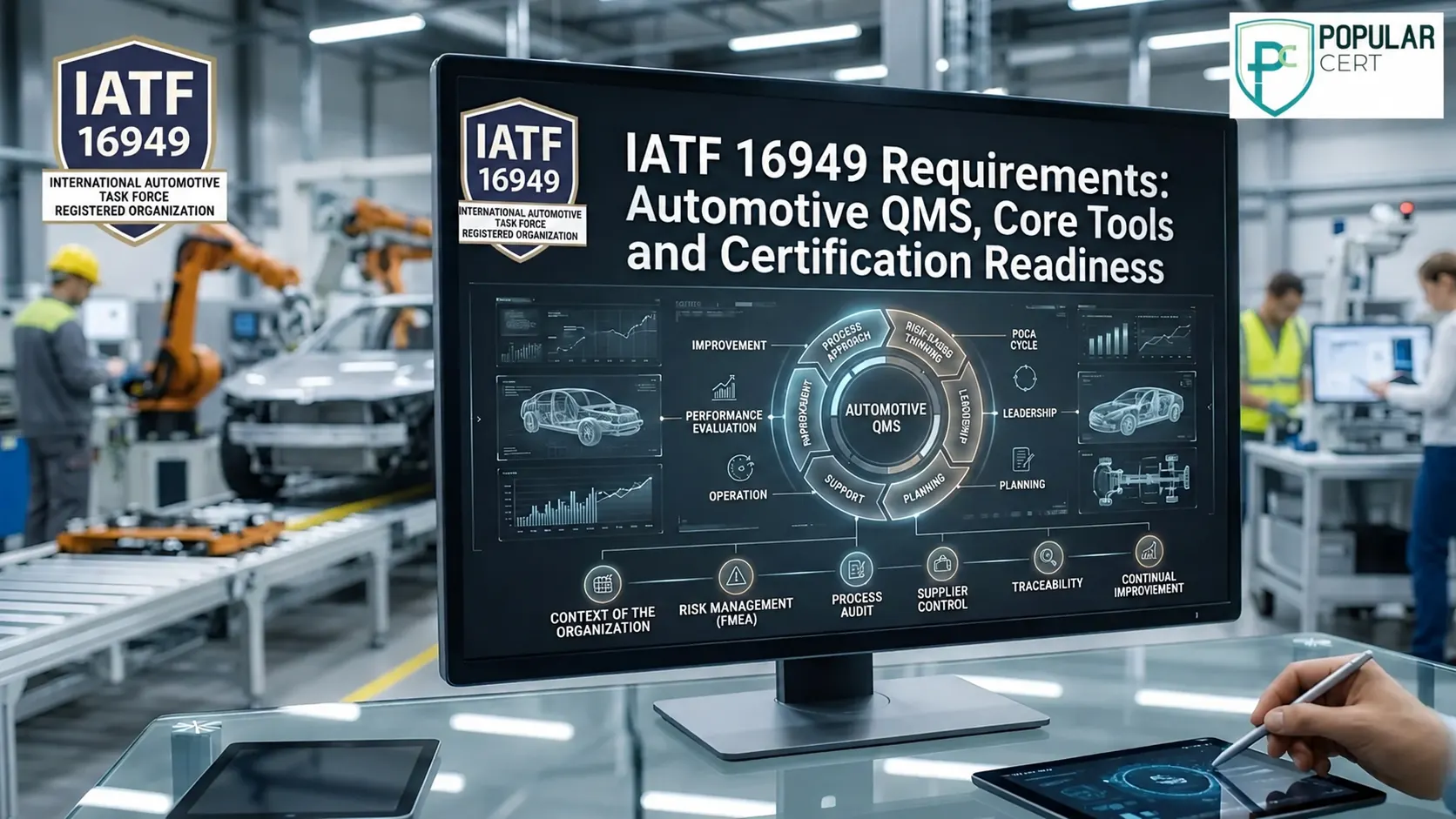
IATF 16949:2016 sets automotive quality management system requirements that build on ISO 9001:2015, adding defect prevention, risk and product safety controls, and core tools: APQP, PPAP, FMEA, MSA and SPC. Only IATF-recognised certification bodies issue certificates. PopularCert provides readiness consulting: gap analysis, documentation, training and internal audits.
IATF 16949 is one of the leading quality management system (QMS) standards for the automotive industry. It incorporates ISO 9001 and adds requirements specific to automotive production and service parts, with a more proactive approach to risk management, product safety and improvement across the supply chain. Many organizations treat it as just another certificate. In practice it is a more demanding system, built to improve product quality and operational efficiency while reducing risk across the product lifecycle.
PopularCert helps you prepare for IATF 16949 certification with step-by-step expert support, so your quality system is ready for audit.
PopularCert is an independent consulting firm. IATF 16949 certificates are issued only by IATF-recognised certification bodies.
Table of Contents
What is IATF 16949?
IATF 16949 is a global standard for the automotive industry, including automotive service parts, and specifies the requirements of a QMS. The standard is intended to provide a common framework for all organizations in the automotive supply chain.
The first edition of IATF 16949 Certification and the first document of IATF after the ISO/TS16949 came into being, was published in October 2016. This 2016 edition remains the current version, with certification bodies now operating under the IATF Rules 6th Edition (effective April 2025), which governs how audits are conducted and certificates are issued.
Some key points of IATF 16949 are:
Strong correlation with the requirements of ISO 9001:2015
Focuses more on prevention of defects than on detection
Focuses on the reduction of variation and waste in processes
Integrating risk-based thinking at all levels
More stringent requirements regarding the safety and traceability of products
Continuous improvement, core objective of the organization
Learn what a safety audit is and how it helps keep your workplace safe. Understand its process, types, and key benefits in a simple way.
Who Issues IATF 16949 Certificates, and What Does PopularCert Do?
Trending Posts
Get Free Consultation
Our Clients

Projects

Our Happy Clients
⭐⭐⭐⭐⭐
“PopularCert made our ISO certification process smooth and professional.”
— Manufacturing Client, Oman
⭐⭐⭐⭐⭐
“Excellent support and documentation guidance.”
— Healthcare Client, Saudi Arabia
⭐⭐⭐⭐⭐
“PopularCert simplified our ISO certification process with professional guidance and fast support.”
— Manufacturing Client, Saudi Arabia
IATF 16949 certificates are issued only by certification bodies recognised by the International Automotive Task Force (IATF). They are not issued by consultants or by general ISO certification bodies. The IATF Rules (6th Edition, effective 1 January 2025) set how those bodies audit and certify organizations.
Activity | IATF-Recognised Certification Body | PopularCert (Readiness Consulting) |
Issues the IATF 16949 certificate | Yes | No, and we cannot guarantee audit outcomes |
Conducts Stage 1, Stage 2 and surveillance audits | Yes | No |
Gap analysis against IATF 16949 | Identifies nonconformities during the audit | Pre-audit gap analysis and action plan |
Quality manual, procedures and records | Reviews them | Helps develop and structure them |
Core tools (APQP, PPAP, FMEA, MSA, SPC) | Audits their use | Implementation support and team training |
Internal audits and management review | Expects them to be in place | Prepares and supports them |
Customer-specific requirements (CSRs) | Audits conformity | Helps you identify and map them |
Choose a certification body that is recognised by IATF for your scope, and confirm this on the IATF Global Oversight website before you sign a contract.
Why IATF 16949 Is Important for Automotive Businesses
Automotive businesses must meet specific quality requirements to compete. IATF 16949 sets out what organizations need to do to satisfy their customers and meet applicable requirements. Many automotive OEMs require certification from their suppliers. Requirements vary by customer, so check each customer’s specific requirements. For a business that wants to supply parts or services to these manufacturers, certification is often a baseline condition rather than an advantage.
Automotive companies adopt the standard because it:
- Reduces defects and inconsistencies across production lines
- Improves trust and transparency between manufacturers, suppliers and customers
- Simplifies management of automotive quality requirements on a global scale
- Saves time and improves productivity through process management
- Raises customer satisfaction through quality and reliability
Key Requirements of IATF 16949 You Must Know
Automotive companies must know the IATF 16949 standard in order to apply it effectively, and the standard is designed to help companies create an excellent quality system.
Focus Area | Key Actions / Requirements |
|---|---|
Continuous Improvement | Look for improvement opportunities in products, services, and operational systems |
| Improve process efficiency and workflow effectiveness | |
| Continuously enhance all aspects of organizational processes | |
Identifying & Minimizing Risk | Reduce process-related risks and operational inefficiencies |
| Minimize material usage where possible | |
| Reduce delays and improve process flow | |
Product Safety | Apply risk management throughout the product life cycle, including development and production |
| Ensure safety requirements are clearly defined, documented, and communicated |
The Core Tools Behind IATF 16949 Requirements
IATF 16949 expects organizations to apply the automotive core tools. The tools come from AIAG (and, for FMEA, the joint AIAG-VDA approach). Auditors look for evidence that you use them, not just that you have templates.
Tool | What it does | Typical evidence an auditor asks for | Common failure point |
APQP (Advanced Product Quality Planning) | Plans new products and processes in phases before production | Project timing plan, phase gate reviews, cross-functional team records | Plan exists but phases and approvals aren’t followed or documented |
PPAP (Production Part Approval Process) | Proves your process can consistently meet customer requirements before full production | Submitted PPAP package and customer approval record | Submitting outdated data or skipping the customer’s required level |
FMEA (Failure Mode and Effects Analysis) | Identifies potential failures and ranks risk before they happen | Design and process FMEAs linked to the control plan | FMEA written once and never updated after failures or changes |
MSA (Measurement Systems Analysis) | Confirms your measurement equipment gives reliable data | Gauge studies (such as Gauge R&R) on critical measurements | Studies done for a few gauges only, or not repeated after changes |
SPC (Statistical Process Control) | Monitors processes with statistical methods to detect variation | Control charts, capability data and reaction plans | Charts maintained but no action taken when signals appear |
The tools work as a chain. APQP structures the project, FMEA drives the control plan, MSA proves the data can be trusted, SPC monitors it in production, and PPAP shows the result to the customer. Confirm the exact clause references and current manual editions in the standard and in your customers’ requirements.
Who is IATF 16949 Certification for?
IATF 16949 applies to organizations involved, directly or indirectly, in the automotive supply chain, especially those working with large automotive manufacturers. Examples include:
- Manufacturers of automotive parts and components
- Manufacturers of vehicle assemblies
- Providers of finishing or other specialized services
- Direct suppliers to automotive OEMs (original equipment manufacturers)
Eligibility depends on your site’s activities and the IATF Rules, so confirm it with an IATF-recognised certification body.
Steps to Get IATF 16949 Certification
The certification process can look daunting, but an orderly approach makes it manageable. The steps are:
- Familiarize yourself with the IATF 16949 standard and your customers’ specific requirements.
- Conduct a gap analysis to find the deficiencies in your current system.
- Define the processes, systems and documentation you need.
- Prepare and deliver awareness and training sessions for the whole workforce.
- Carry out internal audits to measure how ready your organization is. See our guide to auditing for how audits work.
- Select an IATF-recognised certification body for your scope.
- Undergo the certification audit with that body.
Common Challenges in IATF 16949 Implementation
Many organizations run into obstacles when putting the standard in place, which can affect the quality management system. The most frequent challenges include:
- Misunderstanding customer needs and expectations
- Ineffective risk management
- Lack of commitment and involvement from leadership
- Inadequate planning and poor implementation of processes
Benefits of IATF 16949 Certification
Certification can improve operational efficiency and strengthen your reputation in the marketplace. The most significant benefits include:
- Higher customer satisfaction through consistent quality
- Better access to global markets and business opportunities
- A stronger competitive position in the automotive sector
- Fewer errors, less rework and lower operating costs
Learn how to choose the best ISO 9001 consultants in Lebanon and ensure a smooth, successful certification process for your business.
How Popularcert Can Help You Get IATF 16949 Certified
Our consulting is tailored to your organization’s needs. From the first gap analysis through to audit readiness, we focus on IATF 16949’s detailed requirements and on putting them in place without disrupting production.
PopularCert services include:
- Gap analysis towards full IATF 16949 compliance
- Writing and documentation of your quality system
- Training for employees at every level
- Risk analysis and process control support
- Preparation for internal audits and for the certification body’s audit
If your quality system is built on ISO 9001, our ISO 9001 certification support is a natural starting point. When you’re ready, talk to our IATF 16949 consultants.
Conclusion
IATF 16949 certification is not legally required, but many automotive customers require it from their suppliers. It gives organizations a solid platform for managing quality, risk and performance improvement across their operations. For suppliers aiming to work with automotive manufacturers, building a system that meets the standard is a serious investment, and the right preparation makes the road to certification clearer. Certification itself comes only from an IATF-recognised certification body.
Sources and Further Reading
FAQ
What does IATF 16949 certification mean?
It means an organization has passed an audit by an IATF-recognised certification body against a quality management system standard tailored to the automotive industry, with a strong emphasis on preventing defects and continual improvement.
Who issues an IATF 16949 certificate?
Only certification bodies recognised by IATF. Consultants, including PopularCert, prepare you for the audit but do not certify.
Do you have to have IATF 16949 certification?
It is not legally required, but many automotive manufacturers require their suppliers to hold it. Check your customers’ requirements.
How long does IATF 16949 certification take?
It depends on your organization’s size, structure and starting point, but preparation typically takes several months.
How is IATF 16949 different from ISO 9001?
IATF 16949 includes the requirements of ISO 9001 and adds automotive-specific requirements for quality, product safety, risk management and the core tools.
Is a new edition of IATF 16949 coming?
A revision has been reported as planned. Check IATF Global Oversight for its current status. IATF 16949:2016 remains the current standard until IATF announces otherwise.
- Join 1000+ Certified Companies
Ready to Get Certified for Your Next Project?
- Free Consultation
- Expert Guidance
- Fast Turnaround
Reach Us Now