
ISO certification by Popularcert helps organizations meet international standards, improve quality, and build trust.
ISO 22301 Business Continuity Management: Ensuring Resilience for Iraqi Businesses
1000+
Successful Projects
10+ Years
Industry Experience
Worldwide
Certification Services
24/7 Support
Expert Consultation
ISO 22301 is an international standard that ISO Certification helps businesses in Iraq get ready for unexpected problems. It gives a clear framework for finding risks, protecting important operations, and making sure that important services stay available during emergencies. This is especially important for Iraqi businesses because they face problems like unstable politics, changing economies, and problems with their infrastructure.
Companies in Iraq can become more resilient, have less downtime, and gain the trust of customers and partners by using ISO 22301. It helps businesses deal with crises quickly, get back on their feet faster, and keep running their businesses, which leads to long-term stability and growth in a changing world.
Table of Contents
ISO 22301: Building Resilience, Not Just Compliance
BCMS ISO 22301 is referred to as the “independent standard” when it comes to the International Standard for Business Continuity Management Systems (BCMS). It pronounces the backbone of Business Continuity Management Systems as ISO 22301:2019 Security and Resilience – Business Continuity Management Systems Requirements. For a business operating in Iraq, what does that concretely imply?
It is a misconception to believe that continuity plans are recovery plans or only checklist-like documents. ISO 22301 is more sophisticated than that. It achieves organizational (people, processes, facilities) and technological (IT) resilience at the same time for a business in Iraq. It means that the entire value chain is exposed and supplier and cyber attack risks from Baghdad to the regional offices are covered.
The culture of preparedness is the primary reason for implementing ISO 22301. It is a misconception that implementing ISO 22301 is only for compliance. Your organization will be more prepared because you will consistently deliver key services and products. Clients, partners, and even regulators will be able to maintain their confidence in the organization during any crisis.
The PDCA Model: Plan-Do-Check-Act
ISO 22301 remains within the PDCA cycle because all the standards entail something around continual improvement. Here is In depth how the PDCA cycle is used in Iraqi firms.
Plan
- This is the most important phase. The organization needs to set the boundaries of the scope of the BCMS, develop a business continuity policy, and undertake a BIA.
- During the BIA, vital processes, their interdependencies, and the possible financial and reputational damage of their disruption are all ascertained.
- All possible risks such as cyber-attacks, disasters and a possible decline in the political state in Iraq that will hinder the supply movement are evaluated.
Do
- This is the phase where action and planning is put to work. This includes the following.
- Distribution of materials and personnel for business continuity measures.
- Educating and training staff and the emergency response team on SOP’s to be used in such emergencies.
- Risk management techniques to reduce the chances of the aforementioned risks.
- Supplying Iraqi firms such as the use of back up power systems, back up cloud data, and domestic redundant suppliers to reduce the impact on business processes.
Check
- The organization assesses the impact of the measures of BCMS.
- Internal checks and audits on the organisation regarding the standards and measures set within the ISO 22301 standards.
- Normal and computer outage practice drills and simulation exercises to assess the level of preparedness.
- Analyzing the gathered data to determine the level of impact to be below par to enhance the systems.
Act
- Final thoughts involve performing actions based on the intelligence collected. This ensures the system’s model BCMS grows with new innovations, threats, technology, and business changes, rather than being a document which remains unchanged.
Trending Posts
Get Free Consultation
Our Clients

Projects

Our Happy Clients
⭐⭐⭐⭐⭐
“PopularCert made our ISO certification process smooth and professional.”
— Manufacturing Client, Oman
⭐⭐⭐⭐⭐
“Excellent support and documentation guidance.”
— Healthcare Client, Saudi Arabia
⭐⭐⭐⭐⭐
“PopularCert simplified our ISO certification process with professional guidance and fast support.”
— Manufacturing Client, Saudi Arabia
Why ISO 22301 Certification Iraq Matters?
- Operational Resilience: During even the most critical periods, businesses can sustain key operations. A good example is an Iraqi logistics company that supplies critical products even during regional transportation strikes or supplier failures.
- Financial Protection: Lessening the downtime which will be incurred, the risk of losing revenue, and the overall financial burnout, is extremely important when dealing with volatile markets, especially for Iraqi SMEs or even multinational operations.
- Regulatory Compliance: Most of the time Iraqi organizations are viewed as the legally dying, thus with the Iso 22301 certification, it becomes easier to avoid the risks that come with local laws, contracts or even global continuity standards.
- Enhanced Reputation and Trust: Certification is a strong indication of reliability. In the case of Iraq, it is easy to see that the organization is viewed positively, which improves esteem and offers an advantage against the competition.
Core Components of a BCMS in Iraq:
In Iraq the implementation of a business continuity management system will be done using a systematic approach. The major highlights of this system per ISO 22301 are outlined below.
Identification of a Threat
- Identify risks which may occur internally as well as externally such as cyber attacks, natural disasters, unstable politics and supply chain blocks.
- A case in point is an enterprise in the city of Basra or Baghdad which may experience floods and or power outages. Targeted cyber attacks may be directed toward financial institutions and or the government.
Business Impact Analysis
- Identify the core functions of the business and estimate the impact which will be caused in the absence of the function.
- Streamlining of the allocation of resources is best done by prioritizing the critical processes as prescribed in the risk management system.
Mitigation and Treatment of the Risk
- Formulate plans which will minimize the exposure to risk. These may include the diversification of suppliers, the adoption of cloud technology and robust cyber defense.
Continuity Procedures
- Work to be done will be in the form of documenting the actions to be taken to minimize the disruption of business processes.
- Employees should be equipped with effective and actionable playbooks to ensure the clarity of process during high-stress scenarios.
Response to an Incident
- The actions taken as first steps to resolve an issue such as damage control by protecting the personnel, limiting the losses and loss sustained will be treated as triage and stabilization.
Recovery and Restoration
- Stability and normalcy should be swift and proactive actions to ensure uninterrupted business continuity, including the supply chains of Iraq and the rest of the globe.
Business Continuity vs. Business Resilience:
Aspect | Business Continuity | Business Resilience |
Focus | Tactical: Preserving core functions during any disruption | Strategic: Ability to adapt, recover, and grow after a crisis |
Scope | Maintains essential operations temporarily | Broader organizational capability to absorb shocks and thrive |
Integration | Specific processes and procedures for continuity | Seamless integration of BCMS, disaster recovery, risk assessment, and strategic communication |
Goal | Keep the business running during disruption | Ensure the organization emerges stronger and leverages opportunities after a disruption |
Example in Iraq | Ensuring supply chains or IT systems continue operating during a disruption in Baghdad | Adapting business strategies, strengthening systems, and communication to handle future crises in Iraq |
Free ISO 22301 Checklist
Assess compliance, reduce risks, and strengthen your business continuity management.
- Practical & Audit-Ready
- Save Time & Effort
- No Registration Required
Building a Business Continuity Plan (BCP) in Iraq:
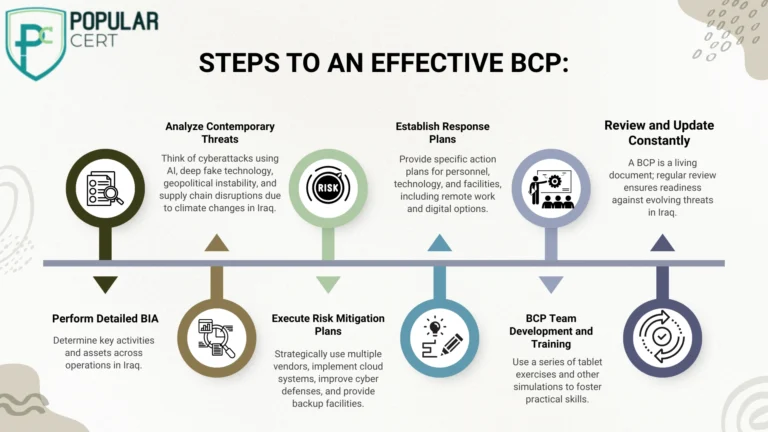
A BCP is an outcome of a BCMS. By 2025, a BCP should be innovative, adapting to global threats and the specific context of Iraq.
Steps to an Effective BCP:
Which Industries matters ISO 22301 Certification?
ISO 22301 certification is designed for any organization that needs to ensure operational resilience and continue functioning during a disruption, but it is particularly critical for industries where downtime leads to severe financial losses, safety risks, or reputational damage.
How much cost of ISO Certification in Iraq?
ISO certification costs in Iraq are not fixed, ranging from a few thousand to several lakhs, depending on company size, industry complexity and chosen certification body. Key cost drivers include employee count, number of locations and the specific standard required. If you want to know more about ISO certification cost, contact our consultant.
Conclusion:
Strengthening business continuity with ISO 22301 helps Iraqi organizations stay resilient, recover quickly, and maintain trust during disruptions. Partner with Popularcert to simplify your certification journey. Take the next step today and secure your business future with expert guidance and reliable support.
FAQ
Is ISO 22301 only for large companies?
No. ISO 22301 is scalable and can benefit organizations of all sizes in Iraq—from SMEs to multinational operations.
How does a BIA help Iraqi organizations?
A BIA prioritizes critical operations, assesses financial and reputational impacts, and guides resource allocation for continuity strategies.
What is the difference between ISO 22301 and a Disaster Recovery Plan?
Disaster Recovery Plans typically focus on IT systems. ISO 22301 covers the entire organization, including people, processes, and facilities.
Why is business resilience important in Iraq in 2025?
Iraq’s dynamic market, political volatility, and environmental risks make resilience a competitive advantage, demonstrating reliability to clients, investors, and regulators.
- Join 1000+ Certified Companies
Ready to Get Certified for Your Next Project?
- Free Consultation
- Expert Guidance
- Fast Turnaround
Reach Us Now