
ISO 13485 Consulting in California, USA: Build a Strong Quality System with Confidence
1000+
Successful Projects
10+ Years
Industry Experience
Worldwide
Certification Services
24/7 Support
Expert Consultation
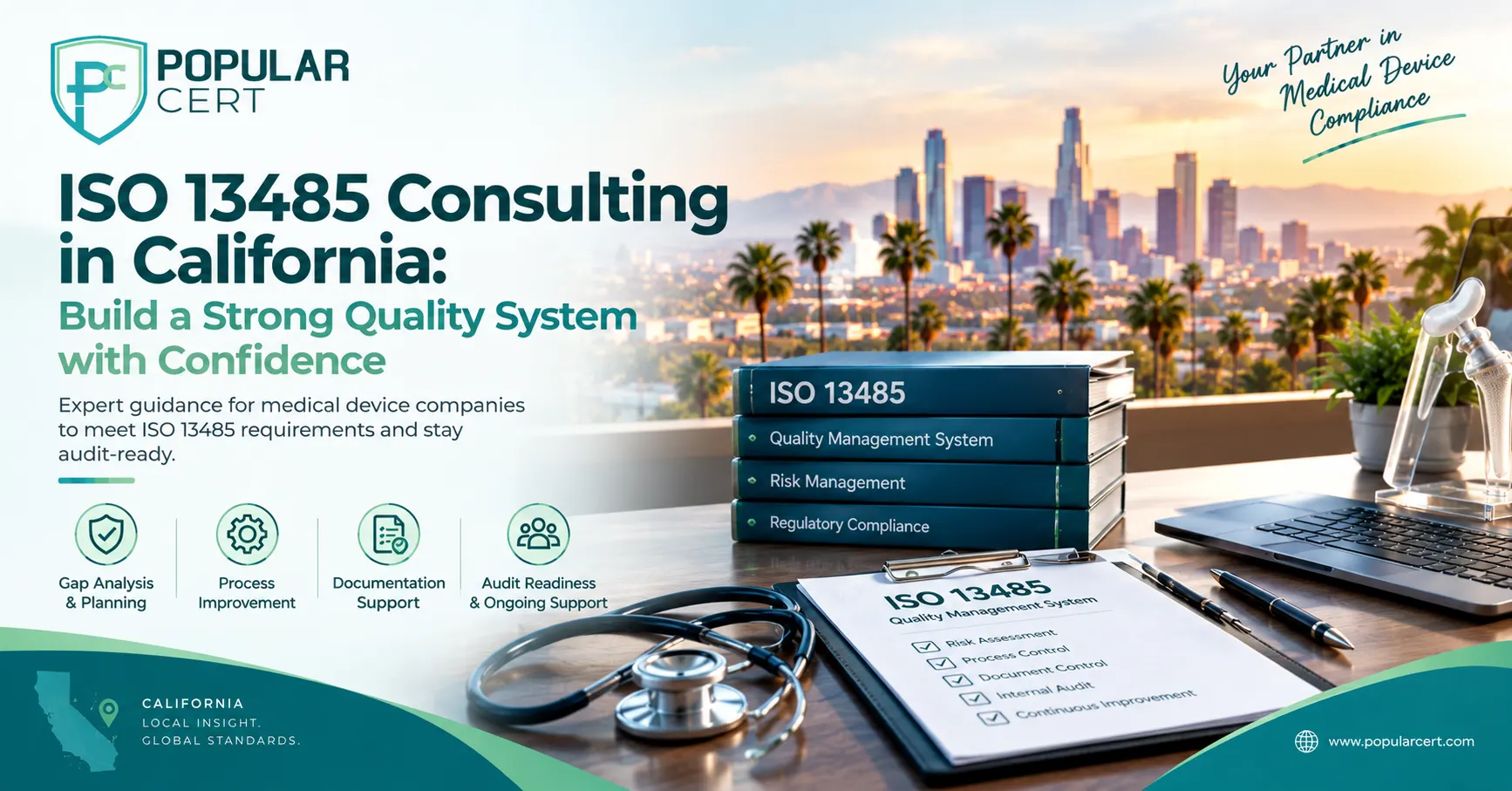
ISO 13485 consulting helps medical device organizations build, implement and prepare a quality management system for certification to ISO 13485:2016. A consultant runs the gap analysis, writes procedures, trains staff, conducts internal audits and prepares you for the certification body audit. Since February 2, 2026, FDA’s QMSR incorporates ISO 13485 by reference.
The medical device industry is growing quickly, and businesses must prove that their products are safe, reliable and meet strict quality requirements. Whether you manufacture medical devices, supply components or provide related services, a strong quality management system is essential.
This is where ISO 13485 consulting in California can help. Instead of struggling with complex requirements on your own, experienced consultants guide you through the certification process step by step. For companies across California and the USA, ISO 13485 is more than a certificate. It improves product quality, meets customer expectations, prepares you for regulatory requirements and builds trust in local and international markets.
Table of Contents
Inside ISO 13485: The Medical Device QMS Standard, Simplified
ISO 13485 is an international quality management standard created specifically for the medical device industry. It helps businesses establish clear processes for designing, manufacturing, storing, distributing and servicing medical devices while maintaining consistent quality.
The standard can be used by:
- Medical device manufacturers
- Component suppliers
- Medical equipment distributors
- Packaging companies
- Calibration laboratories
- Sterilization providers
- Healthcare technology companies
ISO 13485 focuses on patient safety, product quality, risk management, documentation and continual improvement.
ISO 13485:2016 vs FDA QMSR: Key Differences for Medical Device Companies
| Comparison | ISO 13485:2016 | FDA QMSR (21 CFR Part 820) |
|---|---|---|
| Purpose | An international quality management system standard for medical device organizations. | A legally enforceable US regulation covering quality management systems for medical device manufacturers within its scope. |
| Certification and Compliance | Organizations can obtain voluntary certification through an independent certification body. | Manufacturers must comply with applicable QMSR requirements. The FDA does not issue ISO 13485 certificates. |
| Assessment | Independent certification bodies conduct audits to assess conformity with ISO 13485. | The FDA evaluates regulatory compliance through inspections and other oversight activities. |
| Certification Requirements | Generally voluntary but may be required by customers, contracts, or certain market-access arrangements. | ISO 13485 certification is not required by the FDA for QMSR compliance. |
| FDA Inspections | ISO 13485 certification does not exempt manufacturers from FDA inspections. | The FDA may inspect manufacturers to verify compliance with applicable regulations. |
| Relationship | Provides internationally recognized quality management system requirements for the medical device industry. | Incorporates ISO 13485:2016 by reference and adds FDA-specific requirements and definitions. |
| Quality Management System | Covers design and development, production, supplier controls, complaint handling, corrective actions, and risk management, as applicable. | Uses the incorporated ISO 13485 framework while requiring manufacturers to meet additional applicable FDA provisions. |
Trending Posts
Get Free Consultation
Our Clients

Projects

Our Happy Clients
⭐⭐⭐⭐⭐
“PopularCert made our ISO certification process smooth and professional.”
— Manufacturing Client, Oman
⭐⭐⭐⭐⭐
“Excellent support and documentation guidance.”
— Healthcare Client, Saudi Arabia
⭐⭐⭐⭐⭐
“PopularCert simplified our ISO certification process with professional guidance and fast support.”
— Manufacturing Client, Saudi Arabia
Where This Leaves US Medical Device Companies
Since February 2, 2026, the FDA’s Quality Management System Regulation (QMSR) has incorporated ISO 13485:2016 into 21 CFR Part 820. A quality system aligned with ISO 13485 is a strong foundation for QMSR, but manufacturers must also address the FDA’s additional provisions.
California Medtech Runs on Suppliers: Why Customers Ask for Your QMS First
Much of California’s device industry is built on supply chains. Contract manufacturers, machining and molding shops, packaging firms, labs and software teams feed larger device makers, and those customers have to qualify every supplier. A documented ISO 13485 system is the fastest way to pass that qualification. Without one, expect long supplier questionnaires, on-site audits and delays before your first purchase order.
For manufacturers, FDA’s QMSR adds a second reason. It incorporates ISO 13485:2016 by reference, so the standard’s requirements are now part of U.S. regulation. Companies that prove quality early also find it easier to win contracts with hospitals and healthcare organizations and to expand into global markets.
California Medtech Hubs: Regional Priorities at a Glance
| Region | Typical Company Profile | Common ISO 13485 Priorities |
|---|---|---|
| San Diego & Carlsbad | Medical device manufacturers, diagnostic companies, and life sciences startups. | Design controls, risk management, and quality system preparation for initial regulatory submissions. |
| Orange County / Irvine | Established medical device manufacturers and suppliers. | Supplier management, process validation, quality control, and certification audit readiness. |
| San Francisco Bay Area | Medical device startups, digital health companies, and technology-driven businesses. | Quality management system development, software validation, design documentation, and regulatory readiness. |
| Los Angeles Area | Contract manufacturers, medical equipment producers, and component suppliers. | Production controls, product traceability, supplier quality management, and customer audit preparation. |
| Sacramento & Central Valley | Medical laboratories, packaging companies, and small medical device suppliers. | Practical QMS documentation, process improvement, and preparation for initial ISO 13485 certification. |
California Device Manufacturing License + ISO 13485: Two Requirements, One Evidence Trail
Device manufacturers located in California need a Medical Device Manufacturing License from the California Department of Public Health, Food and Drug Branch, in addition to FDA establishment registration. ISO 13485 doesn’t replace either one. But a documented QMS gives you the records and procedures that licensing and inspections rely on, so you don’t build the same evidence twice.
Your First 30 Days: Scoping Before You Write a Single SOP
| Week | Focus Area | Expected Outcome |
|---|---|---|
| Week 1 | Define the QMS scope, identify medical device types, and determine applicable regulatory requirements. | Clearly defined and agreed quality management system scope. |
| Week 2 | Review existing procedures, documentation, quality records, and operational processes. | Gap assessment findings highlighting areas requiring improvement. |
| Week 3 | Compare identified gaps against ISO 13485:2016 and applicable FDA QMSR requirements. | Prioritized action list addressing compliance gaps and improvement opportunities. |
| Week 4 | Assign responsibilities, establish implementation priorities, and develop a realistic project timeline. | Structured implementation plan with assigned responsibilities and target completion dates. |
ISO 13485 Roadmap: From Gap Report to Certificate
| Step: | What You Should Do: |
|---|---|
| Gap Analysis | Review your existing quality management system and compare it with ISO 13485 requirements. Identify missing processes, compliance gaps, and areas that need improvement before implementation. |
| Planning | Develop a clear implementation plan with realistic timelines. Assign responsibilities to relevant team members to ensure everyone understands their role in meeting ISO 13485 requirements. |
| Documentation | Prepare the required quality management system documents, including the quality manual, procedures, work instructions, and quality records. Proper documentation helps maintain consistency and demonstrate compliance. |
| Implementation | Implement documented procedures across daily operations. Ensure employees follow established processes and maintain appropriate records to demonstrate that the quality management system is functioning effectively. |
| Employee Training | Train employees on applicable ISO 13485 requirements, quality procedures, and their individual responsibilities. Effective training helps improve product quality, maintain compliance, and reduce operational errors. |
| Internal Audit | Conduct internal audits to evaluate the effectiveness of the quality management system. Identify nonconformities, assess compliance, and implement appropriate corrective actions before the certification audit. |
| Management Review | Senior management reviews internal audit results, quality objectives, customer feedback, regulatory requirements, and overall QMS performance. This helps identify improvement opportunities and ensure the system remains effective. |
| Certification Audit | An independent certification body conducts the certification audit to assess conformity with ISO 13485 requirements. Once the audit process is successfully completed and certification requirements are met, the certification body issues the ISO 13485 certificate. |
Required vs. Often Forgotten: ISO 13485 Documents Auditors Ask For
Good documentation is one of the most important parts of ISO 13485. It helps businesses maintain consistent processes, meet regulatory requirements and demonstrate that their quality management system is working effectively. Proper documentation also makes audits easier and supports continuous improvement.
Core documents under ISO 13485:
- Quality Policy: A statement of your organization’s commitment to delivering safe, high-quality medical devices and continually improving its quality management system.
- Quality Manual: Explains how your quality management system is structured and how it meets the requirements of ISO 13485.
- Risk Management Records: Identify potential risks throughout the product lifecycle and describe the actions taken to reduce or control them.
- Standard Operating Procedures (SOPs): Step-by-step instructions that help employees perform their tasks consistently and correctly.
- Design and Development Records: Document the planning, testing, validation and approval of medical device design and development activities.
- Training Records: Evidence that employees have the necessary training and skills for their responsibilities.
- Internal Audit Reports: Evaluate whether the quality management system is working as planned and identify areas that need improvement.
- Corrective Action Records: Record problems, their root causes and the actions taken to prevent recurrence.
- Supplier Evaluation Records: Show that suppliers have been assessed and approved to consistently provide quality products or services.
- Complaint Handling Records: Document customer complaints, investigations and corrective actions.
The items auditors find missing most often:
| Clause | Requirement | Evidence auditors expect | Often missed because |
|---|---|---|---|
| 4.1.6 | Validation of QMS software | Validation record for your eQMS or tracking tools | Teams validate devices but not their own software |
| 7.4.1 | Purchasing and supplier control | Approved supplier list and evaluation records | Suppliers were approved informally |
| 7.5.6 | Process validation | Protocols and reports for processes you can’t fully verify | Added after production started |
| 7.5.9 | Traceability | Records linking components to finished devices | Handled in spreadsheets with gaps |
| 7.6 | Monitoring and measuring equipment | Calibration records | Not tied to the QMS |
| 8.2.3 | Reporting to regulatory authorities | Procedure for reportable events | Left out of early-stage QMSs |
Beyond Manufacturers: Who in California Gets Value from ISO 13485 Consulting
ISO 13485 consulting is not only for large medical device manufacturers. Many businesses across California can improve their quality systems and meet customer expectations through certification.
Industries that commonly benefit include:
- Medical device manufacturers
- Medical equipment suppliers
- Healthcare technology companies
- Calibration laboratories
- Sterilization service providers
- Packaging companies
- Component manufacturers
- Contract manufacturers
- Medical device design companies
Whether your company is developing new devices or supplying critical components, ISO 13485 consulting helps create stable processes that support consistent quality and regulatory compliance.
Free ISO 13485 Checklist
Assess compliance, reduce risks, and strengthen your medical device quality practices.
- Practical & Audit-Ready
- Save Time & Effort
- No Registration Required
Six Mistakes California Device Teams Make at the Start
Implementing ISO 13485 can be challenging, especially for first-time adopters. Working with an experienced consultant reduces implementation errors and helps you certify on time. These are the mistakes we see most:
- Writing documents before running a gap analysis. You end up documenting processes you don’t follow.
- Copying a template QMS. Auditors can tell when procedures don’t match how the company actually works.
- Treating risk management as a separate file. It should connect to design, purchasing, production and complaints.
- Leaving supplier controls until late. Suppliers are often the longest-lead item.
- Ignoring FDA-specific additions. ISO 13485 alone doesn’t cover every QMSR provision.
- Skipping the internal audit and management review. These are required inputs before the certification audit.
Before vs. After: What Changes Day to Day Once the QMS Is Live
| Area: | Before: | After: |
|---|---|---|
| Complaints | Handled by email | Logged, investigated, linked to CAPA |
| Suppliers | Chosen by price and availability | Evaluated, approved and monitored |
| Design changes | Informal approval | Controlled and traceable |
| Training | Learned on the job | Recorded and competence-checked |
| Audits | A scramble | Planned and routine |
Seven Business Gains Beyond the Certificate
- Improve Product Quality: ISO 13485 helps businesses establish clear processes and quality controls throughout the product lifecycle, so devices are safe, reliable and consistently meet customer and regulatory requirements.
- Reduce Production Errors: Standardized procedures and regular quality checks help identify problems early. This reduces defects, minimizes waste and lowers the cost of rework and product recalls.
- Increase Customer Trust: Customers and healthcare organizations prefer companies that follow internationally recognized quality standards.
- Strengthen Supplier Relationships: The standard encourages regular supplier evaluation and monitoring, which supports consistent product quality and reduces supply chain risk.
- Improve Regulatory Compliance: ISO 13485 aligns with many global medical device regulations, making it easier to prepare for inspections and audits.
- Access International Markets: Many countries and global customers recognize or require ISO 13485 certification, which makes it easier to expand and build international partnerships.
- Build a Culture of Continual Improvement: Regular process reviews and feedback keep quality, efficiency and customer satisfaction growing over time.
Inspection Readiness: Where ISO 13485 Helps with Regulators
ISO 13485 provides a structured quality management system that helps businesses prepare for regulatory inspections.
It helps organizations:
- Maintain required documentation
- Control design changes
- Monitor product quality
- Manage suppliers
- Handle customer complaints effectively
- Reduce regulatory risks
Although ISO 13485 does not replace FDA requirements, it helps businesses build systems that support compliance.
Remote ISO 13485 Consulting: Five Services Delivered Online
PopularCert provides remote ISO 13485 consulting for medical device companies, working through online meetings, document reviews and practical guidance, without unnecessary travel or operational disruption.
- Remote Gap Analysis: We review your existing QMS through document assessments and virtual discussions with quality, engineering and operations teams.
- Documentation Support: We help develop and organize quality manuals, procedures, work instructions and record templates, reviewed and shared digitally.
- Online Training: Virtual sessions for management, internal auditors and process owners on ISO 13485 requirements and responsibilities.
- Internal Audit and Management Review Support: We guide planning, audit activities and management review preparation. Remote or hybrid support may be arranged depending on your needs and the suitability of remote assessment.
- Certification Audit Preparation: Readiness assessments, mock audits, and guidance on addressing nonconformities and completing corrective actions.
Our remote services support manufacturers, suppliers and healthcare technology companies across California and the United States. Explore our ISO Certification in the USA services for multi-standard support.
ISO 13485 Consulting Cost: The Six Factors That Set the Price
There is no fixed price because every organization has different requirements. Cost is mainly driven by:
- Number of sites and employees
- Device class and complexity
- Whether you design, manufacture, or both
- How much of a QMS already exists
- Whether you need training, internal audits or mock audits
- Your target audit date
The cost usually covers gap analysis, documentation, implementation support, employee training, internal audits and certification preparation. To get an accurate quote, share your device type, headcount, current QMS status and target timeline. We scope the project after a short discovery call.
Seven Questions to Ask Before You Hire an ISO 13485 Consultant
- Have you supported companies with my type of device or service?
- Do you cover FDA QMSR requirements, or only ISO 13485?
- Will you write documents for us or train our team to own them?
- What does the first month look like?
- How is remote support structured?
- Will you help with internal audit, management review and mock audit?
- Do you remain available after the certification audit?
Where Popularcert Fits
At Popularcert, we provide practical guidance that fits your business. Our consultants support you through gap analysis, documentation, implementation, employee training, internal audits and certification preparation. With experience across healthcare, medical devices, manufacturing and life sciences, we build quality management systems that improve operations, not just achieve certification.
Next Step: Start with a Gap Analysis
ISO 13485 certification is more than a compliance requirement. It is an investment in quality, patient safety and long-term business growth. For medical device companies in California, it provides a structured approach to improving processes, reducing risks, maintaining consistent product quality and meeting customer and regulatory expectations.
With the right planning and expert support from Popularcert, certification becomes a smooth and efficient process. Our consultants guide you through every stage, from gap analysis and documentation to implementation, training and certification support.
FAQ
Does FDA require an ISO 13485 certificate?
No. FDA does not require an ISO 13485 certificate, and certification does not exempt you from FDA inspection. However, since February 2, 2026, the FDA’s QMSR incorporates ISO 13485:2016 by reference, so an ISO 13485-based quality system covers most of what QMSR expects. A few FDA-specific requirements still need to be confirmed separately.
Do California startups need ISO 13485 before their first FDA submission?
Not always for the submission itself, but manufacturers must meet the QMSR, and design controls start early. Building the QMS alongside development avoids rework.
Does ISO 13485 replace the California device manufacturing license?
No. They are separate requirements, but a documented QMS supports both.
Can a supplier with no finished devices still get certified?
Yes. Component suppliers, contract manufacturers and service providers can certify within a scope that fits what they do.
Can a California company realistically certify in 3 to 6 months?
Most organizations complete the process within 3 to 6 months, depending on their size and existing quality system.
Can ISO 13485 consulting be done remotely?
Yes. Gap analysis, documentation support, training and audit preparation can be delivered through online meetings and digital document reviews, with remote or hybrid support for internal audits depending on your needs.
Which documents do auditors ask for first?
Typically the quality manual, SOPs, risk management records, training records, internal audit reports and corrective action records, plus supplier evaluation and traceability records.
- Join 1000+ Certified Companies
Ready to Get Certified for Your Next Project?
- Free Consultation
- Expert Guidance
- Fast Turnaround
Reach Us Now