
ISO 20121 by Popularcert helps organizations manage events sustainably by reducing environmental and social impacts.
How ISO 22301 Helps Businesses in Nigeria, Kenya, Tanzania, and the Philippines Prepare for Operational Risks
1000+
Successful Projects
10+ Years
Industry Experience
Worldwide
Certification Services
24/7 Support
Expert Consultation
Every day, companies in emerging economies deal with disruptions—power cuts in Nigeria, cyberattacks in Kenya, floods and typhoons in the Philippines, and logistical issues in Tanzania. These disruptions do not happen in a vacuum. They impact entire operations, supply chains and customer networks, and even cause cascading losses. In these economies, there are unique and interconnected business risks. An imbalanced business system can cause devastating losses in reputation and revenue. The African Development Bank reports that losing unplanned downtime operationally in businesses within Sub-Saharan Africa translates to as high as 5% of annual revenue, substantiating the need for operational resilience.
Organizations in these situations no longer have the option to be passive and rely on blind chance. This is precisely what makes ISO 22301 Certification: Business Continuity Management System (BCMS) a game changer. With the standard’s active structures in place, businesses can foresee possible crises and even carry on with essential functions during the toughest situations. This allows them to respond in a timely and directed manner during a disruption. Now, for businesses in Nigeria, Kenya, Tanzania and the Philippines, adopting this international standard is no longer optional.
Table of Contents
What is ISO 22301? Understanding the Foundation of Business Continuity
ISO 22301 represents the best practice in the field of Business Continuity Management. It takes a wider view of the threats an organization needs to protect essential functions from. Apart from the more commonly recognized risks of natural disasters, cyber threats, and critical infrastructure failure, it takes into account risks within the disruptions of the supply chains. Differentiating itself from patchwork crisis management, ISO 22301 mandates organizations take preparatory actions before any disruption takes place.
ISO 22301 gives organizations a structured approach to managing threats to their essential functions. This includes Business Impact Analysis (BIA) within planning and risk management frameworks to determine essential functions, and the design of the playbooks and other tools to facilitate rapid recovery to business as usual. Testing and improvement in a managed fashion within and between the different cycles in a business enables organizations to address risks. Implementing ISO 22301 leads to reduced cost and enhanced organizational reputation through improved stakeholder engagement, regulatory satisfaction, and market leadership.
How ISO 22301 Helps Organizations Manage Operational Risks
Dealing with operational risks is something all organizations must undergo; however, their survival and success depends on how they manage those risks. ISO 22301 gives organizations the ability to transform uncertainty into actionable processes and allows them to deal with disruptions in a confident and timely manner. With the help of well thought out processes, organizations are able to pinpoint weaknesses, classify important functions, and devise recovery action plans that are implemented in a cyclical manner. These plans undergo several cycles of testing to improve them.
Businesses that have obtained ISO 22301 certification are able to deal with employment disruptions such as power outages, natural disasters and even cyber incidents due to the structured plans and communication hierarchy they have in place. Because of this structured approach, panic is avoided and operations continue. Pre-disposition to crises is enabled by such plans and operational disruptions are avoided. Opting to focus on operational resilience allows Integrated operational disruptions into the overall operational strategy.
Regional Impact: ISO 22301 in Nigeria, Kenya, Tanzania, and the Philippines
Nigeria: Ensuring Continuity Amid Power and Supply Challenges
Businesses in Nigeria’s industrial and manufacturing sectors struggle due to production line and delivery disruptions caused by power outages and supply chain issues. “GreenLife Pharmaceuticals,” one of the most prominent manufacturers of essential medicines, is located in Lagos and has experienced these power outages causing loss of production. However, after obtaining the ISS ISO 22301 certification, the company was able to implement ‘continuous production’ by adopting dual power recovery systems and backup supply systems.
Recently, during one of the grid failures, GreenLife was able to sustain 60% of production capacity immediately and fully resume production within 12 hours. This is an enormous upgrade in GreenLife’s operational capabilities compared to the past, which could cause power outages lasting multiple days. Advance operational disruption strategies enable businesses, such as GreenLife in Nigeria, to safeguard revenue, comply with legal regulations, and rapidly supply lifesaving medicines to patients during power outages. ISO 22301 offers these organizations a framework of standards to undertake such operational planning.
Kenya: Strengthening the Fintech and ICT Ecosystem
Kenya’s growing reliance on the digital economy, especially on its fintech and ICT and mobile services, also relies on continuous uptime and reliable cyber safety. Downtimes result in transactional losses, frustrated clients, and losses on customer goodwill. To build resilience in its IT and operational processes, Nairobi-based fintech startup “FinSure Kenya” implemented ISO 22301.
During a simulated cyberattack, FinSure’s previously six-hour recovery of critical systems was improved to 30 minutes. This approach, while also keeping customer data and financial transactions safe, reinforced customer confidence. Kenyan companies using ISO 22301 can pinpoint a single point of failure, defend critical infrastructure, and test recovery plans and progressive recovery in an area of rapid digital evolution.
Tanzania: Securing Trade and Port Operations
Due to the vulnerability of the elements, infrastructure failure and workflow bottlenecks, the ports and logistic systems of the country are critical to East African trade, therefore, Tanzanian ports and logistic systems are highly vulnerable. As a prominent port Darl Port Logistics Ltd enacted ISO 22301 so that in the event of extreme weather, the port systems would have real time recovery, programs for workforce rotation and pre-planned operational contingencies.
In 2024, when a powerful storm hit Dar es Salaam, operations resumed within 6 hours, down from a previous average of 2 days. This swift recovery mitigated shipping delays and saved exporters and importers economic losses. To avert future interruptions, ISO 22301 provided Tanzanian logistics companies practical frameworks on how to keep trade open during and after turbulent times.
Philippines: Preparing for the Impact of Natural Disasters
With over 20 typhoons every year, disaster preparedness is a must for businesses in the Philippines, especially in the BPO, logistics and retail sectors. To support the development of remote work, data backup and emergency communication plans, Pacific BPO Cebu used ISO 22301. This meant the company could provide seamless services to clients during critical times.
During Typhoon Egay, the company shifted 80% of its client-facing operations to a fully remote structure in 24 hours. Philippine organizations may operate in the most challenging conditions, meet client expectations, and keep staff safe because of ISO 22301. Natural disasters emphasize the need for structured preparedness, which means time, money, and reputation can be saved.
ISO 50001 by Popularcert helps organizations improve energy management, reduce costs, and promote sustainability.
Trending Posts
Get Free Consultation
Our Clients
Projects

Our Happy Clients
⭐⭐⭐⭐⭐
“PopularCert made our ISO certification process smooth and professional.”
— Manufacturing Client, Oman
⭐⭐⭐⭐⭐
“Excellent support and documentation guidance.”
— Healthcare Client, Saudi Arabia
⭐⭐⭐⭐⭐
“PopularCert simplified our ISO certification process with professional guidance and fast support.”
— Manufacturing Client, Saudi Arabia
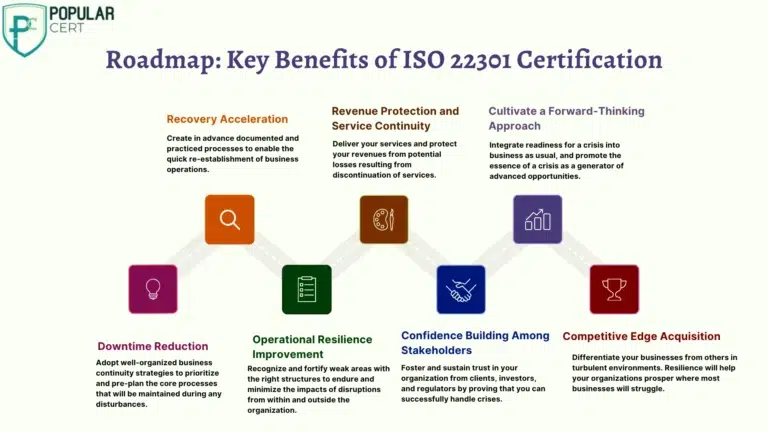
Roadmap: Key Benefits of ISO 22301 Certification
Free ISO 22301 Checklist
Assess compliance, reduce risks, and strengthen your business continuity management.
- Practical & Audit-Ready
- Save Time & Effort
- No Registration Required
How ISO 22301 Strengthens Organizational Preparedness
More than just a standard, ISO 22301 is about building an organization’s culture of operational resilience. Organizations that implement the standard are able to predict impending disruptions, organize their people for immediate action, and ensure uninterrupted execution of essential functions.
In ISO 22301 enhances preparedness in the following ways:
- Risk Anticipation and Impact Analysis
Identifying and evaluating operational impact of risk events, including cyber threats and natural disasters, is critical for organizations. Proactive assessment of risk events and their operational impacts allows organizations to make informed first resource allocation and best critical functions.
- Flexible and Functional Resilience
Classification of business functions and building operational systems with the expectations of trade-off in operational flexibility during periods of stress is best. For example, emergency power systems, outside communication and layered remote work arrangements are a must for seamless continuity.
- Preparedness and Response Training
Preparedness and response training is critical to operational continuity. ISO 22301 Moving forward, organizations must train their people to be operationally aware and define and conduct crisis response drills to allow people to respond with confidence in a disruption.
- Communication and Coordination
In emergency situations, the speed of communication impacts all responding members. This standard outlines communication succession plans and coordination frameworks to maintain clarity and enable the flow of information to staff and clients, thus reducing potential damage to reputation.
- Continuous Improvement
ISO 22301 promotes active engagement; businesses are encouraged to evaluate past incidents and refine processes so that increasing resilience is a continuing objective. With each disruption, the organization builds its strength to meet the next challenge.
Through the above, ISO 22301 helps organizations move from being responsive to having a strategic level of preparedness. This improved state of readiness allows organizations to efficiently manage operational risks in Nigeria, Kenya, Tanzania, and the Philippines.
Why Partner with Popularcert for ISO 22301 Certification
Popularcert offers comprehensive ISO 22301 solutions, from documentation and consultation to certification. With years of experience in Africa and Southeast Asia, we assist organizations in developing sector-specific tailored business continuity plans — from finance and manufacturing to logistics and BPO. Clients enjoy practical training, competitive pricing, and enhanced assistance, ensuring certification success, and establishing a robust operative culture to weather any disruptions.
Conclusion: Turning Uncertainty into Resilience
Cyberattacks, natural disasters and infrastructure failures are all examples of operational risks. Risks are unavoidable, but thriving organizations are able to predict, react and bounce back. Disruptions and uncertainties are part of everyday life. Not every organization can continue to operate in the face of these challenges. For those that can, survival means operational resilience. ISO 22301 Standards provides the structure, tools and confidence every business must have to maintain uninterrupted operations through any disruption. In the complex, uncertain environment of today, operational resilience is more than an advantage, it is a necessity.
FAQ
What is ISO 22301 and why is it important for businesses in Nigeria, Kenya, Tanzania, and the Philippines?
ISO 22301 is the international standard for Business Continuity Management Systems (BCMS). It helps organizations identify risks, minimize downtime, and maintain critical operations during disruptions, from natural disasters to cyberattacks.
How does ISO 22301 reduce financial losses for companies?
By implementing ISO 22301, businesses can plan and test recovery procedures, ensuring operations continue during crises. This significantly reduces revenue losses caused by downtime and protects customer trust.
Which industries benefit the most from ISO 22301 in these countries?
Industries that rely on continuous operations, such as financial services (Kenya), manufacturing and pharmaceuticals (Nigeria), logistics and ports (Tanzania), and BPO/IT services (Philippines), gain the most. However, any organization can enhance resilience through ISO 22301.
How long does it typically take to achieve ISO 22301 certification?
Small to medium enterprises usually complete certification in 3–6 months, depending on size and operational complexity. Large organizations with multiple sites may require longer timelines.
Can ISO 22301 help businesses recover from natural disasters and cyberattacks alike?
Yes. ISO 22301 is designed to handle a broad spectrum of operational risks, including natural disasters, technical failures, cyberattacks, and supply chain disruptions, ensuring organizations remain resilient and operational under pressure.
- Join 1000+ Certified Companies
Ready to Get Certified for Your Next Project?
- Free Consultation
- Expert Guidance
- Fast Turnaround
Reach Us Now