
Learn how ISO 14001 certification helps organizations manage environmental responsibilities, reduce impact, and support sustainable growth—explore with Popularcert here.
From which clause does the implementation starts? ISO 9001– Clause-wise Guidelines
1000+
Successful Projects
10+ Years
Industry Experience
Worldwide
Certification Services
24/7 Support
Expert Consultation

ISO 9001 is intended to be generic and applicable to all organizations, regardless of type, size and product category. It is recognized, however, that not all the requirements of the standard will necessarily be relevant to all organizations.
Table of Contents
Context of the Organization
This clause asks the organization to start by understanding itself and its context before it starts to develop its process-based quality management system (QMS). It asks the organization to consider the external and internal issues that are relevant to its organization’s purpose and strategic direction and to think about the influence these issues could have on its QMS and the results it intends to achieve.
This means that the organization needs to understand its organization’s external environment, its culture, its values, its performance, and its interested parties before developing its QMS. Why? Because the QMS will need to be able to manage all of these influences. Once the organization considered all of this, it will be ready to define the scope of its QMS and to begin its development.
Understanding the organization and its context
This clause asks the organization to start by understanding itself and its context before it starts to develop its process-based ISO 9001 Standard quality management system (QMS). It asks the organization to consider the external and internal issues that are relevant to its organization’s purpose and strategic direction and to think about the influence these issues could have on its QMS and the results it intends to achieve.
This means that the organization needs to understand its organization’s external environment, its culture, its values, its performance, and its interested parties before developing its QMS. Why? Because the QMS will need to be able to manage all of these influences. Once the organization considered all of this, it will be ready to define the scope of its QMS and to begin its development.
What are external and internal parties according to QMS?
To establish the context means to define the external and internal factors that the organizations must consider when they manage risks.
An organization’s external context includes its outside stakeholders, its local operating environment, as well as any external factors that influence the selection of its objectives (goals and targets) or its ability to meet its goals.
An organization’s internal context includes its internal stakeholders, its approach to governance, its contractual relationships with its customers, and its capabilities and culture.
For example, internal context may include, but is not limited to:
Watch our youtube video on clause 4 of ISO 9001 standard
Product and service offerings,
Governance, organizational structure, roles, and accountabilities;
Regulatory requirements;
Policies and goals, and the strategies that are in place to achieve them:
Assets (e.g., facilities, property, equipment and technology:
Employees, there must be availability of people with the motivation to remain as contributing members of the organization and develop the skills necessary to provide a competitive edge;
Capabilities, understood in terms of resources and knowledge (e.g., capital, time, people, processes, systems, and technologies);
Information systems, information flows, and decision-making processes (both formal and informal)
Relationships of the staff and the perceptions and values of their internal stakeholders including suppliers and partners:
Organization’s culture,
Standards, guidelines, and models adopted by the organization; and
Form and extent of the organization’s contractual relationships.
Trending Posts
Get Free Consultation
Our Clients
Projects

Our Happy Clients
⭐⭐⭐⭐⭐
“PopularCert made our ISO certification process smooth and professional.”
— Manufacturing Client, Oman
⭐⭐⭐⭐⭐
“Excellent support and documentation guidance.”
— Healthcare Client, Saudi Arabia
⭐⭐⭐⭐⭐
“PopularCert simplified our ISO certification process with professional guidance and fast support.”
— Manufacturing Client, Saudi Arabia
External context may include, but is not limited to:
Customers:
- Organizations must attract and retain customers by offering products services that meet their needs along with providing excellent customer service
Suppliers:
- Suppliers provide organizations with the resources they need to carry out their activities. Close supplier relationships are an effective way to remain competitive and secure the resources needed
Investors:
- All organizations require investment to grow. Relationships with investors need to be managed carefully as problems can detrimentally affect the long-term success of the organization.
Media:
- Positive media attention can bring success to the organization by maintaining its reputational strength. Managing the media (including the presence in social media) is a challenge.
Competitors:
- Members of the organization need to have a sense of belonging. Can the organization offer benefits that are better than those offered by the competitors? Is there a strong value proposition? Competitor analysis and monitoring is crucial if an organization is to maintain or improve its position in the competitive landscape of the community. The organization must always be aware of its competitor’s activities. The landscape can change quickly.
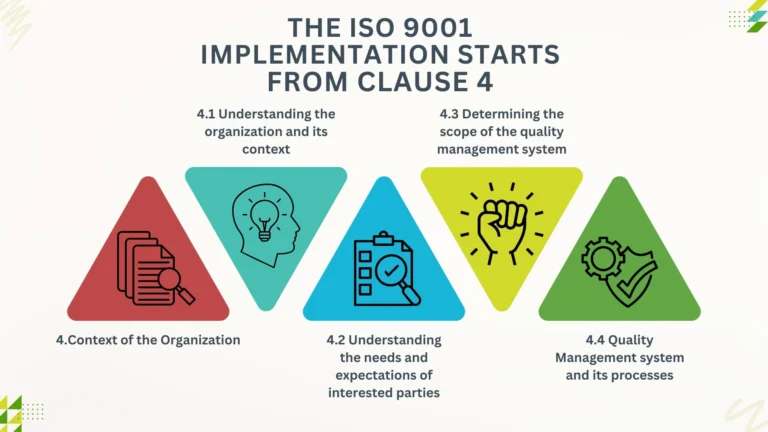
Understanding the needs and expectations of interested parties
The organisation and its stakeholders have a relationship in which each of the parties have needs and expectations of the other.
For example:
The Board of Directors may wish to ensure the organisation makes sufficient profit to return investment to shareholders
A regulator may wish to be satisfied that the organization’s work complies with its rules.
The organisation may expect a trade association to maintain a satisfactory working environment and lobby on its behalf.
An organisation in a chain of supply may expect its customer or supplier to maintain production output and quality standards
An architect will have to design buildings to meet planning and building codes
A structural engineer will use accepted codes of practice to ensure design safety
The organisation could also voluntarily subscribe to policies of Social Responsibility (e.g. ISO 26000) and may adhere to codes of ethics, anti-bribery and employee welfare. The key is to understand the relevant requirements of the relevant interested parties.
Determining the scope of the quality management system
The scope of the quality management system it determined by the organisation. Under the definition of organisation, it can be the whole or part of the entity. The scope of the Quality Management System can therefore be:
An office
A factory
The purchasing department
A logistics function
A cham of shops
A restaurant.
The scope of the organisation will affect its relevant stakeholders and their requirements the interface of the organisation, at its boundaries, needs to be understood, this interface is normally with its customers, internal customers, suppliers and external providers
The requirements of ISO 9001 2015 are generic and, therefore, depending on the scope and the products and services offered by the organisation will have varying degrees of application In ISO 9001 2015, if a requirement can be applied, then it should be. If. for the reason of scope, the requirement cannot be applied, the reason for this needs to be stated.
This is very similar to the “exclusions in ISO 9001 2008 except that, in the 2008 standard, an exclusion can only be applied to clause 7 and its sub-clauses.
As examples of requirements that cannot be applied:
- A burger bar would consider that it does not do any design and that the food it produces is sold on the basis of a self-explicit menu. It might also determine that it has no customer supplied product.
- A company making wooden furniture may not have any need for traceability (e.g. from tree to furniture).
In reality, most companies will only find they’re not applicable requirements in clauses 7 and 8 since the other clauses cover general management activities which, to some degree, have universal applicability.
Where the organisation states this is very much up to the organisation. A documented scope statement might be one way of recording this information but this can also be included in its policy or other document.
Where an organisation “outsources” some parts of work within its scope (e.g. plating, painting, testing, sterilization etc.), these are external suppliers and are controlled in accordance with clause 8.6
Free ISO 9001 Checklist
Assess compliance, reduce risks, and strengthen your quality management system.
- Practical & Audit-Ready
- Save Time & Effort
- No Registration Required
Quality Management system and its processes
QMS Requirement Area | Description / Actions Required |
|---|---|
Purpose of the Clause | Establish a quality management system (QMS) and define the activities required for effective implementation |
Process Inclusion | Ensure all activities from clauses a) to h) are incorporated into the QMS structure |
Process Detail Level | The level of detail depends on process complexity and stability |
Simple Processes | Require only brief and straightforward explanations |
Complex Processes | Need detailed explanations of activities, tasks, and interrelationships for effective implementation |
Define Objectives | Set quality objectives and identify the processes needed to achieve them |
Authority & Responsibility | Establish accountability and responsibilities for managing processes |
Resource Assessment | Understand organizational capabilities and identify resource limitations before implementation |
Process Interdependencies | Analyze how changes in one process affect the overall system |
System Management | Manage interconnected processes efficiently to achieve quality objectives |
Performance Monitoring | Ensure information is available to monitor, analyze, evaluate, and improve processes |
Risk Management | Identify and manage risks that may affect process outputs and QMS effectiveness |
Documentation Requirements | Define processes and maintain records proving outputs meet planned results |
Process Mapping Techniques | Use flowcharts, swim-lane diagrams, graphical methods, or written descriptions to document processes |
Unlock Your Business Potential
Ready to take your organization’s quality management to the next level? Contact PopularCert today to learn more about our ISO 9001 certification services. Let us help you build a culture of quality that drives customer satisfaction and organizational success.
Call us now or visit our website popularcert.com to get started!
Learn how ISO 14001:2015 certification helps organizations manage environmental responsibilities, reduce impact, and support sustainable growth—explore with Popularcert here.
FAQ
From which clause does ISO 9001 implementation begin?
Implementation starts from Clause 4: Context of the Organization. This sets the foundation by analyzing internal/external factors, stakeholders, and process scope.
Why is understanding interested parties important in ISO 9001?
Identifying stakeholders helps align the QMS with expectations like compliance, quality, or responsibility, ensuring the system meets actual business needs.
What does “scope of the QMS” mean?
It defines which parts of the organization are covered by the QMS and what ISO requirements apply. This ensures clarity and focus during implementation
- Join 1000+ Certified Companies
Ready to Get Certified for Your Next Project?
- Free Consultation
- Expert Guidance
- Fast Turnaround
Reach Us Now