
Before the ISO Auditor Arrives: 7 Readiness Gaps Kenyan Businesses Should Check
1000+
Successful Projects
10+ Years
Industry Experience
Worldwide
Certification Services
24/7 Support
Expert Consultation
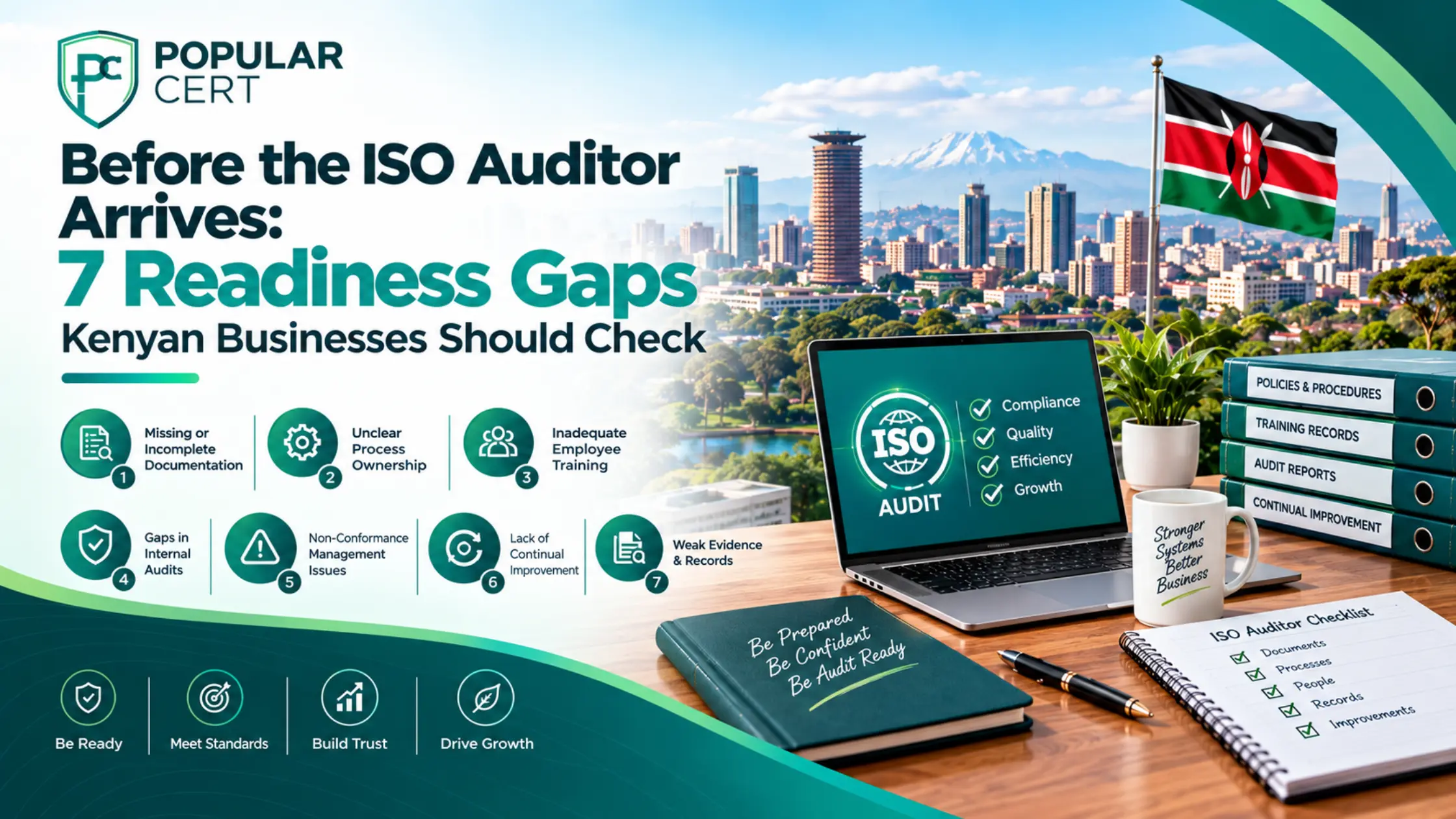
Most ISO audit failures result from small readiness gaps, not poor business practices. Unclear scope, outdated documents, absent management, untrained staff, missing records, skipped internal audits and open corrective actions can affect audit readiness. If you are preparing for ISO Certification in Kenya checking these seven areas early can help reduce delays, control costs and make the certification process smoother.
Table of Contents
Think Like the Auditor for a Moment
An ISO Auditor In Kenya is not there to catch you out. The job is to answer one question: does this business really do what it says it does?
To find out, the auditor looks at three things: what you wrote down, what your people say and what the records prove. When all three match, the audit goes smoothly. When they do not, gaps appear.
So before audit day, try this exercise. Walk through your business as if you were a stranger. Ask staff simple questions. Open a few files. Look for anything that does not line up. That small habit is the heart of this entire blog and it is the same approach a good ISO Consultant In Kenya will use when preparing you.
Gap 1: The Scope Is Vague or Wrong:
- What the auditor notices: Your scope statement says “all activities,” but half your team has never heard of the standard, or a branch is missing from the plan.
- The scope tells everyone which products, services, sites and processes are covered by your ISO Certification in Kenya. If it is unclear, everything after it becomes shaky.
- Quick check: Can you describe your scope in two sentences? Does it list every site and key service?
- How to fix it: Write a clear, honest scope. Include all locations, say what is excluded and give a reason for any exclusion. Share it with your team so everyone understands where the system applies.
Gap 2: Documents Do Not Match Real Work:
- What the auditor notices: The procedure says approvals take two steps, but the staff do it in four. Or the form in the file is an old version.
- This is one of the most common problems. Many companies download a template, change the name and call it done. The paper looks fine, but it does not describe real life.
- Quick check: Ask a staff member to show how a task is done. Compare it with the written procedure.
- How to fix it: Update documents to match actual practice, or change the practice to match a better document. Keep procedures short, simple and easy to follow. A good ISO Consultant In Kenya can help you write documents your team will actually use.
Gap 3: Management Is Not Visibly Involved:
- What the auditor notices: The top manager cannot explain the policy, has not reviewed objectives and is unavailable during the audit.
- ISO standards place real responsibility on leadership. Certification is not something you hand to a junior officer and forget. Auditors want to see that leaders set direction, provide resources and review results.
- Quick check: Does leadership know the quality or safety policy? Are objectives reviewed at least once a year?
- How to fix it: Hold a short leadership briefing before the audit. Make sure managers can explain the policy, the main objectives and their own role. Their presence on audit day also sends a strong message to the whole team.
Top Recent Posts
Get Free Consultation
Our Clients

Projects

Our Happy Clients
⭐⭐⭐⭐⭐
“PopularCert made our ISO certification process smooth and professional.”
— Manufacturing Client, Oman
⭐⭐⭐⭐⭐
“Excellent support and documentation guidance.”
— Healthcare Client, Saudi Arabia
⭐⭐⭐⭐⭐
“PopularCert simplified our ISO certification process with professional guidance and fast support.”
— Manufacturing Client, Saudi Arabia
Gap 4: Staff Cannot Explain Their Role:
- What the auditor notices: When asked “How do you contribute to quality?” an employee goes silent.
- An ISO Auditor In Kenya will speak to people across levels, not only managers. Staff do not need to memorise clauses, but they should know the policy, understand their tasks and know what to do when something goes wrong.
- Quick check: Pick three employees at random and ask: What is our policy? What is your job in the system? What do you do if you find a problem?
- How to fix it: Run short, friendly awareness sessions. Use real examples from daily work. Keep the language simple. When people understand why the system exists, they answer with confidence.
Gap 5: Records Are Missing, Late, or Incomplete:
- What the auditor notices: The training register has blank rows, calibration dates have passed and customer complaints are not logged.
- Records are your proof. A process may run perfectly, but without evidence, the auditor cannot confirm it. In ISO Certification in Kenya, a good record is often more valuable than a long explanation.
- Quick check: Pick any procedure and ask for the last three records it produced. Can you find them in minutes?
- How to fix it: Create simple forms and keep them in one organised place, either paper or digital. Assign someone to review records every month. Never create fake or back-dated records. Auditors can spot them and the damage to trust is serious.
Gap 6: Internal Audit and Management Review Were Rushed:
- What the auditor notices: The internal audit report is a single page with no findings, or the management review happened last week just to “tick the box.”
- These two activities are your dress rehearsal. An internal audit that finds nothing is usually a warning sign, because every system has room to improve.
- Quick check: Was the internal audit done by someone independent of the area checked? Did management review results, complaints, risks and resources?
- How to fix it: Plan the internal audit properly, train your auditors and record real findings. Then hold a genuine management review with action points. A trained ISO Consultant In Kenya can guide the first round so that your team learns how it is done.
Gap 7: Corrective Actions Are Still Open:
- What the auditor notices: The same complaint appears three times in the log and no one has found the root cause.
- Problems are normal. Ignoring them is the real issue. Auditors look for proof that when something goes wrong, you find the cause, fix it and check that it stays fixed.
- Quick check: Review your open issues. Does each one have an owner, a root cause, an action and a closing date?
- How to fix it: Close old items before the audit. For repeat issues, dig deeper than the surface and ask “why” at least three times. This shows the auditor that your system is alive and learning.
7 Common ISO Compliance Gaps and How to Fix Them
Gap | Warning Sign | Quick Fix |
Unclear scope | Missing sites or services | Write a clear scope and share it |
Documents mismatch | Staff do it differently | Update documents to real practice |
Absent management | Leaders cannot explain the policy | Hold a leadership briefing |
Untrained staff | Employees go silent on questions | Run short awareness sessions |
Weak records | Blank rows, old forms | Organise and review monthly |
Rushed audits | No findings, no real review | Plan, train and record properly |
Open actions | Repeat problems | Find root causes and close items |
A Simple 7-Day Countdown
If your ISO audit is approaching, follow this seven-day plan to check readiness and address outstanding issues.
- Day 1: Confirm the audit scope and review the audit plan.
- Day 2: Compare procedures with actual work practices.
- Day 3: Brief management on responsibilities and objectives.
- Day 4: Check employee awareness and provide refresher training.
- Day 5: Organise records and identify missing evidence.
- Day 6: Review open corrective actions and prioritise unresolved issues.
- Day 7: Conduct a final readiness check and organise audit arrangements.
Tip: Start preparing well in advance. Allow enough time to resolve issues properly and never create fake or backdated records to appear audit-ready.
What to Expect on Audit Day with an ISO Auditor in Kenya
Knowing how audit day works removes most of the fear. Here is how it usually runs.
- Opening meeting: The ISO Auditor In Kenya confirms the scope and explains the audit plan. Mention any recent changes in your business.
- Document review and interviews: The auditor checks procedures and speaks with staff at different levels. Answer honestly and simply.
- Site walk-through and records: The auditor observes real work and asks for records such as training logs and complaint files. Keep them easy to find.
- Closing meeting: The auditor explains the findings and any nonconformities identified. The certification body determines the required follow-up.
- After the audit: Once required findings are resolved and the evidence is reviewed, the certification body makes the final certification decision.
Stay calm, be open and with the right ISO Consultant In Kenya beside you, audit day becomes a confident conversation rather than a test.
Why Kenyan Businesses Trust Popularcert
Spotting gaps is one thing. Closing them quickly and correctly is another. This is where the right partner makes a real difference.
Popularcert is a trusted ISO Certification provider that supports Kenyan businesses with practical, well-organised guidance. As an experienced ISO Consultant In Kenya, the team helps you prepare for audit day with clarity and confidence.
Here is what you can expect:
- Honest gap analysis. You see exactly where you stand before the ISO Auditor In Kenya arrives.
- Simple, real-life documents. Procedures are written around how your business actually works.
- Staff training in plain English. Your team learns what matters and why.
- Mock audits. A practice run shows problems early, when they are cheap to fix.
- End-to-end support. From first meeting to final certificate and through surveillance audits afterwards.
- Tailored plans. A small trading firm and a large manufacturer do not get the same approach.
The goal is not only to help you pass. It is to help you build a system that keeps working long after the certificate is framed on the wall.
Final Thoughts
Audit day should not feel like an exam you did not study for. When your scope is clear, your documents are real, your leaders are involved, your staff are confident, your records are tidy, your internal checks are honest and your issues are closed, the ISO Auditor In Kenya will find a business that simply works well.
If you want to walk into that room with confidence, speak with Popularcert. With the right ISO Consultant In Kenya beside you, ISO Certification in Kenya becomes a clear, manageable step that strengthens your business for years to come.
FAQ
How early should we prepare for ISO Certification in Kenya?
Most businesses need a few weeks to a few months, depending on company size, the chosen ISO standard and existing processes. Starting early allows time for documentation, employee training, internal audits and corrective actions before the certification audit.
What does an ISO Auditor in Kenya actually check?
An auditor reviews documents, interviews employees, observes work practices and examines records to verify that the management system meets the applicable ISO standard. They also check whether procedures are followed consistently and whether identified issues are addressed.
Do we need an ISO Consultant in Kenya?
Not always, but first-time applicants often benefit from expert guidance. An ISO consultant can help with gap assessments, documentation, staff training, internal audit preparation and corrective actions, making the certification process more organised.
What if the auditor finds problems?
Auditors may identify nonconformities when requirements are not fully met. The business must address these findings through appropriate corrections and corrective actions, provide supporting evidence and follow the certification body’s process. Certification depends on satisfactory resolution of the findings and fulfilment of the applicable requirements.
- Join 1000+ Certified Companies
Ready to Get Certified for Your Next Project?
- Free Consultation
- Expert Guidance
- Fast Turnaround
Reach Us Now