ISO Certification in Canada

Simplify your path to global compliance. We offer end-to-end consulting, training, and audit support for ISO, HACCP, CE Mark, and a wide range of international standards.

ISO Certification in Canada enhances quality, efficiency, and global trade readiness. Achieve international standards, streamline processes, and strengthen client trust for competitive advantage. Ideal for manufacturers, tech firms, and service providers, ISO certification enhances credibility while reducing risks and costs.

Canada’s strong economy, strategic trade relationships, and reputation for innovation make it an ideal place for businesses to thrive. To succeed in this competitive landscape, companies are increasingly adopting ISO certification to ensure quality, efficiency, and customer trust. The International Organization for Standardization (ISO) provides globally recognized benchmarks that help businesses optimize operations, comply with regulations, and enhance credibility.

For Canadian businesses, ISO certification is a key differentiator, ensuring they meet international expectations while maintaining high standards in industries such as manufacturing, technology, healthcare, and logistics. With PopularCert, a trusted ISO certification provider in Canada, companies can streamline the certification process, implement best practices, and achieve long-term success.

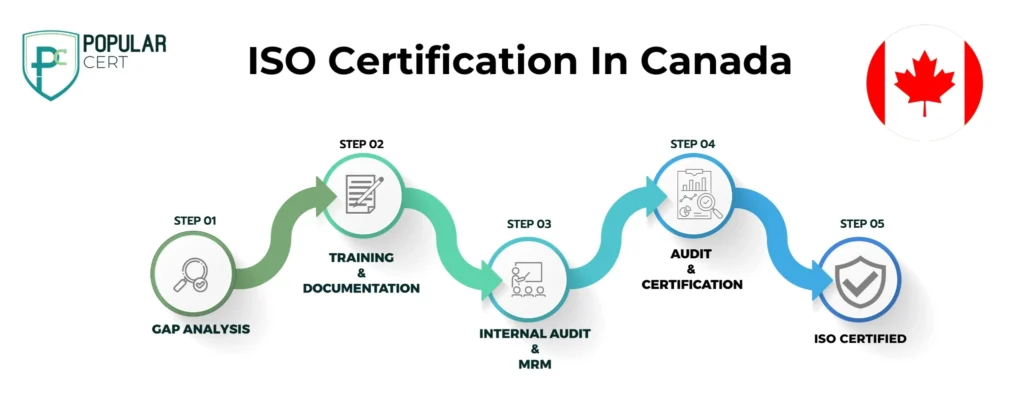
Our ISO Certification Process Explained Step-by-Step

ISO-Certification-in-Canada

Gap Analysis:

This is the diagnostic phase where you compare your current business processes against the specific requirements of the ISO standard you are seeking. The goal is to identify "gaps"—areas where your current practices don't meet the standard—to create a clear roadmap for what needs to change. This ensures that you don't waste resources on parts of your business that are already compliant.

Training & Documentation:

Once the gaps are identified, you must develop the necessary paperwork, such as manuals, policies, and standard operating procedures (SOPs), to formalize your management system. Simultaneously, employees must be trained so they understand their new responsibilities and the importance of following these new procedures. This step is critical for turning the requirements of the ISO standard into daily habits within your organization.

Internal Audit & MRM:

training

Before bringing in an external body, you must perform your own "practice run" known as an internal audit to verify that your new system is working as intended. Following this, a Management Review Meeting (MRM) is held where leadership evaluates the audit results and ensures the system is aligned with the company's strategic goals. These actions prove that the organization is self-correcting and ready for the formal certification audit.

Audit & Certification:

In this stage, a third-party registrar (the Certification Body) conducts an official evaluation of your management system. The auditor reviews your documentation and observes your actual operations to ensure everything matches the ISO requirements. If they find that your system is fully implemented and effective, they will recommend your company for official certification.

ISO Certified:

shield

This is the final milestone where you officially receive your ISO certificate, which is typically valid for three years. Being ISO certified provides a competitive edge in the Canadian market, demonstrating to clients and stakeholders that your business follows internationally recognized best practices. To maintain this status, you will undergo regular surveillance audits to ensure your standards don't slip over time.


Our ISO Certification Process Explained Step-by-Step

Get Free Consultation

Our Clients

Clients-Logo-Images

Our Projects

Projects-Completed-Images

Why Choose PopularCert?

Types Of ISO Certification In Canada

Role of ISO Certification in Canadian Business Growth

ISO certification is more than just a compliance requirement in Canada’s competitive and fast-paced market; it is a driving force behind long-term growth and market leadership. Businesses can meet regulatory requirements, increase efficiency, and obtain a competitive advantage by adhering to globally accepted standards.

Important functions of ISO certification in the success of Canadian businesses:

  • Improving Quality and Consistency: Manufacturers and service providers can maintain consistent quality by lowering errors and improving customer satisfaction with the aid of ISO standards like ISO 9001.
  • Facilitating Market Expansion: Certification satisfies international trade standards, providing access to markets under the USMCA and CETA agreements.
  • Strengthening Data Security: In accordance with Canada’s Digital Charter and privacy laws, ISO 27001 assists Canadian tech companies and service providers in safeguarding sensitive data.
  • Ensuring Industry Compliance: ISO standards that are in line with Health Canada, CFIA, and provincial safety regulations are advantageous to the food, healthcare, and construction industries.
  • Driving Sustainability Goals: By encouraging responsible environmental practices and efficient energy use, ISO 14001 and ISO 50001 help Canada achieve its goal of net-zero emissions by 2050.
  • Enhancing Operational Efficiency: Across all industries, standardized procedures increase productivity, cut expenses, and minimize waste.
  • Gaining the Trust of Clients and Stakeholders: Certification communicates dependability, professionalism, and quality to both domestic and international partners.
Industries That Benefit from ISO Certification in Canada
  • Manufacturing: ISO 9001 (Quality Management) and ISO 14001 (Environmental Management) improve product quality, reduce waste, and enhance operational efficiency.
  • Construction: ISO 45001 (Health & Safety) and ISO 9001 ensure safe work environments and high-quality construction standards, reducing risks and improving project outcomes.
  • Healthcare: ISO 13485 (Medical Devices) and ISO 27001 (Information Security) safeguard patient safety and protect sensitive data, ensuring compliance with regulations.
  • Food & Beverage: ISO 22000 (Food Safety) and HACCP (Hazard Analysis) ensure hygiene, food safety, and traceability, building trust with consumers.
  • IT & Technology: ISO 27001 (Information Security) helps protect sensitive data, ensuring the security of IT systems and reducing cyber risks.
  • Energy & Utilities: ISO 50001 (Energy Management) optimizes energy use, lowers costs, and supports sustainability goals for energy-efficient operations.
  • Logistics & Transportation: ISO 39001 (Road Traffic Safety) improves safety and operational efficiency in transportation, minimizing road accidents and enhancing delivery performance.
  • Education: ISO 21001 (Educational Organizations) improves management systems, ensuring quality education and efficient organizational performance.
  • Hospitality & Tourism: ISO 22483 (Tourism) enhances service quality, ensuring exceptional customer experiences and consistency in hospitality services.
  • Government & Public Sector: ISO 18091 (Local Government) promotes transparency, efficiency, and continuous improvement in government services, building public trust.
  • You may also explore our Canada Certification resources for industry-specific perspectives on ISO implementation.

Request for expert advice

Cost of ISO Certification in Canada

The cost of ISO certification in Canada depends on several factors, including the size of your business, the specific ISO standard required, and the complexity of your processes. ISO certification prices can vary based on whether you’re pursuing ISO 9001, ISO 14001, ISO 27001, or other standards.

At PopularCert, we offer cost-effective solutions designed to meet the unique needs of your business. Our experienced team helps you navigate the entire ISO certification process, from initial assessment to successful certification, ensuring you maximize the value of your investment. ISO certification not only improves operational efficiency but also boosts credibility and customer trust, making it a smart long-term investment for your company.

Why Choose PopularCert for ISO Certification in Canada?

Need experts on ISO Certification in Canada? PopularCert offers ISO certification services for providers in Canada as per your business requirements. Our solutions are strategic and focused to help you attain compliance and improve your operations whether you need ISO 9001, ISO 14001, or ISO 27001.

Reasons why businesses work with us:

  • Consultants guide you to ensure every step of the certification process is completed for service providers in Canada
  • Custom strategies for all sizes of businesses across all industries
  • Fast approval time for the ISO certification
  • Assistance even after the certification is issued for active compliance towards the changes and sustainable improvement practices

With PopularCert, you obtain ISO certification in Canada that gives you international visibility, operational excellence, and increased customer confidence.

FAQ

ISO certification is a globally recognized standard that ensures a company meets high-quality, safety, and efficiency standards. It boosts credibility and opens new business opportunities in Hong Kong.

 The cost varies based on factors like business size, certification type, and complexity. At PopularCert, we offer affordable, tailored solutions to suit your needs.

 The duration depends on your business’s size and the ISO standard you’re pursuing. Typically, it takes a few months to complete the certification process.

 ISO certification improves operational efficiency, boosts customer trust, enhances your competitive advantage, and ensures compliance with international standards.

Yes, ISO certification can benefit small businesses by improving process efficiency, enhancing credibility, and increasing customer satisfaction.

Ready to Get Certified for Your Next Project?

Reach Us Now

Claim Your Free Consultation Today!

New-logo-tiny

Start Your Certification Journey Today

Get Free Consultation and a Clear Roadmap Tailored to your Business