
Hanoi's Blueprint for Brilliance: Navigating ISO Certification in Vietnam's Capital
Simplify your path to global compliance. We offer end-to-end consulting, training, and audit support for ISO, HACCP, CE Mark, and a wide range of international standards.
- 11+ Years Experience
- 30+ Countries Served
In the heart of Vietnam, Hanoi thrives as a city where ancient traditions blend seamlessly with a rapidly modernizing economy. As one of Southeast Asia’s major powerhouses, it has become a hub of opportunity for businesses seeking growth and global recognition.
Today, many enterprises in Hanoi are turning to ISO Certification in Vietnam as a strategic tool to strengthen their operations. This internationally recognized standard helps improve quality, encourage sustainability, and provide a strong competitive edge. Whether it’s businesses rooted in the historic Old Quarter or industries growing in modern parks, ISO certification offers a roadmap for global market access, customer trust, and long-term excellence.
What is ISO Certification, and Why is it Essential for Hanoi's Businesses?
ISO certification is an internationally recognized, third-party validation that an organization, its processes, products, or services meet the rigorous requirements of a specific international standard. Developed and published by the International Organization for Standardization (ISO), these standards are a universal blueprint for excellence, ensuring consistency, safety, and efficiency across a multitude of industries.
For a business in Hanoi, achieving an ISO certificate is more than a simple credential; it’s a powerful statement of commitment. It signals to both domestic and international partners that your organization operates with professionalism and an unwavering dedication to global best practices. This is particularly vital in a market as competitive and fast-growing as Hanoi’s, where building trust and credibility is paramount.
ISO certification fosters a culture of continuous improvement, a philosophy deeply ingrained in successful global enterprises. The Plan-Do-Check-Act (PDCA) cycle, a core principle of many ISO standards, provides a structured methodology for perpetual enhancement. This dynamic process ensures that a certified organization is always assessing its performance, identifying areas for optimization, and implementing effective solutions for greater quality and efficiency. This mindset of perpetual evolution is a powerful catalyst for growth and resilience, particularly in a city where the business landscape is in constant flux.
How to get ISO Certification in Hanoi, Vietnam A step by step roadmap
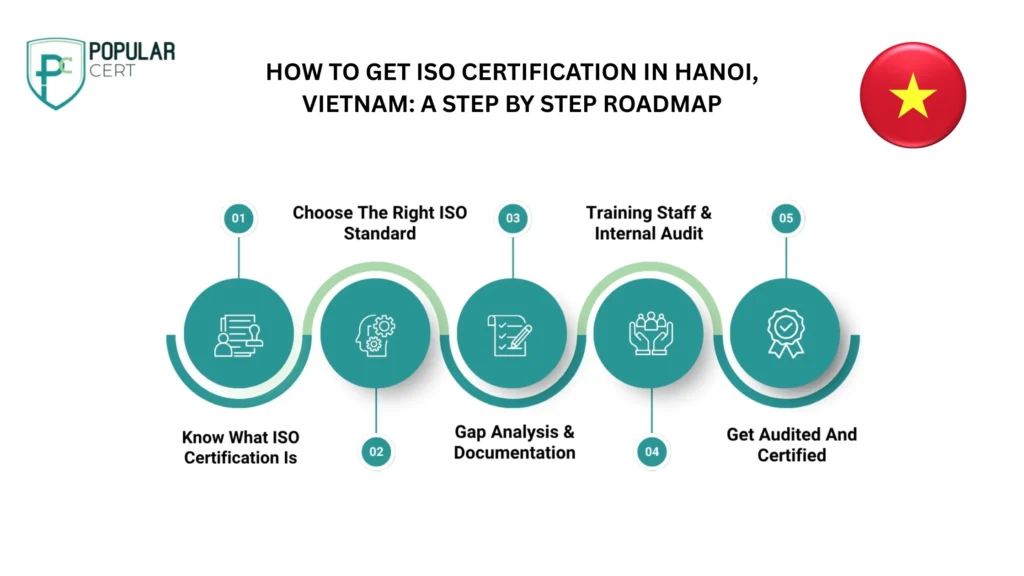
Know What ISO Certification Is

Before starting, it’s important to understand what ISO certification means. ISO standards are internationally recognized frameworks that help organizations ensure quality, safety, efficiency, and compliance. Certification proves that your business follows these standards and meets global best practices.
Choose the Right ISO Standard

Select the ISO standard that aligns with your business goals and industry requirements. For example: ISO 9001 – Quality Management ISO 14001 – Environmental Management ISO 27001 – Information Security Choosing the correct standard ensures relevance and maximum business value.
Gap Analysis & Documentation

Conduct a gap analysis to compare your current processes with the requirements of the chosen ISO standard. Identify areas that need improvement and develop the necessary documentation, such as policies, procedures, and records, to meet compliance requirements.
Training Staff & Internal Audit

Train your employees to understand ISO requirements and their roles in implementation. After implementation, perform an internal audit to evaluate whether your system is effectively meeting the standard and to identify any non-conformities.
Get Audited and Certified

Engage an accredited certification body to conduct the external audit. The process typically includes: Stage 1 Audit: Documentation review Stage 2 Audit: Full system assessment If your organization meets all requirements, you will be awarded ISO certification.
What Are the Most Relevant ISO Standards for Businesses in Hanoi?
Hanoi’s diverse economy, ranging from its bustling Old Quarter to the high-tech industrial parks on its outskirts, requires a variety of specialized standards to ensure peak performance.
ISO 9001: The Cornerstone of Quality Management
ISO 9001 is the most ubiquitous ISO standard globally, serving as the foundational framework for a Quality Management System (QMS). It is a universal standard applicable to any organization, regardless of its size or industry. For a business in Hanoi, from a small family-owned enterprise in the Old Quarter to a major corporation, ISO 9001 is the essential certification that builds customer trust, enhances operational efficiency, and paves the way for sustained success.
It ensures that businesses consistently deliver products and services that meet both customer and regulatory requirements.
Get Free Consultation
Our Clients

Our Projects

Why Choose PopularCert?
- Trusted Global ISO Certification Partner
- Experienced Industry-Focused Consultants
- Complete End-to-End Certification Support
- Fast & Transparent Certification Process
- International Compliance & Audit Readiness
- Dedicated Long-Term Customer Support
Types Of ISO Certification In Vietnam
- ISO Certification In Vietnam
- ISO 9001 Certification in Vietnam
- ISO 14001 Certification in Vietnam
- ISO 45001 Certification in Vietnam
- ISO 22000 Certification in Vietnam
- ISO 27001 Certification in Vietnam
- ISO 17025 Certification in Vietnam
- ISO 13485 Certification in Vietnam
- CE Mark Certification in Vietnam
- ISO 20000-1 Certification in Vietnam
- GMP Certification in Vietnam
- Halal Certification in Vietnam
- SOC-1 Certification in Vietnam
- SOC-2 Certification in Vietnam
Hanoi’s diverse economy, ranging from its bustling Old Quarter to the high-tech industrial parks on its outskirts, requires a variety of specialized standards to ensure peak performance.
ISO 9001: The Cornerstone of Quality Management
ISO 9001 is the most ubiquitous ISO standard globally, serving as the foundational framework for a Quality Management System (QMS). It is a universal standard applicable to any organization, regardless of its size or industry. For a business in Hanoi, from a small family-owned enterprise in the Old Quarter to a major corporation, ISO 9001 is the essential certification that builds customer trust, enhances operational efficiency, and paves the way for sustained success.
It ensures that businesses consistently deliver products and services that meet both customer and regulatory requirements.
ISO 14001: The Guardian of Environmental Stewardship
As a city that is rapidly urbanizing and industrializing, environmental responsibility is a critical concern for Hanoi. ISO 14001 provides a systematic approach for organizations to manage their environmental responsibilities. This standard helps businesses to:
- Minimize their environmental footprint.
- Optimize resource use and reduce waste.
- Comply with environmental regulations.
This is especially crucial for businesses in Hanoi’s industrial and manufacturing sectors, which are under increasing pressure to demonstrate responsible environmental stewardship to both the government and global partners. It is also highly relevant for tourism and hospitality, ensuring the preservation of the city’s natural and cultural beauty. The DEEP C Industrial Park Complex, for instance, has demonstrated its commitment to sustainability with ISO 9001 and ISO 14001 Certifications for its wastewater treatment plant, setting a powerful example for other industrial zones.
ISO 45001 – The Sentinel of Occupational Health and Safety:
The health and safety of employees are non-negotiable. ISO 45001 is a vital standard for any business committed to providing a safe and healthy workplace. It helps organizations proactively identify and control occupational health and safety risks, reduce workplace accidents and illnesses, and improve overall safety performance. This is particularly critical in high-risk industries like construction and manufacturing, and within industrial parks like Yen Phong II Industrial Park and VSIP Industrial Park, where the well-being of a large workforce is a top priority.
ISO 27001 – The Fortress of Information Security:
In today’s interconnected digital world, data is a valuable asset and a potential vulnerability. ISO 27001 provides a robust framework for establishing, implementing, and continually improving an Information Security Management System (ISMS). This is essential for Hanoi’s businesses that handle sensitive data, such as financial institutions, technology startups, and government agencies, protecting them against cyber threats and data breaches.
ISO 22000 – The Guarantee of Food Safety:
Hanoi’s distinct and celebrated Vietnamese cuisine, from the world-famous phở to the savory bún chả, is a cornerstone of its culture and economy. ISO 22000 is the international standard for food safety management systems. It provides a framework to manage food safety risks from “farm to fork,” ensuring products are safe for consumption and comply with international food safety standards. This builds consumer confidence and facilitates both domestic and international trade for the city’s restaurants, street food vendors, and food processing plants
Industries in Hanoi That Benefit Most from ISO Certification
Hanoi has a fast-growing and diverse economy, with industries ranging from manufacturing and technology to tourism and hospitality. In this competitive environment, ISO certification helps businesses improve operational efficiency, strengthen quality management, and meet international expectations. Companies across multiple sectors in Hanoi use ISO standards to enhance credibility, manage risks, and build trust with global partners.
- Manufacturing and Industrial Parks
Manufacturing companies operating in major industrial zones such as Yen Phong and VSIP rely on standards like ISO 9001, ISO 14001, and ISO 45001 to improve product quality, manage environmental impact, and maintain strong workplace safety practices. These certifications help factories streamline production processes and meet international supply chain requirements. - Technology and IT Services
Hanoi’s expanding tech ecosystem includes startups, software developers, and IT service providers. Many of these companies implement ISO 27001 to protect sensitive data, strengthen cybersecurity practices, and ensure secure information management for clients and partners. - Food and Hospitality Businesses
Restaurants, food processing companies, and hospitality providers benefit from ISO 22000 food safety management systems. This standard helps organizations maintain strict hygiene practices, control food safety risks, and consistently deliver safe, high-quality products to customers. - Tourism and Travel Services
Tour operators and tourism businesses in Hanoi often adopt sustainability and management standards to support responsible tourism. These frameworks help protect cultural heritage sites, improve service quality, and promote environmentally responsible travel experiences.
By implementing the right ISO standards, businesses in Hanoi can improve operational performance, meet international compliance requirements, and strengthen their reputation with customers, investors, and global partners.
How Can ISO Standards Help Preserve and Promote Hanoi's Unique Cultural and Natural Heritage?
Hanoi is a city of layers, where ancient pagodas stand alongside modern skyscrapers. Its rich cultural heritage and proximity to stunning natural landscapes make ISO standards a powerful tool for sustainable tourism and cultural preservation.
The Imperial Citadel of Thăng Long & The Temple of Literature:
These iconic landmarks can leverage ISO standards to ensure a world-class visitor experience while preserving their historical integrity.
- ISO 9001 can be applied to the management of visitor services, ensuring a consistent and high-quality experience from ticketing and guided tours to safety and accessibility.
- ISO 45001 is crucial for ensuring the health and safety of both staff and the millions of tourists who visit these sites annually, managing crowd control and maintaining safe walkways.
- ISO 14001 can be used to manage the environmental impact of such a high volume of visitors, from waste management to preserving the surrounding flora.
Ha Long Bay and Ninh Binh:
Hanoi serves as a major gateway to UNESCO World Heritage Sites like Ha Long Bay and the scenic landscapes of Ninh Binh. For ecotourism operators and tour companies, ISO standards provide a framework for responsible operations.
- ISO 14001 helps organizations minimize their environmental impact by managing waste, reducing resource consumption, and protecting the delicate biodiversity of these areas.
- ISO 20121 (Event Sustainability Management Systems) can be applied to large-scale events and festivals held in these regions, providing a framework for organizers to manage the social, economic, and environmental impacts, ensuring a positive legacy.
- ISO 21401 (Sustainable Management System for Tourism Organizations) is a specific standard that helps tourism businesses achieve economic, social, and environmental sustainability. It ensures that activities contribute positively to local communities, preserve the natural environment, and offer an authentic and educational experience for visitors.
By applying these standards, Hanoi’s tourism sector can not only attract more visitors but also ensure that its most cherished natural and cultural assets are protected for future generations.
What are the Typical Hurdles to Certification, and How Can PopularCert Help?
While the benefits of ISO Certification are clear, the path to achieving it can present challenges, especially for businesses in Hanoi. we have extensive experience in helping Vietnamese businesses navigate these common obstacles.
How Do Businesses Overcome Resource Constraints?
Small and medium-sized enterprises (SMEs) are the lifeblood of Hanoi’s economy, but they often face constraints in time, money, and manpower. We address this with scalable, cost-effective solutions. We help you optimize your existing resources and focus on high-impact changes first, ensuring that your investment delivers tangible results without straining your budget. Our approach makes the process accessible and beneficial for organizations of all sizes.
What if a Company Lacks Awareness or Understanding of ISO?
A lack of awareness about the true value of ISO can be a significant barrier. We provide comprehensive awareness training and initial consultations to educate leadership and employees on the benefits, process, and practicalities of ISO. We transform a perceived burden into a shared goal, fostering a company-wide commitment to quality and excellence. We help you build a culture of continuous improvement from the ground up.
How is the Documentation Burden Managed?
The extensive documentation required by some ISO standards can be daunting. We provide streamlined documentation templates and hands-on assistance, making the process efficient and tailored to your organization’s specific needs, avoiding unnecessary bureaucracy. We believe in practical and functional management systems that are easy to implement and maintain, not just complex paper trails.
By proactively addressing these hurdles, we ensure that businesses in Hanoi can successfully navigate the ISO certification process, not only meeting international standards but also truly thriving and achieving sustainable growth in their dynamic and promising market.
What is the Cost of ISO Certification in Hanoi?
The cost of ISO certification in Hanoi varies depending on several factors, as every organization has different operational needs and certification requirements. There is no fixed price because the certification process is tailored to the size and structure of each business.
Key factors that influence the cost include:
- Size of the organization
- Number of employees
- Selected ISO standard
- Business complexity
- Number of operational locations
Generally, small businesses require a lower investment, while larger organizations with multiple departments or branches may have higher certification costs. Working with experienced consultants can help businesses implement ISO standards efficiently while keeping the certification process cost-effective.
Why is PopularCert the Preferred Choice for ISO Certification in Hanoi?
Achieving ISO Certification is a strategic investment that can bring significant, long-term benefits to your business in Hanoi. By partnering with PopularCert, you gain a committed partner that will guide you through every step of the certification journey with expertise, integrity, and a client-focused approach.
We understand the unique business landscape of Hanoi, from its bustling industrial areas to its vibrant cultural and commercial hubs. Our team of experts is dedicated to simplifying the process, helping you unlock the multitude of benefits that ISO certification offers. Whether you are a manufacturing company in a major industrial park like Yen Binh Industrial Park, a tech startup, a food business, or a tourism operator, we have the specialized knowledge to meet your needs.
Don’t wait to unlock the numerous advantages of ISO certification. Contact PopularCert today for a free consultation and discover how we can help your Hanoi organization achieve global recognition, secure a competitive advantage, and build a reputation for excellence that will last for years to come. Let us be your trusted partner in your pursuit of excellence.
FAQ
What is ISO Certification and why is it important for businesses in Hanoi?
ISO Certification is a globally recognized accreditation that validates an organization’s management system, confirming it meets rigorous international standards for quality, safety, efficiency, or other areas. For businesses in Hanoi, obtaining ISO certification is a strategic move that helps them improve operational efficiency, enhance customer satisfaction, and gain a competitive edge in both the local and international markets. It’s not just a certificate; it’s a framework for continuous improvement that can lead to increased profitability and a stronger market position.
Which are the most common ISO standards for companies in Hanoi?
While there are over 23,000 ISO standards, the most dominant ones for businesses in Hanoi are:
- ISO 9001 (Quality Management System): This is the most widely adopted standard and focuses on ensuring consistent product and service quality. It’s essential for industries like manufacturing and services.
- ISO 14001 (Environmental Management System): This standard helps organizations manage their environmental impacts, reduce waste, and improve resource efficiency. It is particularly important for manufacturing and construction.
- ISO 45001 (Occupational Health & Safety Management System): This standard protects worker well-being and helps prevent workplace injuries and illnesses, making it crucial for companies in construction and manufacturing.
- ISO/IEC 27001 (Information Security Management System): This is vital for companies that handle sensitive data, such as those in IT, finance, and telecommunications, as it helps secure data and manage information risks.
How much does ISO certification cost and how long does it take in Hanoi?
The cost and duration of ISO certification vary significantly depending on several factors:
- Company Size and Complexity: Larger companies with more complex processes will have a higher cost and a longer timeline.
- Chosen Standard: The specific ISO standard you pursue can affect the cost and time.
- Consultant Services: Hiring an ISO consultant to guide you through the process will add to the cost but can significantly reduce the duration and stress of the project.
- Certification Body: Fees from the accredited certification body for the audit and certificate issuance are a key part of the total cost.
Typically, the process can range from 3 to 6 months, and costs can vary widely. It’s best to get a customized quote from several local ISO consultants in Hanoi to get an accurate estimate for your business.
What are the main steps for getting ISO certified in Hanoi?
The ISO certification journey involves a structured process:
- Preparation and Planning: Define your objectives, choose the appropriate ISO standard, and get top management support. Consider doing a gap analysis to see how your current systems align with the standard’s requirements.
- System Development and Implementation: Create and document a management system (e.g., a Quality Management System for ISO 9001) that meets the standard. This involves developing policies, procedures, and training for your staff.
- Internal Audit and Review: Conduct an internal audit to evaluate the effectiveness of the implemented system and make any necessary adjustments. The management team should also review the system’s performance.
- External Audit: An independent, accredited certification body will perform an audit of your management system. If you pass, you’ll be awarded the ISO certificate.
- Surveillance Audits: To maintain your certification, you’ll need to undergo annual surveillance audits to ensure ongoing compliance and continuous improvement.
- Join 1000+ Certified Companies
Ready to Get Certified for Your Next Project?
- Free Consultation
- Expert Guidance
- Fast Turnaround
Reach Us Now
Claim Your Free Consultation Today!