
Does ISO Certification Increase Customer Trust in a QMS (Quality Management System)?
1000+
Successful Projects
10+ Years
Industry Experience
Worldwide
Certification Services
24/7 Support
Expert Consultation
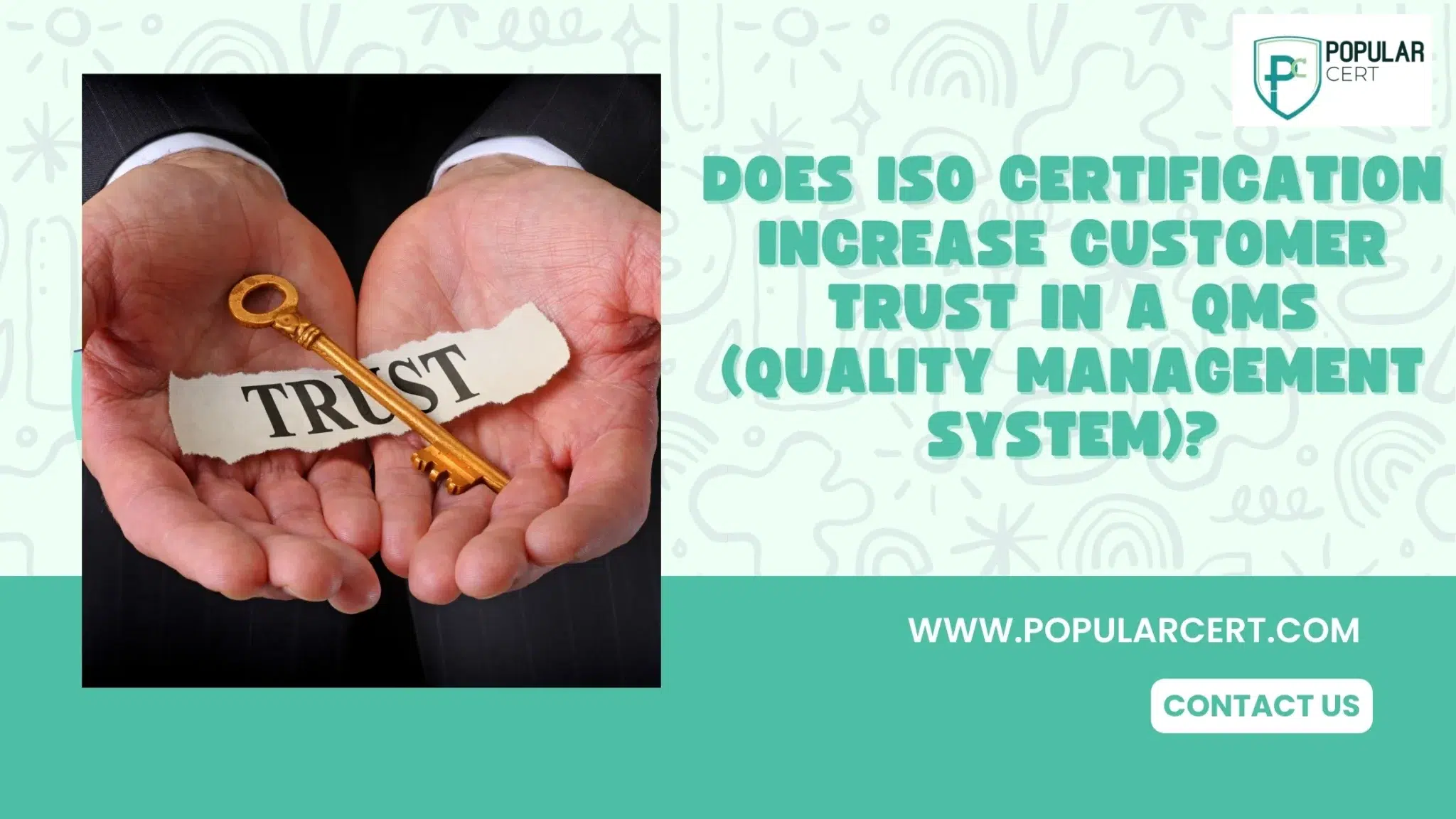
When customers choose a brand, they’re not just buying a product or service they’re buying trust. Trust that the chair won’t collapse, the software won’t leak data, or the hospital won’t run out of safe medical supplies.
In an era of global competition and instant reviews, Quality Management Systems (QMS) are no longer optional they are essential. But customers rarely get to see internal processes. So how do they know a company is truly committed to quality?
That’s where ISO certification comes in. Particularly, ISO 9001 for QMS has become the global trust seal. It’s proof that an organization’s quality promise is not just words it’s backed by structured systems, independent audits, and continuous improvement.
But does ISO certification really increase customer trust? Let’s explore through data, psychology, and real-world examples.
Table of Contents
Section 1: The Trust Gap in Modern Business
- Customers are skeptical. A 2023 Edelman Trust Barometer survey showed thatconsumers distrust corporate claims without third-party proof.
- Competition is fierce. Businesses now compete not only locally but globally. A customer in Kenya may choose a supplier from Dubai or Germany with a single click.
- Mistakes travel fast. One defective product or poor service review can spread across social media, eroding trust instantly.
ISO certification closes this gap by giving customers external assurance that your QMS is built on global standards.
Section 2: Storytelling – Two Companies, Two Outcomes
Picture two manufacturers in the same sector:
Company A: Runs a QMS internally but without ISO certification. They insist their products are reliable but provide no independent proof. Customers hesitate, asking: “How do I know?”
Company B: Holds ISO 9001 certification. Their QMS is externally verified, they display certification on their website and proposals, and they share audit results transparently.
In procurement tenders, Company B wins repeatedly because ISO acts as an instant credibility filter.
Section 3: How ISO Certification Builds Customer Trust in QMS
Independent Validation
- Trust rises when customers see that a neutral third party (certification body) verifies the company’s claims.
Standardized Processes
- ISO 9001 requires companies to document and standardize how work is done, ensuring repeatable, reliable outcomes. Customers know what to expect.
PDCA Cycle – Continuous Improvement
- The Plan-Do-Check-Act cycle ensures companies are not stagnant. Customers prefer organizations that evolve with feedback.
Global Recognition
- ISO is accepted in over 160 countries. For cross-border clients, certification reduces the perceived risk of choosing foreign suppliers.
Transparency & Traceability
- ISO-certified QMS emphasizes records and evidence. If something goes wrong, there’s traceability customers trust companies that are accountable.
Trending Posts
Get Free Consultation
Our Clients

Projects

Our Happy Clients
⭐⭐⭐⭐⭐
“PopularCert made our ISO certification process smooth and professional.”
— Manufacturing Client, Oman
⭐⭐⭐⭐⭐
“Excellent support and documentation guidance.”
— Healthcare Client, Saudi Arabia
⭐⭐⭐⭐⭐
“PopularCert simplified our ISO certification process with professional guidance and fast support.”
— Manufacturing Client, Saudi Arabia
Section 4: Data that Proves the Trust Factor
- A certified companies reported improved customer satisfaction post-ISO (BSI survey).
- Companies with ISO 9001 likely to win international contracts (PWC study).
- Customer retention rates are consistently higher in ISO-certified firms due to reliability.
This data makes it clear: ISO is not just paperwork; it’s a trust multiplier.
Section 5: SWOT Analysis – ISO Certification & Customer Trust
Strengths | Weaknesses |
Proven credibility | Cost of certification |
Consistency & reliability | Requires documentation discipline |
Global recognition | Needs regular audits |
Competitive advantage | Time-consuming initially |
Opportunities | Threats |
Access to larger contracts | Misuse of ISO logo without compliance |
Expansion into new markets | Losing certification damages reputation |
Improved customer loyalty | Competitors also getting certified |
Section 6: Psychological Triggers Behind Trust
Why do customers trust ISO? Psychology explains it:
- Authority Bias: Customers trust experts and recognized authorities—ISO fits this role.
- Risk Reduction: Certification reduces perceived risk in purchasing decisions.
- Social Proof: Seeing ISO logos signals that other reputable firms comply too.
- Consistency Bias: People trust systems that deliver predictable outcomes.
ISO taps into all these biases, making it a shortcut to trust.
How ISO Certification Influences Customer Buying Decisions
In many industries, customers compare multiple suppliers that offer similar products, pricing, and delivery capabilities. In such situations, trust often becomes the deciding factor. ISO certification helps organizations stand out by demonstrating that their quality management system has been independently assessed against internationally recognized standards.
For procurement teams, ISO certification reduces uncertainty when selecting suppliers because it provides evidence of consistent processes and quality controls. For consumers, it signals professionalism, accountability, and a commitment to continuous improvement. As a result, certified organizations often experience stronger customer confidence, improved business relationships, and greater success in competitive tenders where trust and reliability are critical evaluation factors.
Section 8: Objections & How ISO Overcomes Them
Customer Objection | ISO Certification Response |
How do I know your processes are reliable? | Independent ISO audit ensures compliance. |
What if your system fails? | ISO requires corrective actions and root cause analysis. |
Do you actually improve, or stay the same? | PDCA cycle enforces continuous improvement. |
What if you’re hiding mistakes? | ISO demands documented evidence and transparency. |
Section 9: PopularCert’s Role – Turning Certification into Trust
Many companies get certified but fail to leverage it for customer trust. PopularCert consultants help organizations:
- Prepare audit-ready QMS documentation.
- Train teams to adopt customer-first practices.
- Guide through remote or in-person audits.
- Support in marketing ISO certification as a trust signal.
With us, ISO isn’t just a certificate, it’s a business growth tool.
Section 10: Future of ISO & Customer Trust in the Digital Age
- AI-powered compliance tools will make ISO monitoring real-time.
- Blockchain traceability may reinforce transparency in QMS.
- Remote audits will make certification accessible for SMEs worldwide.
- Customer trust will increasingly depend on visible ISO alignment, especially in regulated sectors.
Conclusion: ISO as a Trust Multiplier
Customer trust is the most valuable asset a business can earn. ISO certification strengthens that trust by providing independent proof of quality, reliability, and transparency. For businesses running a QMS, certification is more than a checkbox it’s a strategic investment in credibility. With PopularCert consultants, you can turn ISO certification into a powerful trust-building and contract-winning tool.
FAQ
Do customers really care about ISO certification?
Yes. In government, corporate, and export contracts, it’s often mandatory.
Does ISO 9001 guarantee customer trust?
It doesn’t guarantee—but it strongly boosts trust by proving global compliance.
Which ISO standards affect customer trust the most?
ISO 9001 (quality), ISO 27001 (security), ISO 22000 (food safety), ISO 45001 (safety).
Is ISO certification only for big companies?
No. SMEs and freelancers benefit equally by showing structured, reliable processes.
- Join 1000+ Certified Companies
Ready to Get Certified for Your Next Project?
- Free Consultation
- Expert Guidance
- Fast Turnaround
Reach Us Now