
ISO Certification in Iran
Simplify your path to global compliance. We offer end-to-end consulting, training, and audit support for ISO, HACCP, CE Mark, and a wide range of international standards.
- 11+ Years Experience
- 30+ Countries Served
For Iranian businesses looking to grow, ISO certification in Iran has shifted from a nice-to-have to a must-have. It’s a practical tool that strengthens how you manage quality, safety, the environment, and information security against internationally accepted standards. As more companies in Iran step into regional and global markets, this certification has become a key strategic move, not just paperwork.
Whether you’re in manufacturing, oil and gas, IT, healthcare, construction, or food processing, ISO standards give your team a clear framework to work from. This builds consistency, boosts your credibility, and gives you and your clients confidence that you can meet both local and international regulations.
At PopularCert, we work with organizations from Tehran and Isfahan to Tabriz, Mashhad, and industrial parks nationwide. We provide straightforward, practical ISO certification services designed for Iran’s unique business and regulatory landscape, so you’re genuinely ready for the audit.
Understanding What ISO Certification Really Is
In simple terms, ISO certification is a formal stamp of approval. It means an independent body has verified that your company’s management system meets specific international standards set by the International Organization for Standardization (ISO). These standards are essentially global best-practice manuals for managing your core operations.
Domestically, Iran’s own national standards are set and maintained by the Iran National Standardization Organization (INSO), which works alongside international ISO frameworks many Iranian businesses pursue both INSO compliance for domestic requirements and ISO certification for international market credibility.
At its heart, certification shows you run a systematic operation, you’re proactive about risk, and you’re committed to getting better over time.
ISO Certification and International Sanctions: What Iranian Businesses Need to Know
International sanctions on Iran affect the certification landscape in practical ways businesses should understand before starting the process. Some major Western-headquartered certification bodies limit or restrict operations in Iran due to sanctions compliance requirements, which can affect which accredited certification bodies are practically accessible. This doesn’t mean ISO certification is unavailable accredited certification bodies do operate in and serve Iran but it does mean businesses, especially exporters, should confirm upfront which certification body they’re working with, whether that body’s accreditation is genuinely recognized by their target export markets, and whether sanctions affect any specific aspect of the audit or certification process for their industry. We help clients navigate these practical realities as part of the initial consultation, rather than discovering complications midway through the process.
How to get ISO certified in Iran?
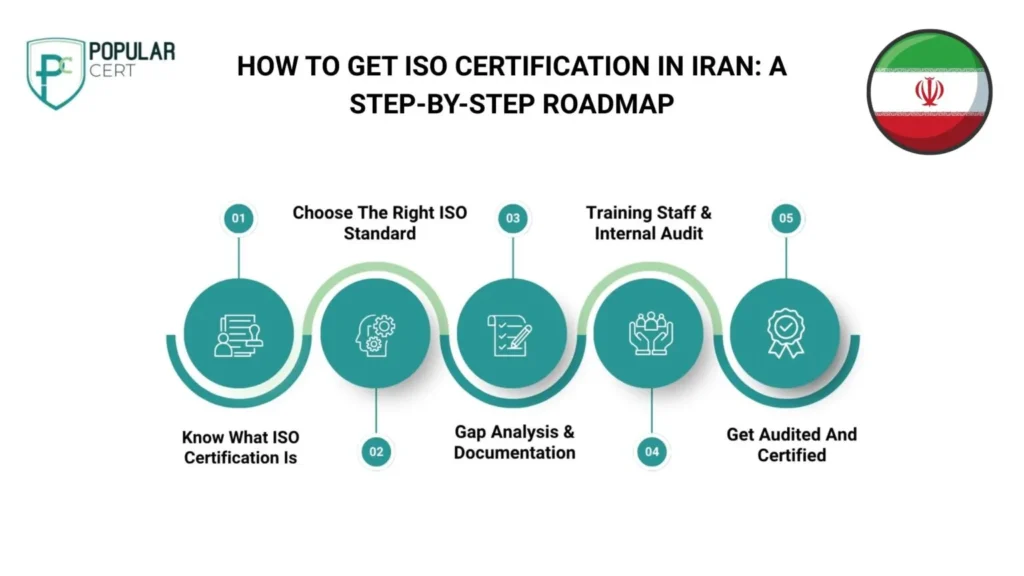
Know What ISO Certification Is

ISO certification is an internationally recognized seal of approval from the International Organization for Standardization. It demonstrates that a company’s management system, manufacturing process, service, or documentation procedure has all the requirements for standardization and quality assurance. For an Iranian business, this means aligning operations with global best practices to improve efficiency and customer satisfaction.
Choose the Right ISO Standard

There are many different ISO standards tailored to specific industries and needs. A business must identify which one aligns with its goals; for example, ISO 9001 focuses on quality management, ISO 14001 on environmental impact, and ISO 27001 on information security. Selecting the appropriate standard ensures that the certification process directly benefits the company’s specific operational focus.
Gap Analysis & Documentation

A gap analysis involves comparing the company’s current processes against the requirements of the chosen ISO standard. Once the "gaps" are identified, the business must create the necessary documentation, including policies, procedures, and manuals. This stage is crucial for building a framework that meets the rigorous criteria required for official certification.
Training Staff & Internal Audit

For a management system to be effective, employees must be trained on the new ISO-compliant procedures. Following training, the company conducts an internal audit—a "practice run" to ensure everything is working as intended. This internal check helps identify any remaining weaknesses or non-conformities before the final, official assessment.
Get Audited and Certified

The final step is the external audit, conducted by an independent, accredited certification body. These auditors will review the company's documentation and processes to verify full compliance with the ISO standard. If the business successfully passes this audit, it is officially awarded the ISO certification, which typically requires periodic renewals to maintain.
Get Free Consultation
Our Clients

Our Projects

Why Choose PopularCert?
- Trusted Global ISO Certification Partner
- Experienced Industry-Focused Consultants
- Complete End-to-End Certification Support
- Fast & Transparent Certification Process
- International Compliance & Audit Readiness
- Dedicated Long-Term Customer Support
Types Of ISO Certification In Iran
- ISO Certification In Iran
- ISO 9001 Certification in Iran
- ISO 14001 Certification in Iran
- ISO 45001 Certification in Iran
- ISO 22000 Certification in Iran
- ISO 27001 Certification in Iran
- ISO 17025 Certification in Iran
- ISO 13485 Certification in Iran
- CE Mark Certification in Iran
- ISO 20000-1 Certification in Iran
- GMP Certification in Iran
- Halal Certification in Iran
- SOC-1 Certification in Iran
- SOC-2 Certification in Iran
The Road to Certification in Iran: A Step-by-Step View
- Initial Chat & Gap Analysis
We start by sitting down with you (virtually or in-person) to understand your current processes. We then compare them to the ISO requirements to identify the gaps. This gives us a clear, practical roadmap—no surprises. - Building Your System & Paperwork
We help you develop the necessary policies and procedures. The key here is to document what you actually do, not create a complex parallel system. We keep it lean and useful. - Getting Your Team On Board
Your people run the system. We provide targeted training for both management and staff to ensure everyone understands their role and takes ownership. - Checking Your Work: Internal Audit & Review
Before any external auditor arrives, we guide you through an internal audit to test the system. Then, we facilitate a management review to ensure everything aligns with your business goals. - The Final Hurdle: External Audit & Certification
An accredited certification body conducts the official audit. We stand by you through this process. Once any minor findings are resolved, you receive your ISO certificate.
What We Actually See in Iranian Companies?
Having worked on projects from Tehran to Tabriz, we know most Iranian businesses already have solid quality and safety practices on the ground. The real hurdle usually isn’t how the work gets done.
The gap is almost always in three areas: document control, running formal internal audits, and holding structured management reviews. In our experience, fixing just these three areas addresses over 70% of audit findings. This means certification is far more achievable than many business owners think, without upending your daily operations.
A Quick Look at Common Standards in Iran
Standard | Best For |
|---|---|
ISO 9001 | Any business wanting consistent quality and happier customers. |
ISO 14001 | Managing environmental obligations and reducing your footprint. |
ISO 45001 | Building a stronger safety culture and protecting your team. |
ISO 27001 | Protecting client data and securing your IT infrastructure. |
ISO 22000 | Essential for food safety and preparing for export markets. |
ISO 50001 | Optimizing energy use in heavy industries. |
ISO 22301 | Ensuring your business can weather operational disruptions. |
Many clients combine several standards into one Integrated Management System (IMS) to save time, money, and effort.
A Real-World Example: ISO 27001 for a Tehran Tech Firm
- Industry: IT and Software Services
- Location: Tehran
- The Challenge: They were losing major enterprise contracts because potential clients doubted their data protection and risk management controls.
- Our Approach: We did a full assessment, built realistic documentation and risk plans, trained their internal auditors, and prepped them thoroughly for the external audit.
- The Result: They achieved ISO 27001 certification in under 10 weeks via an accredited body. All audit findings were closed within 10 working days. Most importantly, they now bid for and win contracts that were previously out of reach.
- In Their Words: ISO 27001 changed our approach to security. PopularCert made a complex process clear and practical for our team.” IT Security Lead, Tehran-based software company
Which Industries in Iran Benefit the Most?
While helpful to nearly everyone, we see exceptional value in:
- Manufacturing & Industrial Production
- Oil, Gas & Petrochemicals
- Food Processing & Agriculture
- Healthcare & Pharmaceuticals
- Construction & Engineering
- Information Technology & Data Services
- Logistics & Export-Oriented Businesses
Each sector uses ISO to strengthen control, ensure compliance, and gain that critical international recognition.
ISO Certification and Export Opportunities for Iranian Businesses
Many businesses in Iran are looking for opportunities to sell their products and services in international markets. However, buyers and business partners often want proof that a company follows recognised quality, safety, or management practices before starting a business relationship. This is where ISO certification can be helpful.
ISO certification shows that a company follows internationally accepted standards and has proper systems in place to manage its operations. This can help build trust with customers, suppliers, distributors, and business partners in different countries.
For manufacturers, food producers, engineering companies, and exporters, ISO certification can make business discussions smoother and improve confidence among potential clients. It also helps companies maintain consistent quality and improve their overall performance. As more Iranian businesses explore regional and international markets, ISO certification is becoming an important step towards long-term growth and business expansion.
Common Challenges Iranian Companies Face During ISO Certification
Managing Documentation Requirements
- One of the most common challenges businesses face during ISO certification is documentation. Many companies already have good systems in place, but their processes are not always properly documented according to ISO requirements. Creating clear policies, procedures, and records is often one of the first steps towards certification.
Employee Awareness and Training
- Successful ISO implementation requires the involvement of employees at all levels. Some organizations face challenges because employees are unfamiliar with ISO requirements or do not fully understand their responsibilities. Regular training and awareness programs help employees follow processes correctly and support the certification journey.
Internal Audits and Continuous Improvement
- Many companies find internal audits and management reviews challenging when they begin the certification process. These activities are important because they help identify gaps and ensure that systems continue to perform effectively. With proper planning and guidance, organizations can use audits as a valuable tool for ongoing improvement.
Overcoming Challenges with the Right Support
- Most certification challenges can be resolved with the right approach and expert guidance. A structured implementation plan, employee involvement, and regular monitoring can make the certification process smoother and help businesses achieve ISO certification successfully while improving their overall operations.
What Does ISO Certification Cost in Iran?
This is the most common question, and the honest answer is: it depends. The cost is influenced by:
- Your organization’s size and number of employees.
- Which standard(s) you choose.
- The complexity and risk level of your operations.
- How mature your existing systems are.
- The scope of certification and required audit days.
At PopularCert, we believe in transparent, cost-effective pricing tailored for both Iranian SMEs and larger enterprises. We’ll give you a clear quote upfront.
Why Iranian Organizations Choose PopularCert?
We’re not just another consultant. We’re a partner with on-the-ground experience in the Iranian market. Here’s what that means for you:
- End-to-end support from day one to certification day.
- Industry-specific knowledge you can actually use.
- Access to accredited certification pathways.
- Practical documentation designed to pass audits.
- Flexible on-site and remote support options.
- Clear timelines and realistic plans you can stick to.
We don’t just help you get a certificate; we help you build a management system that actually works for your business.
Ready to Take the Next Step?
ISO certification is one of the most effective ways to strengthen your business’s foundation, improve performance, and unlock new doors in Iran and beyond. Get a consultation today and let’s map out the most efficient path to certification for you.
FAQ
What is ISO certification, and why does my company in Iran need it?
It’s independent proof that your management systems meet global standards. In Iran, it’s increasingly a prerequisite to be taken seriously by major buyers, to comply with regulations, and to access new markets.
Which industries in Iran should get certified?
Virtually all! Manufacturing, IT, food, healthcare, logistics, and construction see particularly strong returns on investment through improved credibility and operational control.
How much does it cost?
It varies based on your company’s specific details. The only way to get an accurate number is through a consultation. We provide free, customized estimates with no obligation.
How do I start the process?
It begins with a conversation. Contact us for a free gap analysis. We’ll identify where you stand, what you need, and build a straightforward plan to get you certified.
- Join 1000+ Certified Companies
Ready to Get Certified for Your Next Project?
- Free Consultation
- Expert Guidance
- Fast Turnaround
Reach Us Now
Claim Your Free Consultation Today!