
From the Philippines to the World: How ISO Certification Opens Global Opportunities
1000+
Successful Projects
10+ Years
Industry Experience
Worldwide
Certification Services
24/7 Support
Expert Consultation
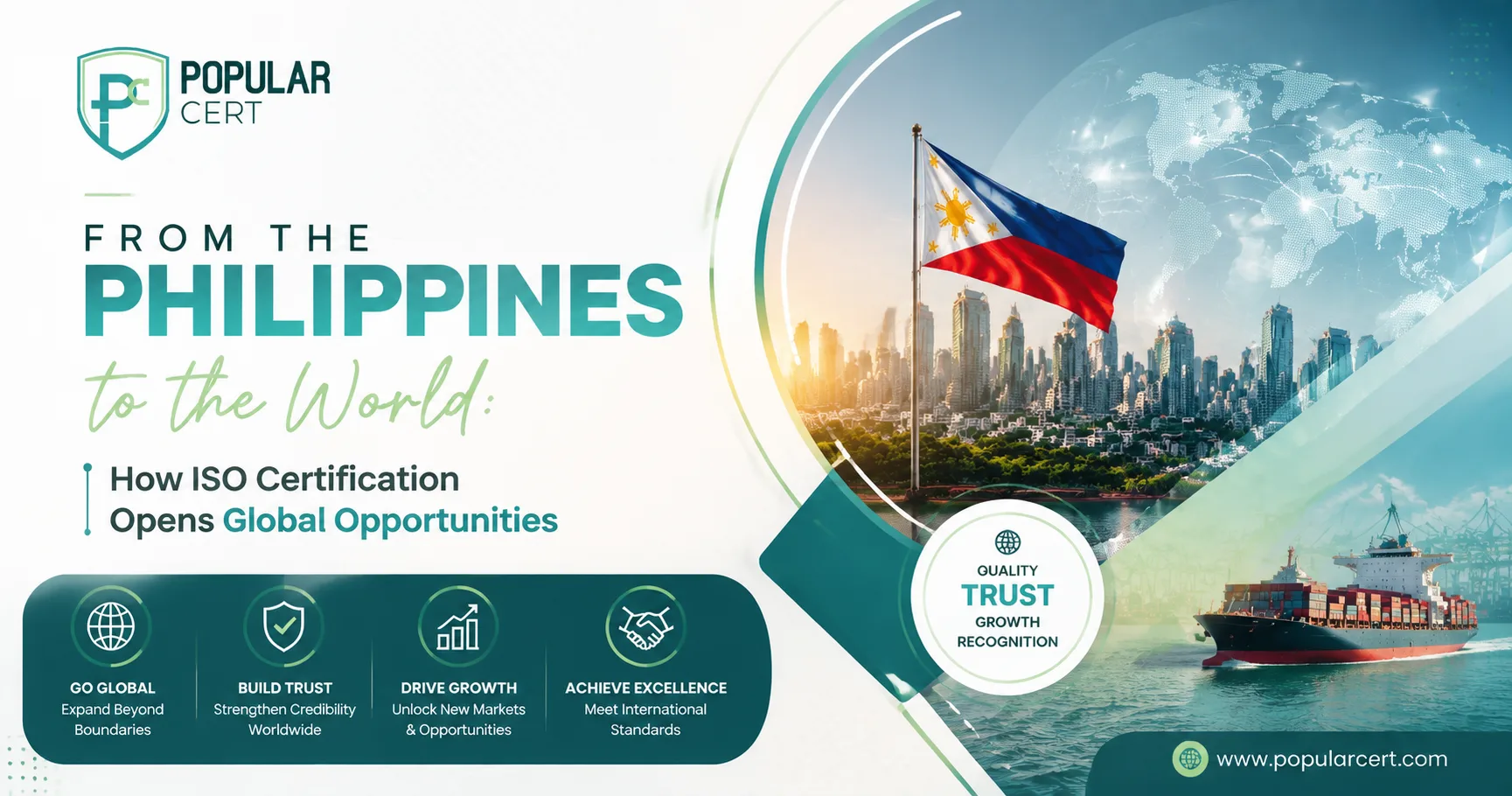
The Philippines has always had something special to offer the world skilled professionals, growing exporters, and manufacturers ready for global markets. Filipino businesses no longer want to stay local, they want international clients, foreign partnerships, and export deals. But one question stands in the way, how do you prove your business is trustworthy to a buyer in Germany, Japan, or the US, someone who’s never met you or seen your facility?
The answer is usually ISO Certification in the Philippines. Here’s why it matters so much for Philippine businesses going global, what it actually does for a company, and how a partner like PopularCert makes the journey smooth and worthwhile.
Table of Contents
What ISO Certification Really Means
ISO stands for the International Organization for Standardization, a global body that develops standards to help organizations operate more efficiently, safely, and consistently. These standards cover almost every area of business, including quality management, environmental responsibility, workplace safety, food safety, and information security.
When a company earns an ISO Certificate, it is telling the world something simple but powerful: “We follow internationally recognized processes, and you can trust the way we do business.”
This is not about decoration. ISO standards require real changes in how a company documents its processes, trains its people, controls quality, manages risk, and improves over time. A certified company has usually gone through a genuine transformation, not just a one-time inspection.
For a Filipino business hoping to work with overseas buyers, this certificate often becomes the single most convincing piece of evidence that the company is ready for international standards.
Why Global Buyers Care So Much About ISO
Put yourself in the shoes of a procurement manager based in Europe or North America. They are looking at hundreds of potential suppliers around the world, many of which they will never visit. They cannot personally check every factory floor or verify every internal process. So they rely on trusted, universal signals.
ISO Certification is exactly that kind of signal. It tells the buyer:
- The company has documented and repeatable processes, not guesswork
- Quality is checked and controlled at every stage, not just at the final step
- The business is regularly audited by qualified assessors
- Risks, whether related to safety, environment, or data, are actively managed
- The company is committed to continuous improvement, not a one-time effort
In many industries, especially manufacturing, construction, food production, logistics, and IT services, buyers will not even consider a supplier that lacks the relevant ISO Certification. It is often listed as a non-negotiable requirement in tenders, government contracts, and international trade agreements.
For Philippine businesses, this means ISO Certification is not simply a “nice to have” credential. In many cases, it is the ticket that gets a company into the room in the first place.
The Philippine Advantage, Strengthened by ISO
Filipino professionals are already known worldwide for their strong work ethic, English Skills, and flexibility. Filipino businesses, from BPOs to manufacturing exporters, already carry a reputation for reliability.
ISO Certification in Philippines builds directly on this reputation. It takes the natural strengths that Filipino companies already have and gives them a formal, internationally recognized structure. Instead of simply saying “we work hard and we care about quality,” a certified company can say “we work hard, we care about quality, and here is the internationally audited system that proves it.”
Trending Posts
Get Free Consultation
Our Clients

Projects

Our Happy Clients
⭐⭐⭐⭐⭐
“PopularCert made our ISO certification process smooth and professional.”
— Manufacturing Client, Oman
⭐⭐⭐⭐⭐
“Excellent support and documentation guidance.”
— Healthcare Client, Saudi Arabia
⭐⭐⭐⭐⭐
“PopularCert simplified our ISO certification process with professional guidance and fast support.”
— Manufacturing Client, Saudi Arabia
This combination, natural strengths plus formal certification, is what allows Philippine businesses to compete confidently with companies from more established exporting nations.
Common ISO Standards Filipino Businesses Pursue
While there are many ISO standards, a few are especially relevant and popular among Philippine businesses looking to expand internationally:
- ISO 9001, Quality Management System This is the most widely adopted ISO standard in the world. It focuses on consistent quality, customer satisfaction, and continuous improvement. It is often the first certification a growing business pursues, and it applies to almost any industry, from manufacturing to services.
- ISO 14001, Environmental Management System As global buyers become more conscious of sustainability, this standard shows that a company manages its environmental impact responsibly. It is increasingly requested by clients in Europe and other regions with strict environmental expectations.
- ISO 45001, Occupational Health and Safety Management System This standard demonstrates that a company protects its workers and maintains safe working conditions, an important factor for buyers who care about ethical sourcing and labor practices.
- ISO 22000, Food Safety Management System For companies in food production, processing, or export, this certification is often essential to enter international food supply chains.
- ISO 27001, Information Security Management System For IT companies, BPOs, and any business handling sensitive data, this certification reassures international clients that their information is protected according to global best practices.
Choosing the right standard, or combination of standards, depends on the industry, the target markets, and the specific requirements of potential buyers or partners.
The Real Business Benefits, Beyond the Certificate
It is easy to think of ISO Certification as something purely for external appearances, but the internal benefits are just as valuable, sometimes even more so.
- Improved internal efficiency: The process of preparing for certification forces a business to document its workflows clearly. This often reveals wasteful, duplicated work, or unclear responsibilities that were quietly costing the company time and money.
- Better decision-making: ISO standards emphasize data-driven decisions and regular internal audits. Over time, this creates a culture where choices are based on evidence rather than assumptions.
- Stronger customer trust: Even domestic clients notice and appreciate ISO Certification. It signals professionalism and reliability, which can help win business closer to home as well.
- Reduced risk: Whether it is safety incidents, environmental violations, or data breaches, ISO management systems are built to identify and reduce risk before it becomes a costly problem.
- Employee engagement: Clear processes and defined responsibilities tend to create a more organized, less stressful work environment, which supports better staff retention over time.
In short, ISO Certification does not just open doors internationally. It strengthens the business from the inside, making it more resilient and more capable of sustainable growth.
Why the Certification Partner You Choose Matters
Not all certification journeys are the same. Some businesses go through the process with confusing paperwork, long delays, and consultants who disappear once the contract is signed. Others go through it with a clear plan, steady support, and a partner who genuinely understands both the ISO requirements and the practical realities of running a business in the Philippines.
This is where PopularCert stands out.
PopularCert has built a reputation as a trusted ISO Certification provider for businesses across the Philippines, guiding companies of all sizes, from growing SMEs to established exporters, through the certification process with clarity and care.
Here is what makes PopularCert a genuinely strong choice for businesses aiming to go global:
- Deep understanding of Philippine industries: PopularCert works closely with local business owners and understands the specific challenges Filipino companies face, from documentation gaps to limited internal manpower for compliance work.
- Guidance tailored to your goals: not a generic template. Rather than applying a one-size-fits-all approach, PopularCert takes time to understand what markets a business is targeting and which standards will actually help them get there.
- Support through the entire journey: From the initial gap assessment, through documentation, staff training, internal audits, and the final certification audit, PopularCert stays involved at every stage, rather than handing over a checklist and stepping away.
- Efficient, transparent process: Delays and unclear timelines are common frustrations in certification work. PopularCert is known for keeping the process organized and communicating clearly, so business owners always know what stage they are at and what comes next.
- A genuine partner in growth: not just a certificate issuer. PopularCert's goal is not simply to hand a business a certificate. It is to help that business build systems strong enough to support real international growth, long after the audit is complete.
For a Filipino business ready to take the leap into international markets, having a certification partner like PopularCert can make the difference between a stressful, drawn-out process and a smooth, confidence-building journey toward global readiness.
Getting Started: What the Journey Usually Looks Like
For businesses new to ISO Certification, the process can feel intimidating at first. In practice, it usually follows a clear path:
- Initial assessment: Understanding the current state of the business and identifying gaps against the chosen ISO standard.
- Planning and documentation: Developing the required policies, procedures, and records that reflect actual daily operations.
- Implementation and training: Rolling out the new or improved processes and making sure staff understand their roles within the system.
- Internal audit: Reviewing the system internally to catch and correct issues before the official audit.
- Certification audit: An accredited external body reviews the business and, if everything meets the standard, issues the certificate.
- Ongoing maintenance: Regular surveillance audits and continuous improvement to keep the certification active and meaningful.
With the right partner guiding each step, this journey becomes far less overwhelming, and far more likely to succeed on the first attempt.
Conclusion
The world is more connected than ever, and Philippine businesses have a genuine opportunity to compete on the global stage. Talent, work ethic, and creativity have never been the problem. What many businesses need is the internationally recognized proof that turns “we are ready” into “we are certified and verified.”
ISO Certification in Philippines provides exactly that proof. It builds trust with international buyers, strengthens internal operations, and positions a Filipino business as a serious, capable player in the global market.
With a knowledgeable and dependable partner like PopularCert by their side, Filipino businesses do not have to navigate this journey alone. From the first assessment to the final certificate, and every improvement beyond it, PopularCert helps turn ISO Certification from a distant goal into a real, achievable milestone, one that carries a business from the Philippines confidently out into the world.
Looking for a trusted ISO Certification partner? Explore our Best ISO Certification Providing Company in India: Complete Guide for Businesses to compare consulting approaches, understand the certification process, and choose the right expert for your business.
FAQ
How long does it take to get ISO Certified in the Philippines?
Most businesses complete the process in two to six months, depending on the size of the company, the ISO standard chosen, and how ready their current processes are. Companies that already have organized documentation and clear workflows tend to move faster, while first-time applicants may need extra time for training and internal audits.
Which ISO certification should a small business get first?
ISO 9001, Quality Management System, is usually the best starting point. It applies to almost any industry, is widely recognized by international buyers, and lays the groundwork for other certifications like ISO 14001 or ISO 45001 later on.
Is ISO Certification only useful for exporters?
No. While it’s especially valuable for businesses targeting international buyers, ISO Certification also improves internal efficiency, builds trust with local clients, and reduces operational risk. Many domestic companies pursue it simply to run a tighter, more reliable operation.
Does the certificate expire, or is it a one-time process?
ISO certificates are not permanent. They typically require surveillance audits every year and full recertification every three years. This ensures the business continues to follow the standard consistently, not just at the time of the initial audit.
- Join 1000+ Certified Companies
Ready to Get Certified for Your Next Project?
- Free Consultation
- Expert Guidance
- Fast Turnaround
Reach Us Now