
ISO Certification In Turkey
Simplify your path to global compliance. We offer end-to-end consulting, training, and audit support for ISO, HACCP, CE Mark, and a wide range of international standards.
- 11+ Years Experience
- 30+ Countries Served
ISO Certification in Turkey is an independent audit confirming your management system meets a standard such as ISO 9001, 14001, 27001 or 45001. You implement the system, pass a two-stage audit by a certification body (preferably TÜRKAK-accredited), and receive a three-year certificate with annual surveillance audits. Most companies finish in three to six months.
Turkish manufacturers, contractors and exporters rarely get asked “are you ISO certified?” as a courtesy. They get asked as a gate: by EU buyers auditing suppliers, by public-tender evaluators, and by multinationals qualifying vendors in Istanbul, Bursa, Izmir, Kocaeli and Gaziantep. This page covers the certification process in Türkiye, the certification bodies buyers accept, and the factors that drive time and cost, so you can plan the audit instead of reacting to a customer deadline. Our ISO Certification services cover the full journey.
How to Get ISO Certification In Turkey ?
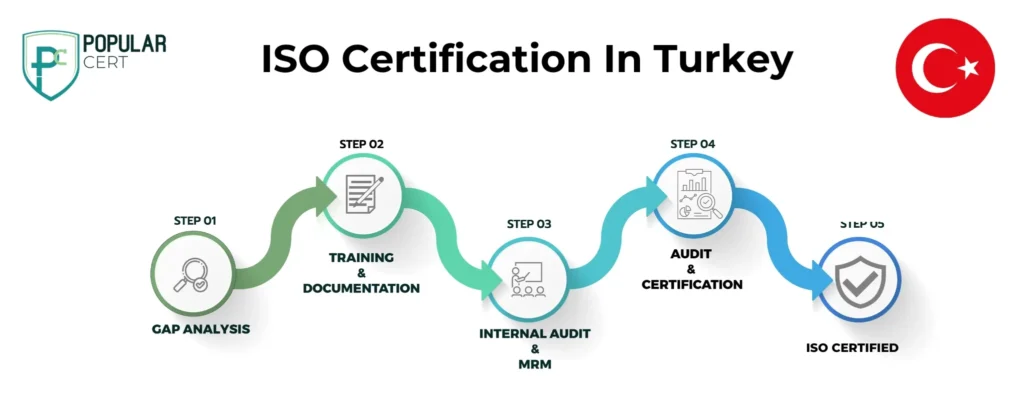
Consultation and Gap Analysis

PopularCert’s experts begin by thoroughly understanding your organization’s specific goals, challenges, and current business processes. We then conduct a comprehensive business analysis to identify key areas that require attention to align with industry best practices in Turkey and international standards.
Planning, Documentation, and Policy Development

Following the analysis, we develop a strategic plan, prioritize essential tasks, and assist in creating the necessary documentation and processes. These optimized workflows are seamlessly integrated into your existing operations to boost efficiency and regulatory compliance in Turkey’s competitive business environment.
Training and Awareness

We offer customized training programs for your team in Turkey, ensuring they fully understand the new procedures, compliance requirements, and their role in contributing to continuous improvement and ISO compliance.
Internal Audit and Management Review

After implementation, we conduct a detailed internal evaluation to assess the effectiveness of your new systems and identify potential gaps. A performance review is then carried out to confirm alignment with your company’s objectives and performance indicators.
External Certification Audit and Certification

We coordinate with accredited third-party evaluators to carry out an external audit. Upon successful assessment, we assist in obtaining the appropriate ISO certification. Additionally, we support you with ongoing evaluations and improvement strategies to maintain long-term compliance in Turkey’s evolving regulatory landscape.
TÜRKAK Accreditation and Certificate Recognition
TÜRKAK (Türk Akreditasyon Kurumu) is Türkiye’s national accreditation body. It does not issue ISO certificates. It assesses and accredits the certification bodies that do, and it is a signatory to the international recognition arrangements administered by IAF and EA. That recognition is why a TÜRKAK-accredited certificate is generally accepted by international buyers.
| Point: | Practical detail: |
|---|---|
| Certificate issuer | An independent certification body, not a consultant and not TÜRKAK |
| Value of accreditation | Independent proof that the body is competent and impartial under ISO/IEC 17021-1 |
| Other accreditation routes | Bodies accredited by other IAF MLA signatories are also internationally recognized, but confirm that your tender or customer accepts them |
| Risk of unaccredited certificates | Rejection by public tenders, large corporates and export customers, plus possible re-audit cost |
| Verification | Check the body’s accreditation scope in the TÜRKAK directory and on IAF CertSearch |
Buyer check: accreditation must cover your specific standard (for example ISO 27001) and your industry sector, not just the certification body’s name.
Certification Body Selection Checklist
Choosing the certification body is the one decision on the project that buyers, tenders and auditors will all examine. A certificate is only as useful as the body behind it, so check each point below before you sign a contract.
- Accreditation scope: the body must hold valid accreditation from TÜRKAK or another IAF MLA signatory, and the scope must cover your specific standard (for example ISO 27001 or ISO 22000).
- Sector competence: confirm the body is accredited to audit your industry sector, since scope codes differ between manufacturing, food, construction and IT.
Get Free Consultation
Our Clients

Our Projects
Why Choose PopularCert?
- Trusted Global ISO Certification Partner
- Experienced Industry-Focused Consultants
- Complete End-to-End Certification Support
- Fast & Transparent Certification Process
- International Compliance & Audit Readiness
- Dedicated Long-Term Customer Support
Types Of ISO Certification in Turkey
- ISO Certification in Turkey
- ISO 9001 Certification in Turkey
- ISO 14001 Certification in Turkey
- ISO 45001 Certification in Turkey
- ISO 22000 Certification in Turkey
- ISO 27001 Certification in Turkey
- ISO 17025 Certification in Turkey
- ISO 13485 Certification in Turkey
- CE Mark Certification in Turkey
- ISO 20000-1 Certification in Turkey
- GMP Certification in Turkey
- Halal Certification in Turkey
- SOC-1 Certification in Turkey
- SOC-2 Certification in Turkey
- Customer and tender acceptance: ask your key customers and tender authorities whether they accept the body’s certificate before you commit.
- Accreditation status verification: confirm the body’s status in the TÜRKAK directory and on IAF CertSearch rather than relying on a logo or a sales claim.
- Audit language and local presence: check that auditors can work in Turkish or your working language and can reach your sites without delays.
- Contract terms: review surveillance audit frequency, recertification terms, audit-day calculations and any fees for transfers or re-audits, and compare quotes for same scope.
- Impartiality: the body that certifies you must be independent of the consultant who helped build your system, so avoid arrangements where one party does both.
Buyer check: a low quote is not a reason to skip any step above. A certificate that a customer or tender rejects costs far more than the audit fee saved.
ISO Standards Used Across Turkish Industries
Each standard is published by the International Organization for Standardization. The ones most requested in Türkiye are ISO 9001 (quality), ISO 14001 (environment), ISO 45001 (occupational health and safety), ISO 27001 (information security), ISO 22000 (food safety) and ISO 50001 (energy).
| Sector: | Commonly requested standards: | Buyer driver: |
|---|---|---|
| Manufacturing, metal and machinery | ISO 9001, 14001, 45001 | Supplier qualification and process consistency |
| Automotive supply chain | ISO 9001 (base); OEMs may separately require IATF 16949 | OEM and Tier-1 approval schemes |
| Textiles and apparel | ISO 9001, 14001, 45001 | Brand and retailer audits on environment and worker safety |
| Food production and packaging | ISO 22000 | Food-safety assurance for retail and export customers |
| Construction and contracting | ISO 9001, 14001, 45001 | Public and private tender prequalification |
| IT, SaaS and outsourcing | ISO 27001 | Security due diligence by enterprise and EU clients |
| Energy and energy-intensive industry | ISO 50001, 14001 | Energy-cost control and emissions-reporting readiness |
EU-Trade Context for Turkish Suppliers
Türkiye trades with the EU under the EU–Türkiye Customs Union for industrial goods, and the EU is a leading export market for Turkish companies. EU buyers expect documented quality, environmental and safety controls, and increasingly ask for emissions and energy data.
- ISO 9001 documents process control, which supports product-conformity workflows such as CE marking. It does not replace them.
- ISO 14001 and ISO 50001 build the environmental and energy data discipline EU supply chains ask for. They do not replace formal obligations such as CBAM reporting, which follows its own verification rules.
- ISO 27001 is now a routine item in EU vendor security questionnaires.
Cost Drivers for ISO Certification in Turkey
The cost of ISO Certification in Turkey depends on the scope of your management system rather than a flat rate, so every quote is built around your organization’s size, standards and sites. The budget typically covers consultancy support, staff training, documentation, certification audits and the recurring audits needed to keep the certificate valid. Integrating several standards into one system, such as ISO 9001, 14001 and 45001, typically reduces duplicated documentation and audit effort.
The main factors that shape the final cost are:
- Standard or combination of standards: a single standard costs less than an integrated system covering quality, environment and safety.
- Company size and complexity: headcount, processes and operational risk determine the audit days required.
- Number of sites and shifts: each additional location or shift adds audit and implementation effort.
- Certification body selected: audit fees and scope vary between accredited bodies, so compare quotes for the same scope.
- Consultancy, training and documentation: the level of support needed depends on how much of your system already exists.
- Surveillance and recertification: annual surveillance audits and the three-year recertification audit are recurring costs to plan for.
Consultant and Certification Body Roles:
PopularCert handles gap analysis, documentation, staff training, internal audits and audit readiness, working only with TÜRKAK-accredited certification bodies. The certificate itself is issued only by an independent, accredited certification body, which preserves audit impartiality.
Secure Your Certification Before the Next Tender
Don’t lose Turkish and EU contracts to certified competitors. ISO Certification is increasingly a condition of doing business in Türkiye, not an optional upgrade, and the companies that plan early are the ones that qualify when a tender or supplier audit arrives. PopularCert manages gap analysis, documentation, training and audit readiness, and you can be certified in as little as three months.
What you get by working with PopularCert:
- Accreditation-aligned certification: we work only with TÜRKAK-accredited certification bodies, so your certificate is accepted by tenders, corporates and EU buyers.
- Audit-ready systems, not paperwork: documentation, internal audits and management reviews are built around how your teams actually work, which helps you pass Stage 1 and Stage 2 first time.
- Scope matched to your market: the right standard or integrated combination for your sector, whether that is ISO 9001, 14001, 45001, 27001, 22000 or 50001.
- Support beyond the certificate: guidance through surveillance audits and recertification so the certificate stays valid.
Request a free ISO gap assessment and get a clear scope, timeline and next steps for your organization. Explore market-specific compliance guidance, TÜRKAK resources and industry updates in our Turkey ISO Certification Hub.
FAQ
Is ISO Certification mandatory in Turkey?
ISO Certification is generally voluntary, but it is often required in practice. Public tenders, large corporates and EU buyers frequently ask suppliers for valid certificates as a prequalification condition. Some regulated sectors may have additional legal requirements, so confirm these for your industry.
How long is an ISO certificate valid?
An ISO Certificate is valid for three years. During that cycle, the certification body carries out annual surveillance audits, and a recertification audit is required before the certificate expires.
Does a TÜRKAK-accredited certificate matter for export customers?
Yes. TÜRKAK is a signatory to the international recognition arrangements administered by IAF and EA, so certificates from TÜRKAK-accredited bodies are generally accepted by international buyers. Always confirm that your customer accepts the certification body and that its accreditation covers your standard and sector.
Can one company hold several ISO certifications at the same time?
Yes. Many Turkish companies integrate ISO 9001, 14001 and 45001 into one management system with a combined audit. This typically reduces duplicated documentation and audit effort compared with certifying each standard separately.
- Join 1000+ Certified Companies
Ready to Get Certified for Your Next Project?
- Free Consultation
- Expert Guidance
- Fast Turnaround
Reach Us Now
Claim Your Free Consultation Today!