
OHSAS 18001 vs. AS/NZS 4801: Understanding Key Differences and Compliance Requirements
1000+
Successful Projects
10+ Years
Industry Experience
Worldwide
Certification Services
24/7 Support
Expert Consultation
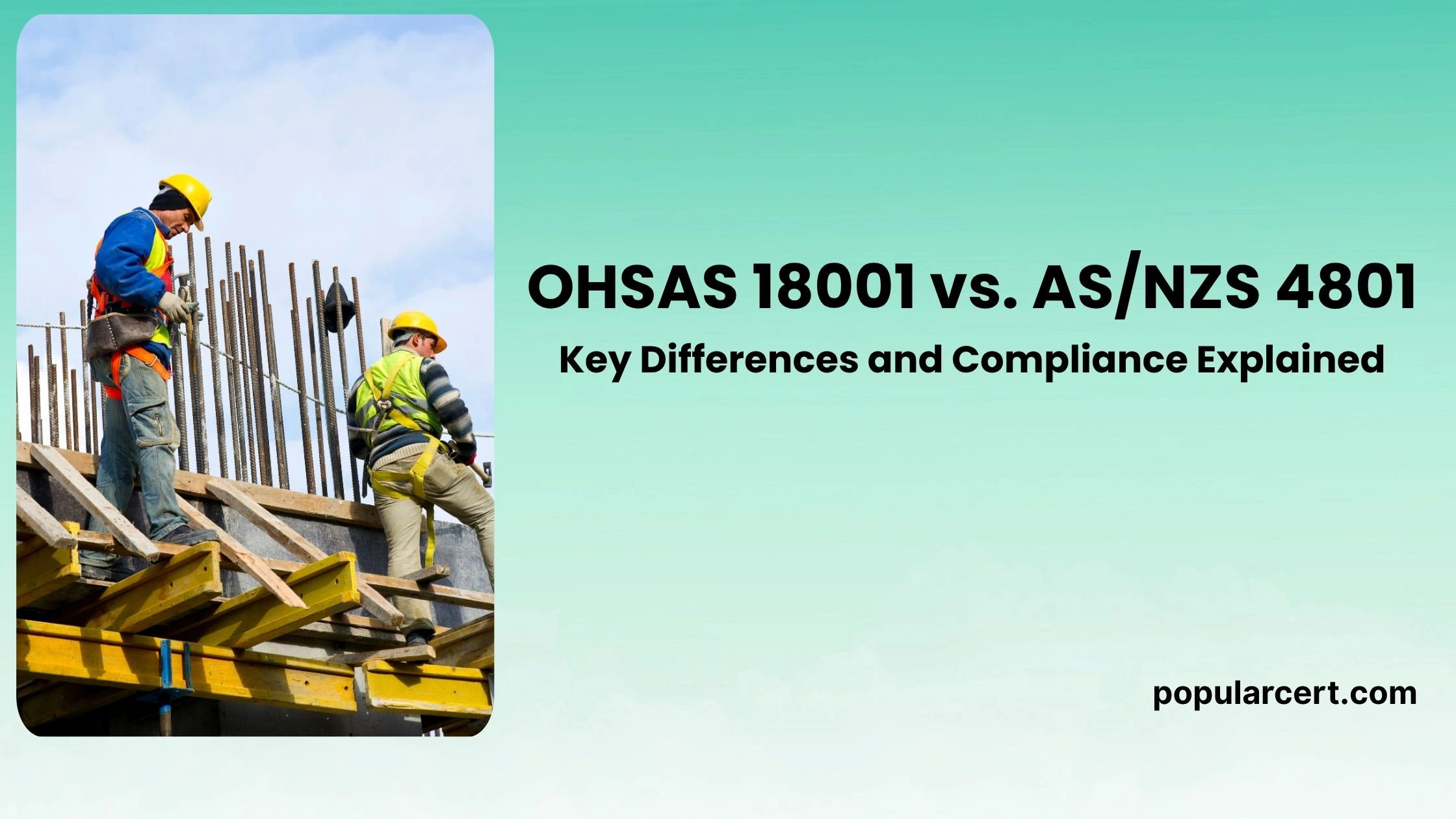
OHSAS 18001, published by BSI, and AS/NZS 4801, developed jointly by Standards Australia and Standards New Zealand, were the two leading occupational health and safety management standards before both were effectively superseded by ISO 45001:2018. If your organization holds a legacy certificate under either standard, this guide covers the key differences between them and your transition path to ISO 45001. If you’re pursuing new certification today, go directly to ISO 45001 that’s the current international standard your certification body will issue.
Table of Contents
OHSAS 18001 vs. AS/NZS 4801: Key Differences
Feature | OHSAS 18001 | AS/NZS 4801 |
Developed By | British Standards Institution (BSI) | Standards Australia & Standards New Zealand |
Geographic Focus | Internationally recognized | Primarily used in Australia and New Zealand |
Legal Alignment | General OH&S management framework | Closely aligned with Australian and New Zealand WHS/OHS legislation |
Certification Recognition | Widely accepted by international certification bodies | Mainly recognized within Australia and New Zealand |
Current Status | Withdrawn and replaced by ISO 45001:2018 | Largely superseded by ISO 45001:2018 |
In practice, organizations pursuing new certification today should implement ISO 45001 rather than either legacy standard both OHSAS 18001 and AS/NZS 4801 are primarily relevant now for organizations managing a transition from an existing legacy certificate.
Transitioning from OHSAS 18001 or AS/NZS 4801 to ISO 45001
Organizations still certified under OHSAS 18001 or AS/NZS 4801 should have already completed migration to ISO 45001:2018 the official transition period closed in March 2021, and certificates under the older standards are no longer valid for new business use. If your organization is still operating under a legacy system, the practical next step is a gap analysis against ISO 45001’s risk-based, Annex SL-aligned structure, followed by a transition audit rather than starting certification from scratch.
The Benefits of OHS Management Systems
Trending Posts
Get Free Consultation
Our Clients
Projects

Our Happy Clients
⭐⭐⭐⭐⭐
“PopularCert made our ISO certification process smooth and professional.”
— Manufacturing Client, Oman
⭐⭐⭐⭐⭐
“Excellent support and documentation guidance.”
— Healthcare Client, Saudi Arabia
⭐⭐⭐⭐⭐
“PopularCert simplified our ISO certification process with professional guidance and fast support.”
— Manufacturing Client, Saudi Arabia
- Compliance with Legislation.
- Ownership of Health & Safety Issues.
- Nominal effort required.
- Training needs are identified & realized.
- Reduce Costs.
- Ongoing improvement.
- Liabilities minimized.
Important Definitions to understand in OHSAS 18001:
- Hazard
Source, situation, or act with a potential for harm in terms of human injury or ill health, or a combination of these - Hazard Identification
Process of recognizing that a hazard exists and defining its characteristics - Risk
Combination of the likelihood of an occurrence of a hazardous event or exposure(s) and the severity of injury or ill health that can be caused by the event or exposure(s) - Risk Assessment
Process of evaluating the risk(s) arising from a hazard(s), taking into account the adequacy of any existing controls, and deciding whether or not the risk(s) is acceptable - Incident
work-related event(s) in which an injury or ill health (regardless of severity) or fatality occurred, or could have occurred.
NOTE 1: An accident is an incident which has given rise to injury, ill health or fatality.
NOTE 2: An incident where no injury, ill health, or fatality occurs may also be referred to as a “near-miss”, “near-hit” “close call” or “dangerous occurrence”.
NOTE 3: An emergency situation is a particular type of incident
- Acceptable risk
Risk that has been reduced to a level that can be tolerated by the organization having regard to its legal obligations and its own OH&S policy
- Occupational health and safety
Conditions and factors that affect, or could affect, the health and safety of employees or other workers (including temporary workers and contractor personnel), visitors, or any other person in the workplace
NOTE Organizations can be subject to legal requirements for the health and safety of persons beyond the immediate workplace, or who are exposed to the workplace activities.
- Audit
systematic, independent and documented process for obtaining “audit evidence” and evaluating it objectively to determine the extent to which “audit criteria” are fulfilled
- Nonconformity
Non-fulfilment of a requirement
The role of Continual Improvement in OHSAS 18001:
- Plan:Identify and prioritize what needs to be addressed
- Do: Implementing controls to manage these issues
- Check: to ensure they are implemented
- Act: upon the results of our checks to improve the system and performance
How to comply with OHSAS 18001 clauses
Adhering to the clause requirements of the standard is simple, please read this guide below:
4.1 General Requirements
The organization shall establish, document, implement and maintain an OHSMS, in accordance with the requirements of the OHSMS/OHSAS standards.
4.2 Occupation, Health & Safety Policy
There shall be a Policy statement authorized by top management
- Appropriate to the nature & scale of the company’s OH&S Risks
- That includes commitment to prevention of injury and ill health and continual improvement in OH&S management performance
- That includes a commitment to continual improvement and commitment to comply with OH&S Legislation, and other requirements to which the company
- subscribes code of practice which provides framework for setting and reviewing OH&S objectives
- Documented, implemented maintained and communicated to all persons working under control of organization with an intent that they understand
- OH&S obligation
- Made available to interested parties;
- Periodically reviewed.
What are the mandatory points to be checked in an OHSMS policy?
| Mandatory Check Point | Details to Verify |
|---|---|
| Appropriateness to Risks | The OHSMS policy should align with the ‘significant’ risks identified through OH&S hazard identification and risk assessment processes. |
| Continual Improvement Commitment | The policy must include a commitment to continual improvement. Verify supporting records such as OHS objectives and targets, monitoring & measurement records, and corrective/preventive action records showing performance improvement trends. |
| Management Commitment | Ensure the policy includes commitment to comply with legal and other requirements. These may include corporate policies, internal standards, industry codes of practice, and related quality or environmental policies. |
| Compatibility with Other Policies | Check alignment with corporate or group policies. Ensure references to internal safety standards, specifications, or industry codes (e.g., workplace codes of practice) are included. |
| Legal Compliance | Confirm the policy complies with applicable laws (e.g., Occupational Health and Safety regulations). Check if updates are made when there are changes like new hazards, updated group policies, or achieved objectives. |
| Policy Communication | Verify that all issued copies match the master version. Ensure the policy is communicated to all employees and that updates are properly shared and recorded. |
| Employee Awareness | Check training and awareness records. Ensure employees understand the policy and their responsibilities. Confirm communication to interested parties like customers, contractors, visitors, and the public where applicable. |
| Availability to Interested Parties | Ensure the policy is accessible to all relevant stakeholders. Verify how updates and revisions are communicated externally and internally. |
| Periodic Review | Confirm the policy is regularly reviewed for relevance and effectiveness. Check management review meeting minutes as evidence. |
Want to know more?
If you are willing to have more information on OHSAS 18001 standard then please visit Popularcert The OHSAS standard is been replaced by ISO 45001 standard now, we have a complete information about the updated version on our site, please click on this ISO 45001 and get more information.
Learn how a simple approach to monitoring, compliance, and workplace safety makes AS/NZS and OHSAS standards easy to understand and apply explore here.
FAQ
What is the main difference between OHSAS 18001 and AS/NZS 4801?
OHSAS 18001 is an internationally recognized standard for Occupational Health and Safety Management Systems (OHSMS), whereas AS/NZS 4801 is specific to Australia and New Zealand. While both focus on workplace safety, AS/NZS 4801 places more emphasis on compliance with local legal requirements.
Has OHSAS 18001 been replaced, and what is its successor?
Yes, OHSAS 18001:2007 has been replaced by ISO 45001:2018, which provides a more structured and risk-based approach to occupational health and safety management. Organizations certified to OHSAS 18001 need to transition to ISO 45001.
Why should an organization implement an OHS Management System like OHSAS 18001 or AS/NZS 4801?
Implementing an OHSMS helps organizations comply with legal requirements, reduce workplace risks, improve safety culture, minimize costs related to workplace incidents, and enhance overall employee well-being. Certification also boosts credibility and stakeholder confidence.
- Join 1000+ Certified Companies
Ready to Get Certified for Your Next Project?
- Free Consultation
- Expert Guidance
- Fast Turnaround
Reach Us Now