
Professional Accreditation Certificate in Oman: Who Needs It and How It Works
1000+
Successful Projects
10+ Years
Industry Experience
Worldwide
Certification Services
24/7 Support
Expert Consultation
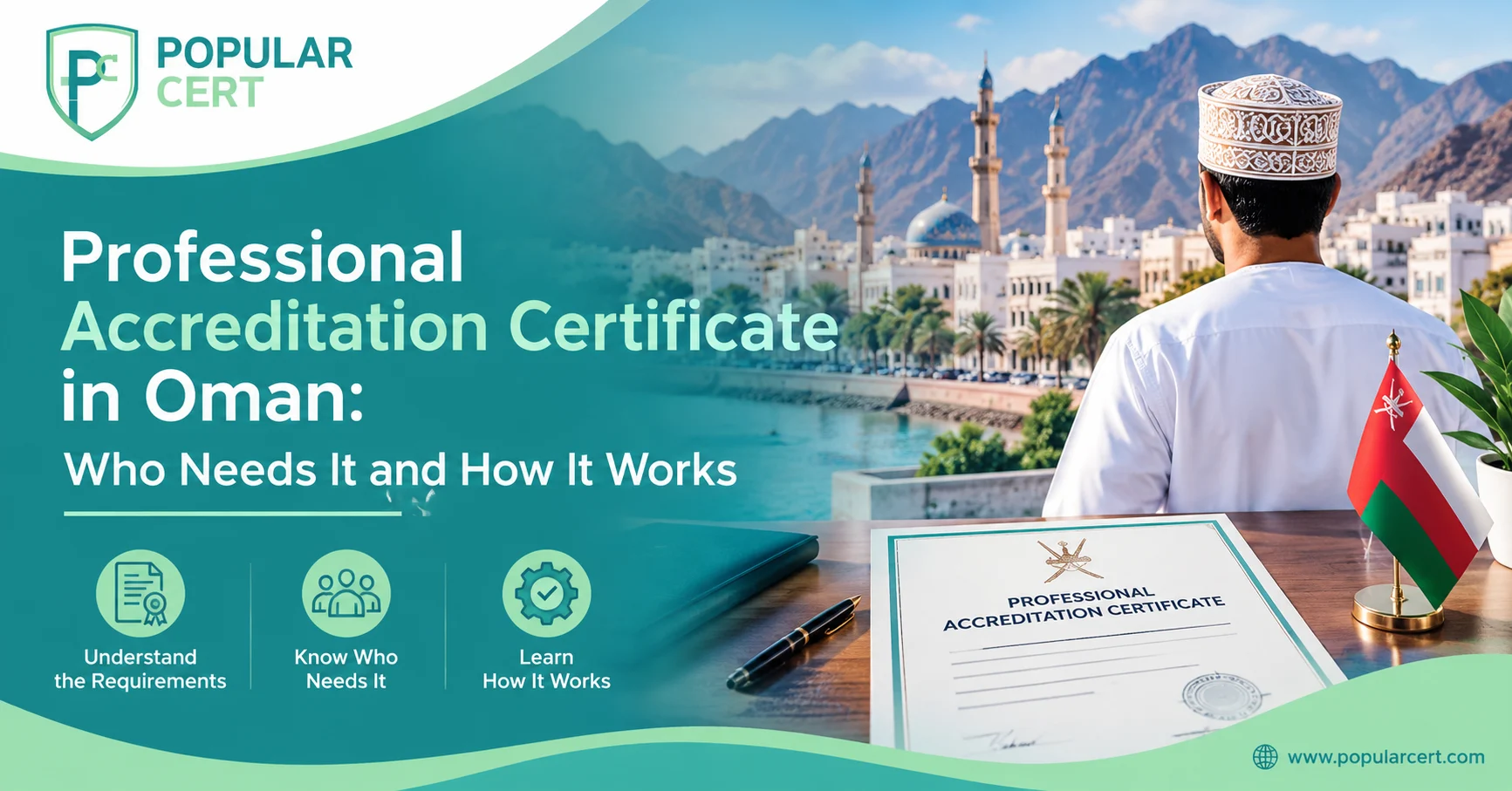
A professional accreditation certificate in Oman is the official document you get through the Ministry of Labour’s Professional Accreditation System, issued by your sector’s Sector Skills Unit. It either classifies your qualification level or licenses you to practise a listed profession. If your job is on the list, your work permit can’t be issued or renewed without it.
If you work in engineering, finance, logistics, energy or industry in Oman, this may already affect you or your employer. The professional accreditation certificate is tied to your job title and your work permit, not to a course you attend, and it is not an ISO certificate. In this guide we cover which sectors are included, who issues the certificate, what applying involves, and how it differs from ISO certification and credentials like IRCA, PMP and NEBOSH.
At a glance
- Who: workers in listed professions, Omani and expatriate.
- Why: the Ministry of Labour does not issue or renew work permits for those professions without it.
- Who issues it: the Sector Skills Unit for your sector, for example the Oman Society of Engineers (OSE) route for engineers.
- Not the same as: ISO certification, which certifies an organization’s management system.
Table of Contents
Understanding the Professional Accreditation Certificate
Oman’s Professional Accreditation System is run by the Ministry of Labour together with industry bodies called Sector Skills Units. What you are asked for depends on your job. It will be one of two documents:
- Professional classification certificate: shows your qualification level for a listed occupation. It looks at your education, your work experience and an assessment.
- Professional practice licence: shows you have the right to practise a listed occupation. It is used mainly for technical and operational roles.
Which one applies to you comes down to your job title and your sector. If your profession is on the list, your work permit can’t be issued or renewed until you hold the right document. This applies to Omanis and expatriates alike. So far it covers engineering, accounting and finance, logistics, energy and minerals, and the industrial sector. The table below goes through each one..
Accreditation vs Certification
The Ministry calls this a “professional accreditation” system, but standards bodies use those two words differently, and the difference matters when you read about this online:
Certification means a person, product or management system has been checked against set requirements. Bodies that certify people work to ISO/IEC 17024, and bodies that certify management systems work to ISO/IEC 17021-1.
Accreditation is a separate step. It is an independent check on whether a certification body is competent, and accreditation bodies do it under ISO/IEC 17011.
ISO itself doesn’t issue certificates. Independent certification bodies do.
|
|
Ministry professional accreditation (Oman) |
ISO management-system certification |
International individual credentials (IRCA, PMP, NEBOSH) |
What it confirms |
A worker’s qualification level or right to practise a listed profession |
That a company’s management system meets a standard (ISO 9001, 14001, 45001, 27001) |
A person’s knowledge or skill in a field |
Who it is for |
Individuals in listed professions (Omani and expatriate) |
Companies and organizations |
Individual professionals |
Who issues it |
The relevant Sector Skills Unit under the Ministry of Labour system |
An independent certification body |
The credential’s own awarding body |
Needed for a work permit? |
Yes, for listed professions |
No |
Not by itself |
What PopularCert does |
We guide you. We can’t issue it |
We help you prepare for the independent audit |
We advise on recognised schemes and training |
Trending Posts
Get Free Consultation
Our Clients

Projects

Our Happy Clients
⭐⭐⭐⭐⭐
“PopularCert made our ISO certification process smooth and professional.”
— Manufacturing Client, Oman
⭐⭐⭐⭐⭐
“Excellent support and documentation guidance.”
— Healthcare Client, Saudi Arabia
⭐⭐⭐⭐⭐
“PopularCert simplified our ISO certification process with professional guidance and fast support.”
— Manufacturing Client, Saudi Arabia
Why Accreditation matters in Oman’s Economic Transformation
Alignment with National and International Requirements
- The Ministry describes the system as a way to standardise qualifications and raise workforce competency, in line with national goals such as Oman Vision 2040. It has also warned that forged certificates and licences carry penalties, so workers and employers both have a reason to verify.
Increasing Professional Advancement Opportunities
- For regulated roles, the certificate decides whether you can work legally at all. Employers are likely to favour candidates who already hold a valid one, because it takes work-permit risk off the table. Whether it changes your pay or promotion prospects depends on the employer, so don’t count on it.
Increases Professional Recognition
- A verified certificate or licence is an official record of your qualifications and level, assessed through an official route. That gives employers and clients something they can check for themselves, which helps when you’re hiring or when someone asks for proof of competence.
Categories of Professional Accreditation Certificates in Oman
Sector | What you need | Where you apply | When it is enforced |
Engineering | Professional classification certificate for anyone with an “engineer” job title | Apply through the Oman Society of Engineers. Your permit depends on the certificate validated by the engineering Sector Skills Unit | From 1 Aug 2025 |
Accounting, finance, auditing | Classification certificate for 19 listed positions, such as internal and external auditors, cost accountants, credit and financial analysts, tax managers and CFOs | Sector Skills Unit for Accounting, Finance and Auditing, working with the Oman Association of Certified Public Accountants (OACPA) | From 1 Sept 2025 (announced July 2025) |
Logistics | Practice licence for listed roles, such as drivers of refrigerated trucks, water tankers, tractor heads and waste transport, and food-delivery staff and supervisors | Logistics Sector Skills Unit platform | From 1 Sept 2025 |
Energy, oil and gas, mining | Practice licence for about 40 listed professions, such as HSE advisors, crane operators and welders | Energy and Minerals Sector Skills Unit | Mandatory from 1 Sept 2025. The grace period ended, and enforcement began on 1 June 2026 |
Industrial sector | Classification certificate and practice licence for listed managerial, technical and specialised roles | Industrial Sector Skills Unit, working with MoCIIP | Applications opened 9 Feb 2026. Enforced from 1 May 2026 |
The list of professions has grown sector by sector, so check the Ministry of Labour’s current schedule for your exact job title.
Where the dates come from: Oman Observer on engineers, Muscat Daily on accounting and finance, DLA Piper on finance and logistics, Oman Observer on the 40 licensed professions, The Arabian Stories on energy and mining enforcement, and Oman Observer on the industrial sector.
ISO-Based Professional Certifications
ISO credentials fall into two different groups, and neither is the Ministry’s certificate:
- Individual credentials: ISO auditor and lead auditor training and certification (for example IRCA-registered courses), plus implementer courses. See our guide to IRCA and ISO auditor accreditation.
- Organizational certification: your company certified to ISO 9001, ISO 14001, ISO 45001 or ISO/IEC 27001 by an independent certification body. See our ISO certification in Oman service.
An ISO auditor certificate does not replace a Ministry classification or licence. If your job title is on the Ministry’s list, you still need the Sector Skills Unit route.
Field-Specific Accreditations
Some professionals also pursue international credentials that sit outside the Ministry system. The common ones are:
- PMP (Project Management Professional): awarded by the Project Management Institute for project management.
- NEBOSH: occupational health and safety qualifications from NEBOSH, widely used in health and safety roles.
- IRCA-registered Lead Auditor training: for people who want to audit ISO management systems. See our guide to IRCA and ISO auditor accreditation.
These credentials can add to your profile when you apply for jobs or tenders. They are voluntary and run by their own awarding bodies. They don’t replace the Ministry certificate, and whether one counts as evidence in an application is up to the Sector Skills Unit, so check before you rely on it.
How the Process Works by Sector
Engineers (OSE). OSE’s own “How to Apply” page sets out two steps:
- Verify your degree, if it is from outside Oman. You can skip this if you hold an Omani degree or a Ministry of Higher Education equivalency certificate. Otherwise, use an OSE-listed verification company (DataFlow or QuadraBay) and send your degree certificate, passport and transcript. OSE says this takes up to 21 working days or more.
- Register on the OSE portal and upload your photo, resident card or passport, degree certificate, verification report (if you need one), transcript, and experience certificates from graduation to now, including job descriptions. OSE says approval takes 14 working days after its committee reviews your file.
Accounting, finance and auditing (OACPA). The association’s classification system rests on three pillars: verifying your academic qualifications, evaluating your practical experience, and assessing your technical and soft skills. Your level is worked out from your education, your years of relevant experience after graduation, and any professional certificate you hold. You typically upload your passport, residency card, education documents, experience documents and professional certificates. If your degree is from outside Oman, you also need a verification report from the association’s accredited verification partner.
Logistics, energy and minerals, and industry. You apply through the official platform of the relevant Sector Skills Unit. The Ministry has said it oversees the training institutes and assessment centres that are authorised to evaluate and licence professions needing vocational classification. Criteria and assessments differ by profession, so use the platform’s own checklist for your job title.
Fees, timelines and documents can change. Process details above were checked against the OSE and OACPA websites in October 2026.
Planning Mistakes to Avoid
- Starting at renewal time. OSE’s own steps add up to roughly 35 working days (21 for verification plus 14 for approval), or about seven weeks, before any delay or queue. Treat that as a minimum, not a plan.
- Leaving degree verification to last. For engineers it is the first step, and it can take longer than the stated 21 working days.
- Assuming an ISO or PMP certificate substitutes for it. It does not replace the Ministry requirement. In accounting, a professional certificate is one input to the classification level, but the Sector Skills Unit still decides.
- Ignoring the job title. The requirement attaches to listed job titles, so check the title on the permit against the Ministry’s list.
- Treating it as a foreigners-only rule. The announced rules cover Omani and expatriate workers.
How to Obtain a Professional Accreditation Certificate in Oman
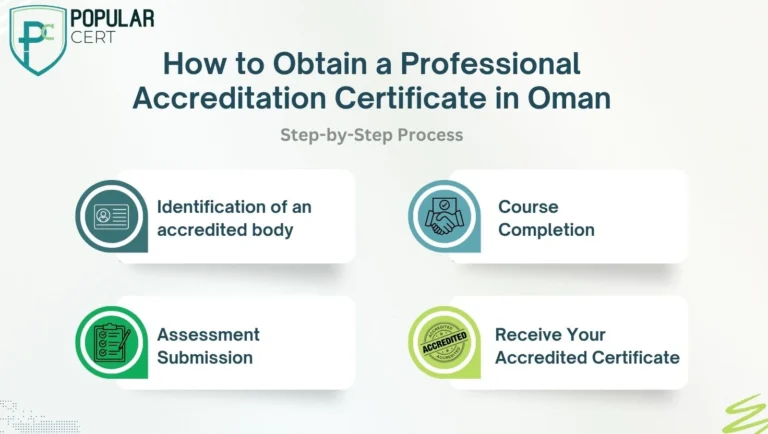
- Check your job title against the Ministry of Labour’s schedule for your sector.
- Identify your Sector Skills Unit and its application platform.
- Verify foreign degrees early through the unit’s listed verification partner, if your degree is from outside Oman.
- Gather your evidence: passport or resident card, degree and transcript, experience certificates with job descriptions, and any professional certificates.
- Apply and pay the unit’s fee through its official platform.
- Submit the certificate or licence with the work permit application or renewal. Track its validity and renewal conditions with your unit.
Advantages of Hiring Certified Professionals for Companies
For employers, the value is compliance, continuity and audit evidence. Before you hire or renew staff in a listed profession, check these points:
- Job titles: match each title on the work permit against the Ministry’s list for your sector.
- Certificate status: confirm each person’s certificate or licence is held and valid before you plan a start date.
- Time allowance: build in the full application time. For engineers, OSE’s own steps add up to roughly seven weeks before any delay.
- Authenticity: check documents carefully, because the Ministry has warned of penalties for forged certificates and licences.
- Renewal dates: validity and renewal vary by certificate type and Sector Skills Unit, so track each date.
- Audit records: ISO management-system standards require documented evidence of competence. A verified certificate can form part of that record.
Myths About Professional Accreditation in Oman
Myth | Truth |
An ISO or PMP certificate replaces the Oman certificate | They are separate. Whether a credential counts as evidence is decided by the Sector Skills Unit. |
It only applies to foreign workers | The rules announced for several sectors cover Omani and expatriate workers. |
Any training certificate is accredited | Many courses are not recognised by any scheme. Check the issuing body and its scope. |
A consultant can issue it | Only the official route (Ministry and Sector Skills Units) issues it. |
It never expires | Validity and renewal depend on the certificate type and unit. Confirm before it lapses. |
The Contribution of Professional Accreditation in Reference to Oman’s Vision 2040
Meeting the National Development Priorities
Oman Vision 2040 aims for a competitive, knowledge-based economy. By classifying or licensing workers in listed professions, the system gives employers, regulators and clients a consistent way to confirm qualifications and experience.
Upgrading Local Talent to Meet Global Standards
For Omani professionals, a classification certificate or practice licence is an official, recognised record of their qualifications and level. Because the same rules apply to local and expatriate workers, employers can see who is qualified for which role and where training gaps remain, which supports Omanisation planning.
Why Choose PopularCert in Oman?
PopularCert is an ISO and compliance consultancy. We do not issue Ministry certificates, practice licences or ISO certificates.
- Route guidance: we explain which credential applies to your team (the Ministry route, ISO auditor training, or neither).
- ISO support: gap assessments, documentation, implementation support and audit preparation for independent ISO certification.
- Training guidance: we advise on recognised auditor and implementer schemes so you enrol in the right course.
- Sector experience: construction, healthcare, oil and gas, and manufacturing.
Conclusion
The Value of a Professional Accreditation Certificate
In Oman, a professional accreditation certificate is now mainly a work-permit matter for listed professions. It is issued through the Ministry of Labour’s system and its Sector Skills Units, and it confirms your qualifications and level through an official route. Beyond compliance, a verified certificate gives employers and clients a clear, checkable record of your competence.
The practical next steps are simple:
- Check whether your job title is on the Ministry’s list for your sector.
- Identify your Sector Skills Unit and start the application, including degree verification, well before your permit renewal.
- Treat ISO, IRCA, PMP and NEBOSH as separate credentials that can strengthen your profile, but do not replace the Ministry requirement.
If your organization is also working toward ISO certification, the two efforts support each other: competent, verified people are what ISO audits look for. Learn more about ISO certification in Oman.
Not Sure Which Route Applies to Your Team?
Tell us your sector and job titles. We’ll explain whether the Ministry route, ISO auditor training or ISO certification applies, and what to prepare next. We guide the process. Certificates are issued by the Sector Skills Units and independent certification bodies.
FAQ
What is a professional accreditation certificate in Oman?
It is an official document, either a classification certificate or a practice licence, issued through the Ministry of Labour’s Professional Accreditation System by your sector’s Sector Skills Unit. It confirms your qualification level or your right to practise a listed profession, and you need it for a work permit in those professions.
Why is professional accreditation important in Oman?
For listed professions, it decides whether your work permit can be issued or renewed. Beyond compliance, a verified certificate gives employers and clients an official record of your qualifications, and international credentials like PMP or NEBOSH can add to your profile.
How can I get a professional accreditation certificate in Oman?
Apply through the official platform of the Sector Skills Unit for your sector. Engineers, for example, apply through the Oman Society of Engineers (OSE). Each unit sets its own criteria, and training providers and consultancies don’t issue the certificate.
Is ISO certification considered a professional accreditation?
No. ISO certification is for organizations: an independent certification body checks a company’s management system against a standard such as ISO 9001. It is not the Ministry’s certificate for individual workers, and auditor credentials such as IRCA are separate too.
Can professional accreditation help me get a job in GCC countries?
It can help, but it depends on the country and the employer. The Ministry’s certificate is specific to Oman’s work-permit system, so check each country’s own requirements. International credentials such as PMP or NEBOSH may be more widely recognised across borders.
- Join 1000+ Certified Companies
Ready to Get Certified for Your Next Project?
- Free Consultation
- Expert Guidance
- Fast Turnaround
Reach Us Now