
Learn how best practices in food safety for transportation, labeling, and training help maintain hygiene, prevent contamination, and ensure compliance explore here.
What Is a SOC 1 Report and When Do You Need It? A Complete Guide for Service Providers
1000+
Successful Projects
10+ Years
Industry Experience
Worldwide
Certification Services
24/7 Support
Expert Consultation

A SOC 1 report helps service providers demonstrate effective internal controls over financial reporting. It is essential for organizations handling financial data, enabling them to build client trust, support audits, and meet compliance requirements.
As companies hand off vital tasks such as payroll, bookkeeping, and data processing, making sure those partners run tight internal controls becomes a top concern. That is where the SOC 1 report steps in a widely recognised way for a service provider to show that its controls relevant to clients’ financial reporting are designed and operating effectively particularly important on a financial-controls or compliance topic where credibility carries real weight. But what is it, exactly, and when should your firm care about getting one?
Table of Contents
What Is a SOC 1 Report?
A SOC 1 report (System and Organization Controls 1) is an attestation report issued by an independent CPA firm. snapshot of how well a service supplier safeguards financial reporting controls. Grounded in the AICPA SSAE 18 standard, it is aimed at firms that process sensitive monetary transactions for customers.
A few terms which comes up constantly in SOC 1 reports and are the worth of knowing before you start the process. The company is being audited — your organization — is the service organization. Your clients, whose financial statements are ultimately affected by your controls, are the user entities. Because a service organization can’t control everything on its own, most SOC 1 reports also include Complementary User Entity Controls (CUECs) — controls the report assumes the client itself is responsible for (for example, reviewing and approving payroll data before it’s submitted). Understanding CUECs matters because gaps here are a common source of confusion during a client’s own financial audit.
Key Factors to Consider
The service group wrote an assertion about its system and safeguards; an independent CPA’s opinion on whether those controls are well designed and working as promised; and a line-by-line record of control targets plus the auditors testing results.
Types of SOC 1 Reports: Type 1 vs Type 2
SOC 1 reports come in two types, and the right one depends on how deep and how sustained the assurance needs to beyour internal controls really are:
SOC 1 Type 1
- Think of it as a snapshot taken on a single day.
- It checks whether your controls are built the right way, on paper.
- Best for brand-new audits or teams still figuring out the compliance game.
SOC 1 Type 2
- Now you’re looking at a stretch of months-usually between six and twelve.
- This time the audit probes whether those controls keep doing their job day after day.
- Larger clients and seasoned firms usually ask for Type 2 to see lasting results.
- Companies often kick off with Type 1 and slide into Type 2 as their processes level up.
When Do You Need a SOC 1 Report?
Learn how best practices in food safety for transportation, labeling, and training follow international best practices, improve efficiency, and build global trust explore with Popularcert here.
You probably want a SOC 1 if your business:
- Moves money or handles sensitive financial data for other firms.
- Runs outsourced payroll, accounting, investment reporting, or claims work.
- Clients demand the report during procurement talks or contract sign-offs.
- Plans to grow fast or break into enterprise markets where rules are strict.
- Wants to earn trust and cut the hassle during audits or due-diligence checks.
Trending Posts
Get Free Consultation
Our Clients

Projects

Our Happy Clients
⭐⭐⭐⭐⭐
“PopularCert made our ISO certification process smooth and professional.”
— Manufacturing Client, Oman
⭐⭐⭐⭐⭐
“Excellent support and documentation guidance.”
— Healthcare Client, Saudi Arabia
⭐⭐⭐⭐⭐
“PopularCert simplified our ISO certification process with professional guidance and fast support.”
— Manufacturing Client, Saudi Arabia
Fields That Commonly Rely on SOC 1
- Payroll service providers.
- Accounting and bookkeeping firms.
- Cloud-based ERP or billing platforms.
- Third-party administrators (TPAs).
- SaaS platforms that handle financial reporting.
How a SOC 1 Report Helps Win Enterprise Clients and Vendor Approvals
As organizations increasingly outsource financial and business-critical processes, enterprise clients now expect stronger proof of control effectiveness before signing contracts. A SOC 1 report demonstrates that your organization has established and maintained reliable internal controls over financial reporting, reducing risk for customers and stakeholders.
For payroll providers, SaaS companies, accounting firms, fintech organizations, and third-party service providers, a SOC 1 report can accelerate vendor approval processes, simplify client due diligence, and strengthen credibility in competitive markets. It also provides assurance that financial data is handled accurately, securely, and in accordance with recognized industry standards.
What’s Included in a SOC 1 Report?
A SOC 1 report typically contains:
- Independent service auditor’s report: the CPA firm’s opinion.
- Management’s assertion: management’s statement about the description of the system and the controls.
- Description of the system: the services, infrastructure, people, processes and data relevant to clients’ financial reporting.
- Control objectives, controls and test results: the objectives, the controls that meet them and (Type 2) the auditor’s tests and results.
- Other information: management’s responses to exceptions, or additional context.
Benefits of Getting a SOC 1 Report
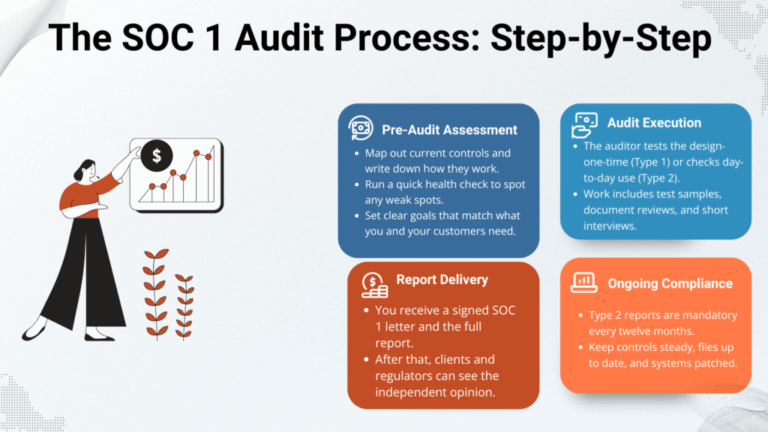
The SOC 1 Audit Process, Step by Step
A SOC 1 engagement typically moves through five stages:
- Readiness Assessment — A gap analysis against SSAE 18 requirements identifies which controls already exist and where documentation or design gaps remain.
- Scoping — The service organization and auditor agree on which systems, processes, and control objectives fall within the report’s boundaries.
- Control Design Review — Auditors evaluate whether the controls, as designed, are capable of meeting the stated control objectives. This is the core of a Type 1 report.
- Operating Effectiveness Testing — For a Type 2 report, auditors test whether those controls actually operated consistently over the review period (typically 6–12 months), using samples and evidence.
- Report Issuance — The auditor delivers the final SOC 1 report, including the system description, management’s assertion, the auditor’s opinion, and — for Type 2 — the detailed testing results.
Most first-time SOC 1 engagements start with a Type 1 report to establish that controls are properly designed, then move to Type 2 in a subsequent cycle once operating history can be demonstrated.
: SOC 1 vs ISAE 3402
Most of your audience is outside the US. Put this right after “SOC 1 vs SOC 2”.
SOC 1 is reported under the US AICPA standard (SSAE 18). **ISAE 3402** is the international standard issued by the IAASB for assurance reports on controls at a service organisation relevant to financial reporting. The two are closely aligned, and many service providers with clients in both the US and elsewhere ask their auditor for a combined SOC 1 / ISAE 3402 report. Which one a client accepts depends on their auditors, so ask them before you scope the engagement.
Free SOC Checklist
Assess compliance, reduce risks, and strengthen your management system.
- Practical & Audit-Ready
- Save Time & Effort
- No Registration Required
SOC 1 vs. SOC 2: What's the Difference?
SOC 1 and SOC 2 are both attestation reports issued under AICPA standards (SSAE 18 in the US), but they answer only the different questions for different audiences.
Category | SOC 1 | SOC 2 |
|---|---|---|
Focus | Internal controls over financial reporting (ICFR) | Controls over security, availability, processing integrity, confidentiality, and privacy |
Who asks for it | A client’s financial auditors as part of their audit of financial statements | Clients’ security, procurement, or vendor risk teams during due diligence |
Typical requester | Payroll, accounting, and finance-related service providers | SaaS, cloud, and IT service providers |
Report types | Type 1 (point in time) or Type 2 (over a period of time) | Type 1 (point in time) or Type 2 (over a period of time) |
Common overlap | Companies handling financial data may need both SOC 1 and SOC 2 | Companies providing IT services may need both SOC 1 and SOC 2 |
If your clients auditors are asking about the financial-reporting controls specifically, you need SOC 1. If your clients security or purchasing teams are asking about the data handling, uptime, or confidentiality more broadly, that is how a SOC 2 conversation happens. Some service providers, particularly SaaS platforms, process transactions that feed clients’ financial statements that also process the financial transactions and end up needing the both.
Who Asks for a SOC 1 Report — and How Long Is It Valid?
A SOC 1 report is the most often requested by the client’s external financial auditors, as part of their own audit of the client’s financial statements — since the client’s controls the depends on your part. It’s also increasing and requested directly by buying and vendor-risk the teams during the contract negotiations. A SOC 1 report covers a specific period (for Type 2) or a specific date (for Type 1), so most of the organizations renew annually to keep the report current for ongoing client audits and contract renewals.
Why Choose Popularcert for Your SOC 1 Report?
At Popularcert, we guide service companies of every size through the SOC 1 audit journey. Our certified auditors and compliance pros pair broad industry know-how with a clear, efficient approach.
With Popularcert, you get:
- AICPA-compliant SOC audit services
- Industry-specific pre-audit consulting
- Expert guidance from planning to certification
- Affordable, fixed-cost pricing with no surprises
- Global experience across fintech, SaaS, healthcare, and logistics
Whether you’re securing SOC 1 Type 1 for the first time or upgrading to Type 2, we deliver results on schedule and within budget.
Compliance Resources: Explore our SOC 1 Report resources for expert guidance on AICPA compliance, internal controls, audit readiness, Type 1 and Type 2 reporting, and best practices for building client trust.
Conclusion: Secure Your Growth with SOC 1
For many service providers, a current SOC 1 report is a requirement to win or keep larger clients. who handle financial data. It comforts clients, elevates your reputation, and unlocks larger, enterprise contracts.
Want to tighten compliance and win trust?
Let Popularcert steer you through the SOC 1 process — easily, on budget, and professionally.
FAQ
How long does it take to get a SOC 1 report?
Designated Type 1 reviews usually wrap up in three to six weeks. So-called Type 2 reports, however, need about three to six months because they observe controls over time.
Who performs SOC 1 audits?
SOC 1 examinations must be performed by an independent licensed CPA firm. Popularcert helps service organisations prepare: we run readiness assessments, help define the system description and control objectives, and support you through the examination, which is carried out by your chosen CPA firm.
Can a small business get a SOC 1 report?
Absolutely. Countless start-ups pursue a Type 1 to calm customers and grow fast.
Is SOC 1 the same as SSAE 18?
Yes, SSAE 18 is the guiding standard on which SOC 1 examinations are built.
How often do I need a SOC 1 report?
Once a year, especially if contracts auto-renew or clients check compliance on schedule.
- Join 1000+ Certified Companies
Ready to Get Certified for Your Next Project?
- Free Consultation
- Expert Guidance
- Fast Turnaround
Reach Us Now