
Top management is accountable for ensuring objectives are established, but workers and their representatives must be consulted. Department heads and the H&S team usually help set realistic targets, since they own the resources and the day-to-day risks the objectives address.
OH&S Objectives for ISO 45001 Certification: Measurable Safety Goals With Examples
1000+
Successful Projects
10+ Years
Industry Experience
Worldwide
Certification Services
24/7 Support
Expert Consultation
OH&S objectives under ISO 45001 are goals an organization sets under Clause 6.2 to improve health and safety performance. They must be consistent with the OH&S policy, measurable where practicable, monitored, communicated, and updated, with documented plans stating what will be done, who is responsible, what resources are needed, and when.
Setting clear OH&S objectives is how an organization turns its safety policy into measurable action. Objectives help identify risks, prevent workplace incidents, and show auditors and regulators that safety performance is actively managed. For organizations working toward ISO 45001, they are also a requirement: Clause 6.2 expects objectives that are planned, monitored, and kept up to date as part of the management system.
Table of Contents
Characteristics of a Strong Safety Objective
A strong OH&S objective does more than state an intention. It gives the organization a clear target, a way to verify progress, and a direct link to the risks it needs to control. Under ISO 45001, objectives that meet the points below are easier to plan, monitor, and defend during an audit.
- Measurable: The result can be verified and tracked, for example “reduce lost-time injuries by 15% within 12 months.”
- Aligned with the OH&S policy: The target reflects the organization’s safety commitments and risk assessment results.
- Prevention-focused: The goal stops incidents and health problems before they happen instead of only reacting to them.
- Compliant: It supports legal requirements and other requirements the organization has committed to.
- Continually improved: Targets are reviewed and raised as performance improves, because safety is an ongoing process.
Common Types of OH&S Objectives
Most OH&S objectives fall into a few broad categories. Knowing which category fits your biggest risks makes it easier to choose the right target and KPI. Under ISO 45001, the objectives you pick should come from your risk assessment, legal requirements, and past incident data, not from a generic list.
- Reducing workplace risks: Address hazards such as poorly maintained machinery, hazardous chemical exposure, and poor ergonomics to lower incidents and work-related ill health.
- Improving the safety management system: Introduce better reporting channels, new training programs, or digital inspection checklists.
- Strengthening existing safety measures: Improve how consistently procedures are followed, such as emergency evacuation or correct use of personal protective equipment (PPE).
- Preventing recurring incidents: Use incident data to find repeat causes and remove them. If most accidents come from slippery floors, add floor traction, clear signage, and regular audits.
- Maintaining legal compliance: Keep policies and inspection records current with changing health and safety laws and industry standards.
Worked Example: Reducing Slip, Trip, and Fall Incidents
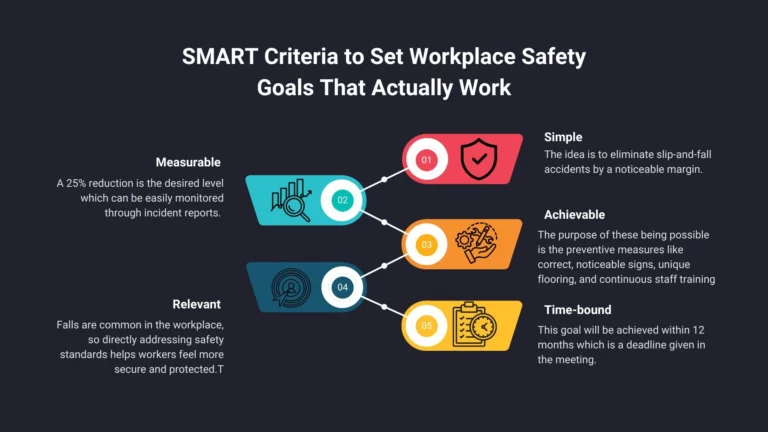
Objective: Within 12 months, reduce slip, trip, and fall incidents by 25% compared with the previous 12 months.
- Specific: The goal targets one incident type, slips, trips, and falls, instead of “general safety.”
- Measurable: A 25% reduction is tracked through incident reports and hours worked.
- Achievable: Practical controls such as clear signage, non-slip flooring, and ongoing staff training make the target realistic.
- Relevant: Falls are a common cause of workplace injury, so addressing them directly improves worker safety and confidence.
- Time-bound: The target is met within 12 months, with a review at the six-month point.
Trending Posts
Get Free Consultation
Our Clients

Projects

Our Happy Clients
⭐⭐⭐⭐⭐
“PopularCert made our ISO certification process smooth and professional.”
— Manufacturing Client, Oman
⭐⭐⭐⭐⭐
“Excellent support and documentation guidance.”
— Healthcare Client, Saudi Arabia
⭐⭐⭐⭐⭐
“PopularCert simplified our ISO certification process with professional guidance and fast support.”
— Manufacturing Client, Saudi Arabia
Action plan to reach the target:
Setting a 25% reduction target only works if it is backed by a clear plan. The five steps below turn the slip, trip, and fall objective into actions that can be assigned, scheduled, and checked. Each step gives an auditor visible evidence of what will be done, by when, and how results will be reviewed.
- Identify high-risk areas: Inspect wet floors, uneven surfaces, and other locations where incidents are most likely.
- Improve flooring and signage: Replace damaged non-slip mats, repair damaged floors, and place warning signs in hazard areas.
- Train employees: Cover proper footwear, spill cleanup (with practical demonstrations), and safe working techniques.
- Inspect and monitor: Run monthly safety checks and track results to confirm that fewer incidents is a lasting trend, not a temporary dip.
- Review and adjust: At month six, evaluate how well the program is working and modify it to improve results.
10 Example OH&S Objectives With Measurable KPIs
Use these examples as a starting point. Adjust baselines, targets, and owners to your own risk assessment, legal requirements, and consultation with workers.
| Focus Area | Objective | KPI | Target | Data Source | Owner | Frequency |
|---|---|---|---|---|---|---|
| 1 | Reduce slip, trip, and fall incidents | Slip, trip, and fall incidents per 200,000 hours worked | 25% reduction vs. the prior 12 months | Incident log | Facilities / H&S Manager | Monthly |
| 2 | Reduce lost-time injuries | Lost Time Injury Frequency Rate (LTIFR) | 15% reduction year-on-year | Injury register and payroll hours | H&S Manager | Monthly |
| 3 | Strengthen hazard reporting | Hazards and near misses reported per 100 employees | Minimum 5 per 100 employees per quarter | Reporting system | Department Heads | Quarterly |
| 4 | Close corrective actions on time | % of corrective actions closed by due date | 90% or higher | Corrective action register | Department Heads | Monthly |
| 5 | Ensure worker competence | % of workers completing role-specific OH&S training | 100% of in-scope workers within 90 days of onboarding or role change | Training records | HR / H&S Manager | Quarterly |
| 6 | Verify emergency preparedness | Emergency drills completed; evacuation time | 2 drills per site per year; evacuation within the site’s set time limit | Drill reports | Site Manager | Semi-annually |
| 7 | Improve PPE compliance | % PPE compliance found in workplace inspections | 95% or higher | Inspection checklist | Supervisors | Monthly |
| 8 | Control exposure to hazardous substances | % of scheduled exposure monitoring completed; results above legal exposure limits | 100% of scheduled monitoring completed; zero results above legal limits | Monitoring reports | H&S / Occupational Hygiene | Quarterly |
| 9 | Verify that risk controls are working | % of planned workplace inspections and risk assessment reviews completed | 100% of planned inspections; high-risk activities reviewed at least annually | Inspection schedule | H&S Manager | Monthly |
| 10 | Strengthen worker consultation and participation | OH&S committee meetings held; % of worker-raised issues responded to | Meetings held as scheduled; 90% or more of issues answered within 30 days | Meeting minutes | Management Representative | Quarterly |
Audit tip: For every objective, an ISO 45001 auditor looks for a documented plan (what will be done, who is responsible, what resources are needed, the timeline, and how results will be evaluated), monitoring results, and evidence that the objective was communicated to workers. A KPI with no documented plan and owner is a common nonconformity.
OH&S Objectives Tracking Template
Copy these tables into a spreadsheet or your management system. Use one row per objective.
Part 1: Objective Setup
| Objective | KPI | Baseline | Target | Owner | Resources Required | Start Date | Due Date |
|---|---|---|---|---|---|---|---|
| Reduce slips, trips, and falls | Incidents per 200,000 hours | 12 | 9 | Facilities Manager | Anti-slip flooring, signage, training | Jan 1 | Dec 31 |
Part 2: Progress Tracking
| Objective | Q1 Actual | Q2 Actual | Q3 Actual | Q4 Actual | Status | Corrective Action if Off Track | Review Date |
|---|---|---|---|---|---|---|---|
| Reduce slips, trips, and falls | On track / At risk / Off track |
Checks Before Finalizing Your Objectives
Before an objective is approved, it should be tested against what the organization can realistically deliver. Objectives that look strong on paper often fail because the budget was never set aside, the owners were never named, or the target clashes with production goals. The five checks below help you catch those gaps early, and they give an ISO 45001 auditor evidence that the objectives were planned with the required resources, responsibilities, and timelines in mind. Before objectives are approved, confirm the following:
- Technology has been considered: Review whether technical controls can remove or reduce major hazards, such as mechanical feed systems that avoid direct handling of hazardous substances.
- The budget is sufficient: Resources for equipment, training, and monitoring are included in financial plans.
- Objectives are realistic and balanced: Goals are achievable alongside productivity, quality, and environmental priorities.
- The program is documented: Actions, responsibilities, and deadlines are clearly written and understood by everyone involved.
- Reviews are scheduled: The program is reviewed periodically and whenever operations, processes, or regulatory requirements change.
From Objectives to ISO 45001 Certification
Well-defined OH&S objectives reduce incidents, improve employee confidence, support legal compliance, and give auditors clear evidence of continual improvement. Regular monitoring, risk review, and corrective action keep them effective over time.
Ready to turn your OH&S objectives into a certified management system? Our lead auditors and consultants will review your risks, help you set measurable objectives, and prepare your team for ISO 45001 certification.
Contact PopularCert today, they support you at every stage, from risk assessment and setting OH&S objectives to implementing ISO 45001 requirements and preparing for certification. Talk to an ISO 45001 consultant today and take the first step toward stronger safety and compliance.
FAQ
Does ISO 45001 require OH&S objectives to be measurable?
Clause 6.2.1 requires objectives to be measurable where practicable, or otherwise capable of being evaluated. If a number is not realistic, such as for a cultural goal, use a defined indicator that still lets you judge progress. Auditors expect clear evidence of how results are tracked.
Is there a minimum number of OH&S objectives?
No. ISO 45001 does not set a number. Objectives should come from your risk assessment, legal requirements, and consultation with workers. A few focused objectives with owners, resources, and deadlines are stronger than a long list nobody tracks.
Which records show an auditor that objectives are being met?
Auditors typically look for documented objectives, a plan naming the owner, resources, and timeline, KPI monitoring results, review records, and proof that objectives were communicated to workers. Corrective actions for missed targets and management review minutes also support compliance.
Who should be involved in setting OH&S objectives?
- Join 1000+ Certified Companies
Ready to Get Certified for Your Next Project?
- Free Consultation
- Expert Guidance
- Fast Turnaround
Reach Us Now