
Discover how ISO certification helps organizations meet global standards, improve quality, and build customer trust explore with Popularcert here
Bangladesh’s New Cybersecurity Rules: Why ISO 27001 Certification is Critical for Your Business
1000+
Successful Projects
10+ Years
Industry Experience
Worldwide
Certification Services
24/7 Support
Expert Consultation

Cyber-security threats in Bangladesh are on the rise, with Dhaka witnessing a growing number of cyber-attacks each day. From banks to e-government portals, core sectors are increasingly targeted, exposing loopholes in security systems. To counter these risks, the Government of Bangladesh has introduced stricter cybersecurity regulations, including mandatory ISO 27001 certification for organizations handling sensitive information.
If your business operates in IT, finance, healthcare, or logistics sectors within Dhaka, complying with these regulations is no longer optional. Beyond compliance, ISO 27001 certification provides better protection against cyber threats and opens doors to lucrative government contracts.
Here’s everything you need to know to prepare your organization for this crucial certification and secure your position in Bangladesh’s fast-evolving digital economy.
Table of Contents
Why Bangladesh is Strengthening Cybersecurity Regulations
Cyber incidents have become a growing liability for businesses in Dhaka and across the country. The government’s push for stricter measures, including ISO 27001 certification, is rooted in three key factors.
Surging Cyber Threats
Bangladesh’s rapid digitization has led to a sharp rise in cyberattacks, and the risks have only grown as more critical infrastructure and financial services move online. BGD e-GOV CIRT, Bangladesh’s National Computer Incident Response Team established after the 2016 Bangladesh Bank cyberattack, continues to track a high volume of incidents daily, particularly across banking, government IT systems, and manufacturing. With the Cyber Security Ordinance 2025 and its 2026 data residency amendment now in force, businesses handling sensitive or critical infrastructure data face closer scrutiny than ever, making a structured framework like ISO 27001 less of a nice-to-have and more of a practical necessity.
Compliance for Businesses Serving Key Sectors
If your business operates in the following sectors, achieving ISO 27001 certification will likely become mandatory soon to remain compliant and competitive:
- IT and Software Development (e.g., government projects)
- Financial Services (e.g., banks, payment gateways)
- Healthcare and Telemedicine (e.g., patient record management)
- Logistics and E-commerce (e.g., handling personal consumer data)
- Smart City and IoT Projects (e.g., managing cloud and IoT applications)
Failing to meet these requirements can exclude your organization from government tenders, trigger legal penalties under the Digital Security Act, and cause a significant drop in consumer trust.
Consequences of Ignoring ISO 27001
Approaching cybersecurity with a “check-the-box” mentality is a risky approach for businesses. Not securing ISO 27001 certification could lead to the following consequences in Dhaka’s competitive landscape:
- Loss of Government Contracts: Organizations without certification may no longer qualify for public sector projects.
- Legal and Financial Penalties: Data breaches can result in heavy fines under the Digital Security Act, compounded by possible lawsuits.
- Damaged Reputation: A lack of compliance signals weak risk management, discouraging both investors and customers from trusting your brand.
For businesses striving to remain competitive, adopting ISO 27001 certification isn’t just about compliance but long-term sustainability.
Trending Posts
Get Free Consultation
Our Clients

Projects

Our Happy Clients
⭐⭐⭐⭐⭐
“PopularCert made our ISO certification process smooth and professional.”
— Manufacturing Client, Oman
⭐⭐⭐⭐⭐
“Excellent support and documentation guidance.”
— Healthcare Client, Saudi Arabia
⭐⭐⭐⭐⭐
“PopularCert simplified our ISO certification process with professional guidance and fast support.”
— Manufacturing Client, Saudi Arabia
What is ISO 27001 Certification?
ISO 27001 is the gold standard for safeguarding information security. Recognized globally, this certification provides organizations with a framework to assess and address risks associated with data breaches and cyber threats.
Key Benefits of ISO 27001 Certification
- Proactive Risk Management: Anticipate, identify, and mitigate potential threats.
- Data Protection: Prevents unauthorized access and minimizes cyber risks.
- Regulatory Compliance: Aligns your company with laws like GDPR and the Digital Security Act.
- Strengthened Reputation: Demonstrates your commitment to safeguarding customer and partner information.
- Competitive Advantage: Essential for organizations bidding for lucrative contracts or working with government agencies.
For businesses in Dhaka, achieving ISO 27001 certification is not just a best practice but increasingly a necessity for survival and success
ISO 27001 vs. Cyber Security Ordinance compliance
Requirement | Cyber Security Ordinance 2025 | ISO 27001 Certification |
Mandatory for | Designated Critical Information Infrastructure & specific service providers | Voluntary, but increasingly expected by clients/tenders |
Focus | Legal compliance, incident reporting, registration | International best-practice information security management |
Enforced by | National Cyber Security Agency (NCSA) | Accredited certification bodies |
Data residency (2026 update) | Restricted data and CII-related data now require a real-time synced copy stored inside Bangladesh | N/A directly, but ISO 27001’s data handling controls support this requirement |
Best approach | Use ISO 27001 as the practical framework to meet Ordinance requirements | Complements legal compliance with a recognized, auditable system |
Free ISO 27001 Checklist
Assess compliance, reduce risks, and strengthen your information security management.
- Practical & Audit-Ready
- Save Time & Effort
- No Registration Required
Steps to Achieve ISO 27001 Certification
Securing ISO 27001 certification may seem daunting, but with the right guidance, the process becomes straightforward. Here’s how your business can achieve certification efficiently.
Step 1: Conduct a Security Gap Assessment
Start by evaluating your current security infrastructure. A gap assessment will identify weak points and help build a roadmap for compliance. At this stage, experts assess areas such as access controls, incident response plans, and encryption methods.
Step 2: Implement Information Security Controls
Once gaps are identified, your organization needs to strengthen internal systems by implementing advanced security controls like these:
- Access control for sensitive data (restrict data access to authorized personnel only)
- Network safeguards (e.g., firewalls and encryption tools)
- Cybersecurity awareness training for employees
- Disaster recovery and incident response plans
Step 3: Undergo the Certification Audit
ISO 27001 certification culminates in a two-stage audit by accredited certifiers:
- Stage 1 (Document Review) checks that your organization’s policies comply with ISO standards.
- Stage 2 (On-Site Audit) evaluates whether the implemented security measures work in practice.
With professional assistance, many businesses in Dhaka can complete this process in as little as 60 days.
Why PopularCert is the Best Choice for ISO 27001 Certification
Navigating the certification process on your own can be challenging. That’s where PopularCert comes in. Here’s why our team is trusted by businesses across Bangladesh.
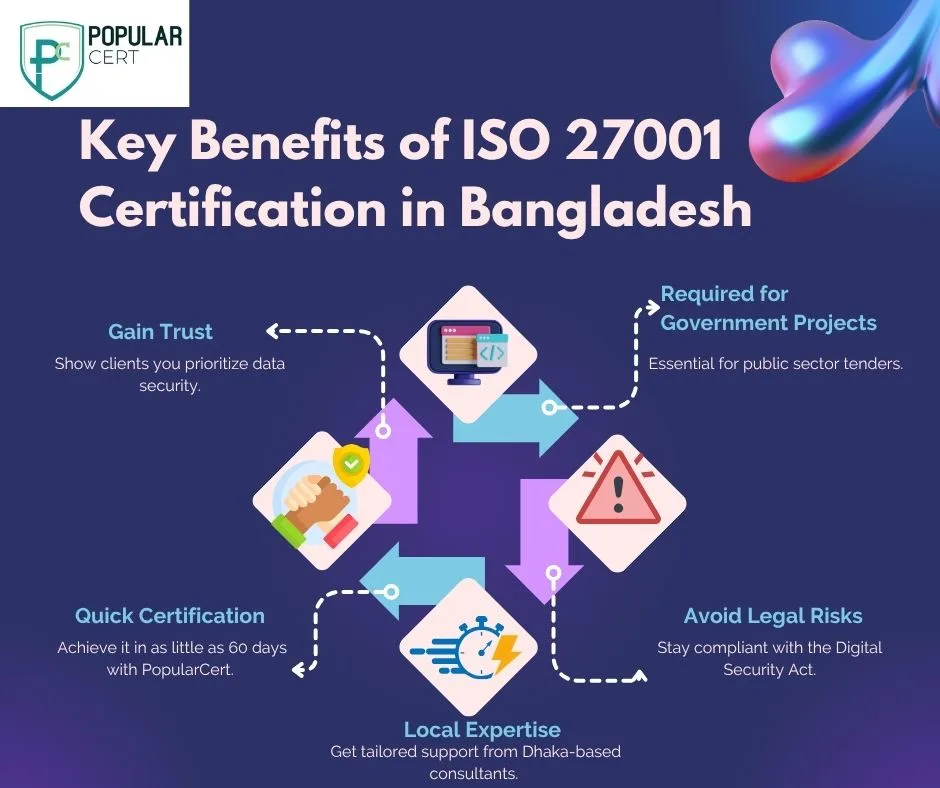
- Local Expertise: Industry-leading cybersecurity consultants based in Dhaka with in-depth knowledge of local regulations.
- Fast Certifications: We simplify the process so you can secure your ISO 27001 certification in under 60 days.
- Affordable Pricing: Guaranteed lowest market rates with no hidden charges.
- Post-Certification Support: Beyond certification, we provide ongoing guidance to protect your organization against emerging cyber threats.
Choosing PopularCert not only ensures compliance but also prepares your organization for long-term cybersecurity resilience.
Conclusion:
The stakes have never been higher. Businesses in Dhaka that fail to achieve ISO 27001 certification risk losing competitive ground, facing legal repercussions, and struggling to recover damaged reputations. Bangladesh’s digital economy demands that businesses go beyond basic cybersecurity defenses. ISO 27001 certification is now crucial for compliance, reputation, and long-term success. By partnering with PopularCert, you gain an edge in securing your organization while meeting the government’s cybersecurity standards.Don’t wait for a cyber incident to threaten your business. Get certified with PopularCert today and future-proof your operations.
Discover how ISO certification helps organizations meet global standards, improve quality, and build customer trust—explore with Popularcert here.
FAQ
Is ISO 27001 certification mandatory in Bangladesh?
For organizations handling sensitive data (e.g., IT, finance, healthcare) or working on government projects, ISO 27001 certification is increasingly government-mandated under stricter cybersecurity regulations.
How long does ISO 27001 certification take in Dhaka?
The certification process typically takes 4–8 weeks, depending on the size and readiness of your business.
Can small businesses benefit from ISO 27001 certification?
Yes, even small organizations can protect sensitive data, enhance customer trust, and position themselves for government tenders with ISO 27001 certification.
How much does ISO certification cost in Bangladesh?
Costs vary based on company size and required standards. Popularcert offers affordable packages tailored for businesses in Dhaka and other cities in Bangladesh.
- Join 1000+ Certified Companies
Ready to Get Certified for Your Next Project?
- Free Consultation
- Expert Guidance
- Fast Turnaround
Reach Us Now